That growth means more facility managers are asking one blunt question: what does this actually cost? The honest answer is that it depends. Robot type, coverage area, AI sophistication, and your specific use case — retail, healthcare, hospitality, manufacturing, or education — all move the number significantly.
This guide breaks down pricing ranges, the cost components most buyers overlook, what drives price up or down, and how to build a budget that actually reflects your facility.
Key Takeaways
- Entry-level units start in the low five figures; enterprise-grade robots can exceed $80,000
- Navigation technology, autonomy level, filtration, and tank capacity are the biggest price drivers
- Small offices and boutique retail fit entry-level tiers; hospitals and large plants need high-end systems
- Total cost of ownership includes installation, consumables, and maintenance — not just the sticker price
- Larger facilities with multi-shift labor costs see the fastest payback on higher-end robots
How Much Does an AI Cleaning Robot Cost? (Pricing Overview)
There's no fixed price tag for an AI cleaning robot. Cost swings based on robot type, tank size, and how much artificial intelligence is doing the navigating.
Buyers commonly get the budget wrong in a few predictable ways:
- Underbudgeting for consumables and batteries: brushes, filters, and battery packs wear out and need replacing
- Mismatching robot size to square footage: an entry-level unit in a 100,000 sq ft warehouse won't keep up
- Ignoring recurring service and software costs: maintenance contracts aren't optional line items; they're built into the ownership model
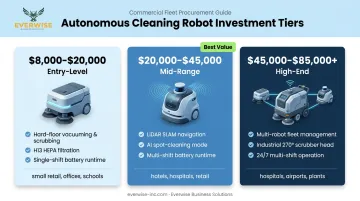
Because manufacturers quote pricing after a site assessment rather than publishing rate cards, exact numbers require a consultation. Based on typical capacity tiers and feature sets across the market, facilities generally plan around three broad bands:
| Tier | General Planning Range | Coverage Class |
|---|---|---|
| Entry-level | $8,000 – $20,000 | Compact vacuum or scrubber |
| Mid-range | $20,000 – $45,000 | Standard scrubber-vacuum combo |
| High-end | $45,000 – $85,000+ | Advanced multi-surface AI robot |
These figures typically cover base hardware and standard navigation. They usually exclude installation, service plans, taxes, and shipping, costs added once a specific deployment is scoped.
Entry-Level Tier
What's typically included: basic autonomous navigation, a smaller tank and battery, and limited scheduling features. Compact models like the Gausium Phantas or Gausium Vacuum 40 fall here, both built for small-to-midsize spaces with 3-in-1 cleaning and zero-distance edge cleaning.
Best for small retail stores, small offices, and schools with limited square footage.
Mid-Range Tier
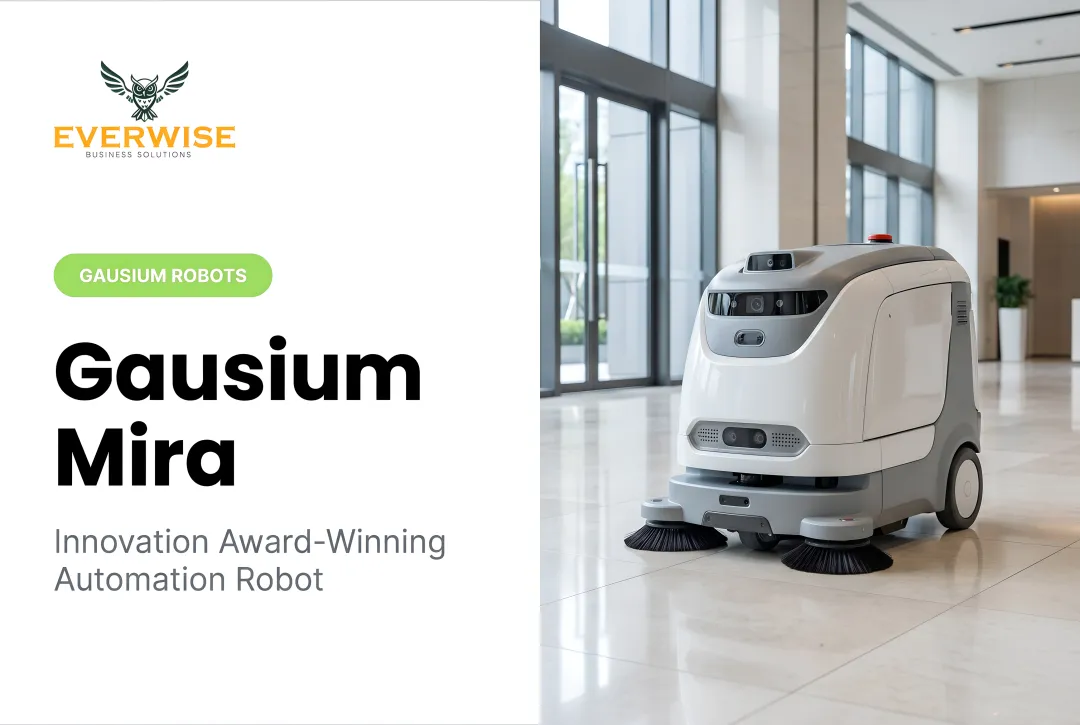
What's typically included: LiDAR or 3D depth-camera navigation, a larger cleaning path, and basic fleet software. The Gausium Mira anchors this tier for mid-scale hotels, hospitals, large retail floors, and light manufacturing.
Best for facilities where a compact unit is undersized but an enterprise-grade robot would be overkill.
High-End Tier
What's typically included: advanced AI floor identification, medical-grade H13 HEPA filtration, zero-distance edge cleaning, and multi-robot fleet integration. This is where Gausium-class robots sit: the Marvel, Beetle, and Omnie.
Best for hospitals, airports, large campuses, and manufacturing plants needing near-continuous autonomous cleaning.
What Drives the Price Up or Down
Pricing depends on technical sophistication, operational scale, and facility-specific requirements. A few factors matter more than others.
- Robot type and configuration — vacuum-only units like the Gausium Vacuum 40 cost less than scrubber-dryer combos; simple obstacle avoidance is cheaper than full SLAM/3D-camera AI navigation
- Size, capacity, and coverage area — larger tanks, bigger batteries, and wider cleaning paths raise the price, especially for continuous, large-scale coverage versus single-shift use
- Level of autonomy — semi-autonomous models cost less than fully autonomous robots with AI floor identification; premium features like edge cleaning and air purification raise the price further
- Customization and fleet integration — a single off-the-shelf unit is cheaper than multi-robot fleet management software with centralized scheduling
- Installation and setup — site mapping, charging dock installation, and network configuration add cost, particularly in multi-floor or irregularly laid-out buildings
In similar deployments, AI-driven scrubbers have freed up 5-6 labor hours per night previously spent running equipment manually — a useful illustration of why higher-capability robots command higher prices.
Low-Cost vs. High-Cost: What You're Really Paying For
| Factor | Lower-Cost Models | Higher-Cost Models |
|---|---|---|
| Performance | Basic obstacle avoidance, slower coverage | AI-driven precision mapping, faster and more thorough cleaning |
| Durability | Lighter-duty components, shorter lifespan | Industrial-grade parts built for continuous operation |
| Long-term value | Earlier replacement, limited ROI | Stronger labor savings and durability over time |
Cost Breakdown of an AI Cleaning Robot
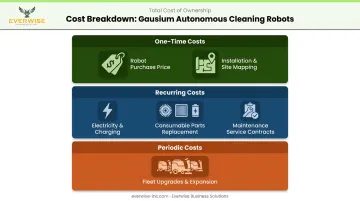
The purchase price is only the starting line. Total cost of ownership includes several distinct categories.
One-time costs:
- Initial purchase or lease down payment — covers base hardware, the onboard AI/navigation software license, and standard accessories
- Installation and setup — site mapping, charging station installation, and network/connectivity configuration
Recurring costs:
- Operating costs — electricity, cleaning solution and consumables, and periodic battery replacement
- Maintenance and service contracts — preventive maintenance, technician visits, and software updates
A comprehensive maintenance plan matters more than most buyers expect. Everwise Business Solutions, the authorized Gausium distributor for Texas, structures its preventive maintenance around usage intensity: quarterly visits for high-traffic multi-shift deployments, semi-annual for lighter-use facilities.
Each visit covers brush condition, HEPA filter replacement, battery health, and sensor calibration. That kind of scheduled care extends a robot's functional lifespan rather than letting wear accumulate unchecked.
Periodic costs:
- Upgrades and fleet expansion — adding units, upgrading sensors or software, and scaling fleet management as facility needs grow
How to Estimate the Right Budget for Your Business
The right budget balances your facility's needs against long-term savings, not just the lowest sticker price.
Consider these factors before setting a budget:
- Square footage and floor type of the facility being cleaned
- Frequency and hours of operation — a single shift versus near-continuous cleaning changes which robot class makes sense
- Current labor costs and the potential savings automation could unlock
- Compliance and hygiene requirements, especially in healthcare and food service
- Charging infrastructure and network connectivity already available on-site
Weighing labor costs against automation savings shows how quickly this investment pays for itself. Payback periods for robotic floor scrubbers can run as short as 12-18 months, though the timeline depends on local labor rates, facility area, and deployment frequency, per Cleaning & Maintenance Management.
Common budgeting mistakes to avoid:
- Focusing only on upfront purchase price while ignoring maintenance or service costs
- Over-specifying advanced features beyond what the facility actually needs
- Choosing the cheapest option without evaluating navigation reliability or vendor support
- Skipping a demo or pilot period before committing to a full fleet purchase
Conclusion
The cost of an AI cleaning robot varies depending on robot type, autonomy level, and facility scale — there's no single number that applies across the board. Understanding the full cost breakdown, from purchase through installation and ongoing maintenance, is what leads to accurate budgeting instead of unpleasant surprises six months in.
The "right" cost weighs performance and reliability against the labor savings your facility can realistically expect. For Texas businesses weighing this decision, Everwise Business Solutions offers a complimentary ROI modeling session. The team can also walk through a tailored quote based on your square footage, floor type, shift schedule, and current labor costs.
Frequently Asked Questions
How much does a commercial AI cleaning robot cost on average?
Entry-level units generally start around $8,000-$20,000, with mid-range models running $20,000-$45,000 and high-end systems exceeding $45,000. The exact price depends on robot type and facility size.
Is it cheaper to buy or lease an AI cleaning robot?
Leasing reduces upfront cost, while buying carries a higher initial spend but lower total cost over time. Section 179 and bonus depreciation can make outright purchase more tax-advantaged.
What is the difference between an AI cleaning robot and a traditional robotic vacuum?
AI cleaning robots use navigation like LiDAR or 3D depth cameras, intelligent floor identification, and real-time rerouting. Traditional robotic vacuums typically follow pre-programmed patterns with far less autonomy.
How much does it cost to maintain an AI cleaning robot per year?
Maintenance costs vary by usage intensity and service plan, with multi-shift facilities needing more frequent visits. A formal service contract is the safest way to budget accurately.
Do AI cleaning robots really save money compared to hiring cleaning staff?
Savings depend on facility size, labor costs, and hours of operation, with larger, multi-shift facilities seeing the fastest returns. Smaller, single-shift operations may see a longer but still positive payback window.
How long does it take to see ROI on an AI cleaning robot?
ROI timelines commonly range from 12 to 36 months, driven mainly by shift count, facility square footage, and labor costs displaced. Requesting a facility-specific estimate from Everwise gives a far more accurate number than industry averages.