Most "cleaning automation" content online misses the point entirely. It covers scheduling apps and CRM software built for janitorial service companies — not the actual business case for facilities that want to invest in autonomous cleaning robots that physically scrub, sweep, and vacuum the floors.
This guide is different. It builds a complete, numbers-based case for autonomous cleaning robot adoption in 2026: the cost drivers pushing facilities toward automation, the ROI math that justifies the purchase, a smart-cleaning decision framework, and a step-by-step action plan you can actually use.
Key Takeaways
- Labor costs and staffing shortages are the top drivers pushing facilities toward autonomous cleaning robots in 2026
- A credible business case weighs manual costs (wages, turnover, supervision) against robot cost and payback period
- Automation needs human oversight and coverage data; unmanaged robots deliver inconsistent results
- Hospitals, hotels, schools, and large offices see the fastest ROI
- Working with an authorized, experienced distributor protects your long-term ROI
Why Cleaning Automation Is a Business-Critical Priority for 2026
Cleaning automation has shifted from an optional upgrade to a line item facility leaders can't avoid budgeting for. Operating costs keep rising, and the labor pool that used to absorb them keeps shrinking.
The Escalating Labor Cost & Staffing Crisis in Commercial Cleaning
The math starts with the workforce itself. The Bureau of Labor Statistics projects roughly 351,300 annual job openings for janitors and building cleaners through 2034, even though total employment in the field is growing only 2%.
That gap means facilities are competing hard for a limited supply of workers. Most of those openings exist simply because people transfer out of the occupation or leave the workforce entirely.
In Texas, the wage floor hasn't moved. The state follows the federal minimum of $7.25 per hour, unchanged since 2009. But actual paid wages tell a different story: Texas janitors and cleaners earned a mean wage of roughly $14.93/hour as of the most recent BLS occupational data.
Add shift premiums for evening, night, or weekend coverage, and multi-shift facilities are paying well above the statutory floor just to keep positions filled.
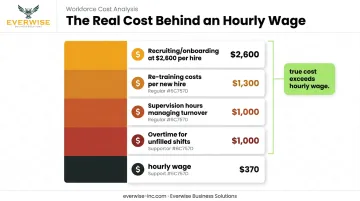
The costs decision-makers underestimate rarely show up on a single line:
- Overtime to cover unfilled shifts
- Supervision hours spent managing constant turnover
- Re-training costs every time a new hire starts
- Recruiting and onboarding a single front-line worker costs roughly $2,600, once training and ramp-up time are factored in
None of that shows up in a basic hourly-wage comparison, which is exactly why so many automation business cases underestimate the manual baseline.
Rising Hygiene, Compliance, and Sustainability Expectations
Post-pandemic hygiene standards haven't relaxed. In healthcare specifically, the CDC's environmental cleaning guidance calls for floor cleaning at least once daily in general inpatient areas, twice daily in exam rooms, and twice daily plus as-needed in intensive care units — with documented schedules identifying who cleaned what, when, and how.
That documentation requirement matters. Facilities are now expected to prove cleaning happened, not just claim it did. Medical-grade air filtration, specifically H13 HEPA, has moved from a nice bonus to something healthcare, hospitality, and education buyers expect as standard.
At the same time, ESG and sustainability reporting frameworks are pushing facilities to track water, chemical, and energy use per cleaning cycle. This is another area where documented, consistent automated cleaning has a natural advantage over manual logs.
Calculating the ROI: Manual vs. Autonomous Cleaning Costs
Any credible automation business case starts with an honest accounting of what manual cleaning actually costs today. Not the hourly wage line: the whole cost stack.
Breaking Down the True Cost of Manual Cleaning
A complete manual cleaning cost model includes:
- Direct wages and benefits for every cleaning FTE
- Supervisory overhead: the time managers spend scheduling, checking quality, and retraining
- Turnover and re-training costs, compounded by high attrition in the industry
- Rework costs from inconsistent quality, missed spots, or complaints
For a baseline reference point, ISSA reports commercial cleaning generally runs $0.09 to $0.17 per square foot for offices, $0.14 to $0.29 for healthcare, and $0.07 to $0.15 for retail and schools. These figures shift based on service scope, frequency, and building complexity. That per-square-foot range is still your starting point for comparing what automation needs to beat.
Modeling Robot ROI and Payback Period
The payback formula itself is simple:
Payback period = (robot acquisition + service cost) ÷ (monthly labor hours reallocated × hourly cost)
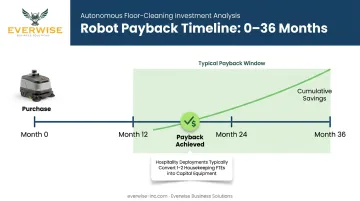
In practice, reported payback windows for autonomous floor-cleaning robots tend to fall between one and three years. This range varies heavily by facility layout, floor type, and how well the robot's coverage matches the space.
Small footprints, heavy carpet, or a poorly matched machine can push payback well beyond that range, which is why model selection matters as much as the purchase decision itself.
Beyond direct labor savings, a full ROI model should also account for:
- Reduced repetitive-strain injury exposure. Janitorial workers see notably higher rates of overexertion injuries than the general workforce, and those claims carry real cost.
- Extended equipment life through professional maintenance rather than ad hoc repairs.
- Freed-up staff hours redirected to higher-value tasks like guest service or detail cleaning.
Everwise Business Solutions models this exact math for Texas facilities during a complimentary ROI consultation, typically projecting 12 to 36 month payback periods based on shift count, square footage, and local labor benchmarks. Hospitality deployments, for instance, often convert 1 to 2 housekeeping FTEs per shift into capital equipment.
The 5 Rules of Smart Cleaning Automation for 2026
Buying a robot only marks the beginning. Facilities that get the best results treat automation as a managed system, not a set-it-and-forget-it purchase.
- Automate the predictable, not the exceptional. Let robots handle routine, repetitive floor cleaning, such as corridors, lobbies, and warehouse aisles, while staff retain judgment-based work like spot treatment and guest interaction.
- Pair automation with human oversight. Unmanaged robots, with no supervision or quality checks, tend to produce inconsistent results and unhappy clients. Automation still needs a human accountable for outcomes.
- Prioritize data and reporting. Choose systems that log coverage and performance so facility managers can verify results instead of just trusting the machine ran.
- Match the technology to the environment. Confirm navigation, sensors, and floor-type compatibility, including hard floors, carpets, and mixed-use spaces, before you deploy, not after.
- Plan for maintenance and scalability from day one. Build in service contracts and technician support so machines keep performing and the model can extend to additional locations later.
That last rule is where a lot of automation projects break down. A robot without a maintenance plan degrades fast, and a facility without a scaling plan ends up stuck with a single-unit pilot that never grows into real savings.
Choosing the Right Cleaning Robot & the Industries Winning with Automation
Not every autonomous cleaning robot is built for every environment, and picking the wrong one is the single most common reason ROI projections fall short.
What to Look for in an Autonomous Cleaning Robot
Three capabilities separate a reliable long-term deployment from a machine that ends up gathering dust in a supply closet:
- AI-driven navigation with 3D depth-camera floor identification — automatically detects surface type (hardwood, tile, marble, carpet) and adjusts cleaning mode and brush height without reprogramming.
- Medical-grade H13 HEPA filtration — standard on the Vacuum 40 and Beetle, now a baseline expectation in healthcare, hospitality, and education settings.
- Zero-distance edge cleaning sensors — high-precision sensors and side brushes clean directly against walls and corners, eliminating the manual touch-up work that follows a standard pass.
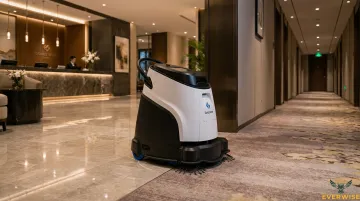
Gausium's Vacuum 40, distributed in Texas by Everwise Business Solutions, puts this navigation to work moving from a hotel's stone lobby into a carpeted guest corridor mid-route, while the Phantas is engineered for 0cm-from-edge performance in tighter commercial spaces.
Industries Best Positioned for Fast Automation ROI
Some verticals see automation pay off faster simply because of scale and frequency requirements:
- Hospitals and healthcare — infection control demands and compliance documentation make consistent, logged cleaning non-negotiable
- Hotels — guest experience expectations and 24/7 turnover create constant floor-cleaning demand
- Schools — large square footage on notoriously tight maintenance budgets
- Offices, manufacturing, and transportation hubs — big facilities that need round-the-clock, consistent coverage without adding headcount
Building Your Cleaning Automation Business Case: A 5-Step Framework
Once you've done the ROI math, here's how to turn it into an actual procurement decision:
- Audit current cleaning costs and pain points. Document labor hours, complaint frequency, and turnover rates to establish your real baseline — not an estimate.
- Define measurable KPIs. Track cost per square foot, cleaning consistency scores, and hours of staff time reallocated to higher-value work.
- Run a pilot first. Deploy in one high-traffic zone or building before committing to a full facility-wide rollout. This limits risk and gives you real performance data.
- Select an experienced, authorized technology partner. Everwise Business Solutions is the authorized Texas distributor of Gausium robots, offering preventive maintenance, OEM parts, and factory-trained technician support throughout San Antonio, Austin, Dallas, Houston, and the Rio Grande Valley. This support protects the ROI calculated in step two.
- Track results and decide whether to scale. Review coverage data and cost savings after a defined period, then use that evidence to expand automation to additional locations or shifts.
Frequently Asked Questions
How much does it cost to clean a 2,000 sq ft office?
Industry benchmarks put commercial office cleaning at roughly $0.09 to $0.17 per square foot, meaning a 2,000 sq ft office runs somewhere in the $180 to $340/month range. Use this figure as your baseline when calculating automation savings.
What are the 5 rules of smart cleaning?
Automate the predictable, not the exceptional; pair automation with human oversight; prioritize data and reporting; match technology to the environment; and plan for maintenance and scalability from day one.
How much does an autonomous cleaning robot cost?
Cost varies widely by model capability and coverage area, so most authorized distributors, including Everwise, price on request after a facility assessment. Leasing, capital lease, and Section 179 depreciation options can lower the upfront investment.
What is the typical ROI payback period for cleaning automation?
Most facilities see payback in 12 to 36 months, depending on shift count, square footage, and labor costs reallocated. Hospitality deployments converting 1 to 2 housekeeping FTEs per shift often land in the 18 to 36 month range.
Can autonomous robots work alongside human cleaning staff?
Yes — a hybrid model is standard practice. Robots handle routine floor cleaning while staff focus on detail work, spot treatment, and quality control.
Is cleaning automation worth it for small and mid-sized businesses?
Yes. Flexible financing structures and scaled model options, like the compact Gausium Phantas, make automation accessible well beyond large enterprise facilities.