Introduction
Facility managers across Texas and beyond are caught between two competing pressures: rising labor costs and uncompromising hygiene standards. The US janitorial services industry sits at $112 billion, yet 85% of commercial cleaning companies report that recruiting qualified staff is a major challenge. Meanwhile, cleaning quality directly affects everything from patient safety to hotel guest satisfaction scores.
Autonomous robot vacuums have become a practical answer to both pressures — yet most coverage focuses on consumer gadgets rather than the measurable business case for commercial facilities.
This guide breaks down what operations leads, facilities managers, and business owners actually need to know: the labor cost math, consistency gains, compliance considerations, and where robotic cleaning realistically fits into existing workflows.
Key Takeaways
- Autonomous robot vacuums cut cleaning labor hours, reducing contractor spend and freeing staff for higher-value work
- Commercial-grade units deliver consistent, programmable cleaning quality — no sick days, fatigue, or missed corners
- H13 HEPA filtration and intelligent floor detection support compliance in healthcare, hospitality, and education
- Savings scale with facility size — one model projects a 16.5-month payback on a 35,000 sq ft deployment
- ROI improves with consistent scheduling, optimized routing, and routine maintenance
What Are Autonomous Robot Vacuums?
Autonomous robot vacuums are self-navigating cleaning machines that use sensors, AI, and mapping technology to clean floors without human operation. They build facility maps, follow programmed routes, detect obstacles in real time, and return to their docking stations to recharge, then resume exactly where they left off.
Commercial-grade units differ substantially from consumer models — in scale, durability, and operational design. They're built for:
- Large and multi-zone floor areas (hotels, hospitals, retail floors, office campuses)
- Continuous or multi-shift operation
- Diverse surface types — sealed concrete, tile, vinyl/LVT, carpet, marble, hardwood, and mixed surfaces
- Remote management and scheduling through mobile platforms
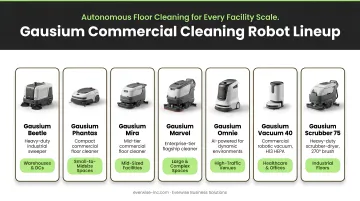
Everwise Business Solutions, Texas's authorized Gausium distributor, carries seven commercial models — Beetle, Phantas, Omnie, Vacuum 40, Mira, Marvel, and Scrubber 75 — each designed for specific facility environments and cleaning demands. The Vacuum 40, for example, features a 24 kPa suction motor, H13 HEPA medical-grade filtration, and 3D depth cameras with AI-powered floor identification— specifications built around commercial performance requirements.
The operational case for this technology is straightforward: lower cleaning labor spend, consistent hygiene standards, and staff time redirected toward work that requires human judgment.
Key Advantages of Autonomous Robot Vacuums
For facilities managers and operations leads evaluating autonomous cleaning, the case comes down to four measurable outcomes: cost, quality, scheduling, and scale. Here's how each one plays out in practice.
Advantage 1: Significant Reduction in Cleaning Labor Costs
Autonomous robot vacuums take over the most labor-intensive part of floor maintenance: the repetitive, time-consuming passes across large areas. When robots handle that work, the hours previously billed to that task either disappear from contractor invoices or get redirected to specialized cleaning that requires human attention.
How it works in practice: robots are scheduled to run during off-hours or low-traffic windows — overnight in a hotel, between shifts in a hospital, during restocking hours in retail. They complete full facility sweeps without supervision.
Why does this matter financially?
- Commercial cleaning companies bill $25 to $60 per hour, with labor representing 50–70% of total operating costs
- BLS data puts median janitorial wages at $17.27/hour, with healthcare and government sectors pushing $18–$20/hour
- One industry ROI model for a 35,000 sq ft facility cleaned twice daily projects annual labor cost reduction from $52,650 to $11,700 — a 16.5-month payback and $238,100 in lifetime savings over seven years
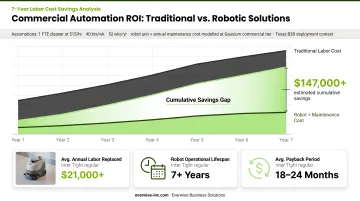
At scale, those numbers compound. A national grocery chain deploying robotic floor cleaning reported a 21% reduction in cleaning and maintenance costs, totaling over $2 million in annual savings.
Autonomous robots also bring cost predictability. They don't call in sick, require overtime, or need break coverage. For facilities with high cleaning labor turnover — a persistent problem in the sector — that consistency alone has real operational value.
KPIs this moves: cleaning labor cost per square foot, total janitorial hours per week, overtime frequency
Most relevant for: hotels, large retail stores, office campuses, airports, and hospitals where daily cleaning demands are high and labor costs are proportionally significant
Advantage 2: Consistent, Precision Cleaning Quality Across Large Spaces
Human-led cleaning is variable by nature. Quality depends on staff performance, fatigue, time pressure, and how many zones a single cleaner is covering. An autonomous robot follows the same programmed route every cycle, with identical suction settings, edge coverage, and surface adjustments — regardless of the time of day or day of the week.
How commercial robots achieve this consistency:
- AI-powered mapping creates systematic cleaning paths across the entire floor area
- Intelligent floor identification adjusts suction intensity and brush height automatically based on surface type
- Zero-Distance Edge Cleaning (available on the Vacuum 40) uses high-precision sensors to clean flush against walls and corners — the areas manual cleaning most often misses
Inconsistent cleaning creates real business risk, not just operational inefficiency.
In healthcare, approximately 1 in 31 US hospital patients contracts a healthcare-associated infection on any given day. CMS's hospital Conditions of Participation under 42 CFR 482.42 require facilities to maintain a clean and sanitary environment as part of infection prevention compliance. Cleaning frequency and method aren't optional — they're regulated.
In hospitality, the stakes are different but equally direct. J.D. Power's 2025 Hotel Guest Satisfaction Index found that guests who experienced housekeeping problems saw a 217-point drop in satisfaction on a 1,000-point scale.
The Gausium Vacuum 40's H13 HEPA filter captures fine dust, allergens, and harmful particles to medical-grade air purification standards, making it well suited to hospitals, schools, and any environment where air quality affects health outcomes or accreditation status.
KPIs this moves: hygiene audit pass rates, allergen/particulate counts, customer satisfaction scores, infection incident rates
Most relevant for: healthcare facilities, hotels, and schools where cleaning consistency directly affects health outcomes or brand reputation
Advantage 3: 24/7 Operational Availability and Scheduling Flexibility
Autonomous robots aren't bound by shift schedules, break periods, or business hours. They can run at 3am, between guest check-ins, during hospital shift changes, or alongside restocking crews — without a staff member present.
Real-world scheduling scenarios:
- Hotel lobby cleaned overnight between late check-ins and early departures
- Hospital corridor cleaned between shifts, meeting CDC's risk-based frequency requirements for high-traffic areas
- Retail floor running a cleaning cycle during after-hours restocking
- Office building completing a full sweep before the workday begins
The Gausium Mobile App lets facility managers schedule, monitor, and adjust cleaning cycles remotely. The robots' auto-charging capability — autonomously returning to dock when battery is low and resuming once powered — enables full overnight operation without manual intervention.
Scheduling robots during off-hours removes a practical pain point: no wet floor signs, no blocked aisles, no noise during operating hours. Beyond convenience, the compliance angle matters. A single missed cleaning cycle in a hospital or food service environment can put the facility out of compliance. Autonomous scheduling removes that dependency on staff availability entirely.
KPIs this moves: cleaning cycles per day, hours of coverage per facility, after-hours labor spend
Most relevant for: 24-hour operations (hospitals, hotels, airports) and businesses with high turnover in their cleaning workforce
What Happens When Autonomous Cleaning Is Ignored
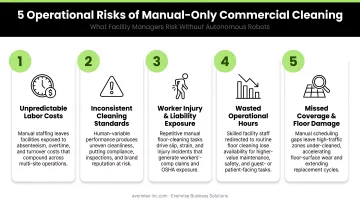
Manual-only cleaning creates real operational gaps — and the costs compound quickly across staffing, compliance, and facility maintenance:
- Hygiene gaps and compliance failures — inconsistent coverage in healthcare or food service creates direct regulatory exposure under CMS and Joint Commission standards
- Staffing dependency — turnover, sick days, and scheduling gaps reduce coverage with no built-in buffer
- Rising costs without rising quality — labor rates climb steadily, but higher spending doesn't guarantee better or more frequent cleaning
- Scaling problems — every added square foot means proportional labor hours; autonomous systems don't carry that overhead
- Reactive rather than preventive cleaning — responding to visible dirt instead of preventing it leads to deeper maintenance issues and higher long-term costs
The customer impact is measurable. ISSA research found that 94% of surveyed adults said they would avoid a business in the future after encountering a dirty restroom. In hospitality, J.D. Power's data ties housekeeping problems directly to a 217-point satisfaction decline (on a 1,000-point scale).
How to Get the Most Value from Autonomous Robot Vacuums
Autonomous cleaning produces consistent results when it's built into your facility's operational routine — not deployed once and forgotten.
Four practices that drive better results over time:
- Schedule consistently across defined zones — map routes to your actual facility layout, update them when layouts change, and ensure full coverage without redundancy or gaps
- Use the reporting data — the Gausium Mobile App provides remote monitoring, status updates, and schedule management; review this regularly to identify underserved areas and adjust routes
- Maintain the equipment on a regular schedule — filters, brushes, and sensors require routine servicing to preserve performance; Texas-based facilities can work with Everwise Business Solutions (San Antonio and Pharr) for scheduled maintenance and technical support from their local service team
- Complement, don't replace, cleaning staff — redirect freed cleaning hours toward tasks that require human judgment: restroom sanitation, surface disinfection, deep cleaning, and areas the robots can't reach
Robots handle the high-frequency, large-area floor work. The hours your staff get back are most valuable when redirected to specialized tasks — the cleaning that genuinely requires a person on-site.
Conclusion
The core value of autonomous robot vacuums is operational control: consistent hygiene, predictable costs, and cleaning coverage that holds regardless of staffing on any given day.
Those advantages scale with facility size and consistency of use. A single robot in a 5,000 sq ft space delivers modest returns. A coordinated deployment across a hotel, hospital wing, or large retail floor — scheduled on a routine, maintained proactively, and tracked through usage data — compounds into meaningful long-term savings and measurable quality improvement.
For Texas facilities ready to move from evaluation to deployment, Everwise Business Solutions offers sales, deployment support, and ongoing maintenance as the authorized Gausium distributor in the state. Contact them directly at 210.884.0559 or german.zavala@everwise-inc.com to discuss your facility's needs.
Frequently Asked Questions
Frequently Asked Questions
What are the benefits of autonomous robots?
The primary business benefits are labor cost reduction, 24/7 operational availability, and consistent cleaning quality across large spaces. Hours previously spent on repetitive floor cleaning can shift to higher-value tasks like surface disinfection or guest services.
What vacuum is best for allergies?
Commercial robots with H13 HEPA filtration — like the Gausium Vacuum 40 — are among the best options for allergy-sensitive environments, capturing fine dust, allergens, and particles that standard vacuums pass through. This makes them well-suited for healthcare facilities, schools, and hospitality spaces.
Can you use a robot vacuum on LVP flooring?
Yes. The Gausium Vacuum 40's Intelligent Floor Identification uses 3D depth cameras and AI to detect vinyl/LVT surfaces and automatically switch to the appropriate cleaning mode. It supports LVP alongside tile, hardwood, sealed concrete, marble, and mixed-surface environments.
How much can a business save by switching to autonomous cleaning robots?
Savings vary by facility size and labor costs. One industry model projects a 16.5-month payback and $238,100 in lifetime savings for a 35,000 sq ft facility; a national grocery chain reported over $2 million in annual savings with a 21% reduction in cleaning and maintenance costs.
Are autonomous cleaning robots suitable for large commercial spaces?
Commercial-grade robots are specifically designed for large floor areas. The Gausium Vacuum 40 achieves practical cleaning efficiency of 400–800 m²/hour, and Gausium's professional systems can map areas up to 100,000 square meters with ±10mm localization accuracy — capabilities that far exceed what any residential unit can deliver at commercial scale.
How do autonomous robot vacuums navigate around obstacles and people?
Commercial autonomous robots use 3D depth cameras combined with AI-powered mapping to detect obstacles and reroute in real time. The Vacuum 40, for example, perceives environmental changes as they happen, updates its internal map, and adjusts its path without stopping or getting stuck — making it safe for active business environments with foot traffic.