According to the BLS, there are over 2.4 million janitor and building cleaner jobs in the US, with 351,300 projected openings per year through 2034 — largely driven by replacement needs. That turnover reality is precisely why facility managers and operations directors are looking hard at autonomous cleaning robots.
This article covers the technology behind modern commercial cleaning robots, how they reshape daily operations, the business case for automation, and what to evaluate before committing to a model. The core premise is straightforward: cleaning robots don't just clean floors — they give businesses back time, reduce costs, and deliver hygiene standards that manual-only operations struggle to maintain at scale.
Key Takeaways
- Autonomous cleaning robots use LiDAR, SLAM navigation, and AI to execute systematic, route-planned cleaning — not random patterns
- Models like the Gausium Vacuum 40 detect surface transitions automatically and adjust brush height, suction, and cleaning mode without operator input
- Robots run scheduled routes during off-hours or between shifts, redirecting staff time to guest-facing, safety, and operational priorities
- H13 HEPA filtration on select models captures fine particulates during operation — a critical spec for healthcare, education, and manufacturing facilities
- Total cost of ownership — factoring in labor, turnover, and maintenance — is the right metric for evaluating cleaning automation, not upfront unit price alone
The Technology Behind Autonomous Cleaning Robots
Navigation: How Robots Actually Know Where They Are
Modern commercial cleaning robots don't bump around randomly hoping to cover a floor. They build a virtual map of the space using SLAM (Simultaneous Localization and Mapping) — a method where the robot estimates its position while constructing a floor plan from sensor data. Peer-reviewed research published in Sensors confirms that LiDAR-based SLAM enables systematic path planning, allowing robots to execute defined cleaning routes rather than unstructured movement that leaves gaps.
The result is full-floor coverage in a defined sequence — no missed zones, no repeated passes over the same area.
ISO 18646-2:2019 establishes navigation performance testing standards for mobile service robots — a benchmark when evaluating navigation claims from any vendor.
Intelligent Floor Identification
Navigation precision sets the coverage pattern. What the robot does once it gets there depends on what's underfoot. The Gausium Vacuum 40 uses 3D depth cameras combined with AI to detect floor surface transitions — hardwood, stone, vinyl/LVT, and various carpet pile depths — and adjusts automatically:
- Brush height raises or lowers to match the surface
- Cleaning mode switches between vacuuming/sweeping on carpet and sweeping/dry mopping on hard floors
- Carpet intensity selects from three levels (Light, Medium, Deep) based on pile type
- 24 kPa suction is applied appropriately without damaging floor surfaces
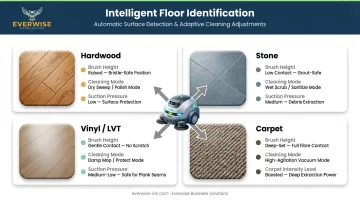
This happens without any operator input. A hotel robot navigating from lobby stone to corridor carpet to guest room entrance switches modes mid-route without stopping or requiring manual override.
Real-Time Obstacle Avoidance and Edge Cleaning
Surface adaptation handles what the robot cleans. Obstacle avoidance handles what it navigates around. Commercial robots use depth sensors to detect both static objects (furniture, machinery) and moving obstacles (people, carts) — rerouting automatically without human intervention.
The Gausium Omnie, built for high-dynamic environments like retail stores during open hours or hospital corridors during shift change, takes this further. Its AI-powered Auto Spot Cleaning detects spills and high-soil zones in real time and concentrates effort there, rather than following a rigid preset route.
For precision cleaning, the Gausium Phantas achieves 0cm-from-edge cleaning — meaning it cleans flush against walls, baseboards, and furniture legs using high-precision sensors and side brushes. No uncleaned strip along the walls, no manual touch-up required afterward.
H13 HEPA Filtration During Operation
Two models in the Gausium lineup — the Vacuum 40 and the Beetle — include H13 medical-grade HEPA filtration as standard. The EPA defines HEPA filtration as capturing at least 99.97% of particles at 0.3 microns — the most penetrating particle size. In both models, filtration runs continuously during the cleaning cycle, not as a separate mode.
For healthcare environments, schools, and enclosed warehouses, this distinction matters:
- Continuous filtration captures resuspended particles during cleaning, not just after occupants leave
- H13 grade meets the threshold a hospital IAQ review in PMC identifies as relevant to facilities where irregular cleaning allows particulate deposition that gets resuspended by occupant activity
This makes filtration a functional requirement in sensitive environments, not just a marketing feature.
How Cleaning Robots Reshape Daily Operations
Scheduling That Doesn't Compete with Your Workday
The most immediate operational shift is timing. Robots can be programmed to clean during off-hours, lunch breaks, or between shift changes. Cleaning happens on schedule — not when a staff member is available, not when someone notices the floor is dirty.
For a retail store or hotel, this means robots clean floors before opening — no coordination overhead. For a manufacturing facility, the warehouse gets swept after the last shift without pulling anyone off the production floor.
Consistency That Manual Cleaning Can't Match at Scale
Human cleaning output varies based on fatigue, workload, and turnover. A robot executes the same route with the same settings every cycle. The Gausium Scrubber 75, for instance, wet-scrubs and dries floors in a single pass using SLAM navigation that maps and repeats the same path — the same route, the same pressure, every time.
That consistency translates directly into compliance value. The Gausium Mobile App generates cleaning logs that support audit documentation — relevant for Joint Commission, CMS, OSHA, and EH&S surveys.
Labor Redeployment, Not Just Replacement
ISSA describes the operating model as robots absorbing repetitive floor cleaning while human staff focus on detail areas, restrooms, and tasks requiring judgment. Everwise's ROI framework models this as converting 1–2 janitorial FTE per shift into capital equipment — with fully-loaded Texas labor costs typically running $40,000–$70,000 per FTE annually, depending on shift premiums.
The staff don't disappear. Their time shifts toward restrooms, detail cleaning, and guest-facing work that robots can't handle.
Scalability Across Locations
Gausium's fleet management through the Gausium Mobile App gives facility managers centralized control across every deployed unit. For retail district managers or hospital system EVS directors overseeing multiple locations, that means:
- Monitor all robots across sites from a single dashboard
- Adjust cleaning schedules remotely without on-site visits
- Receive real-time status updates across the entire fleet
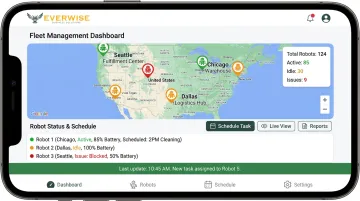
For operations teams managing 5 or 50 locations, the visibility alone reduces the coordination burden of keeping floors clean at scale.
The Measurable Business Benefits
Labor Cost Reduction
BLS data shows a national median of $35,930 per year for janitors and building cleaners — wages only. Using BLS September 2024 data for private-industry service occupations, total compensation reaches $22.22 per hour including $5.01 in benefits.
Factor in recruiting costs — SHRM pegged the average cost per hire at nearly $4,700 across occupations — and the fully-loaded cost of turnover in a janitorial role adds up quickly.
A cleaning robot doesn't call out sick, doesn't require onboarding each time, and doesn't generate a replacement cost when it leaves.
Hygiene Consistency and Compliance
For regulated industries, inconsistent cleaning creates audit risk. The Gausium Mobile App's cleaning logs create a documented, timestamped record of when and where cleaning occurred — directly supporting compliance requirements in healthcare (Joint Commission, CMS) and industrial environments (OSHA, EH&S).
Floor Longevity
WFCA guidelines warn that abrasive cleaners, excess water, and unsuitable products accelerate floor wear. Robots applying surface-matched cleaning modes — the right pressure, the right moisture level, for the right floor type — reduce the over-scrubbing and chemical overuse that shortens flooring asset life.
ROI Framing
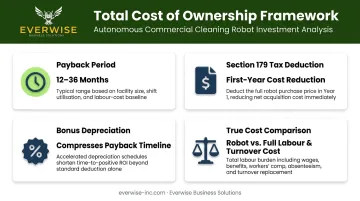
When labor costs, turnover, compliance risk, and floor asset life are all on the table, the financial case becomes a TCO calculation — not a sticker-price comparison. Everwise models the key variables this way:
- Payback period: typically 12–36 months depending on shift count, floor area, and labor benchmarks
- Section 179 tax deduction: applicable to qualifying commercial robot purchases, reducing first-year net cost
- Bonus depreciation: available on qualifying equipment, further compressing the payback timeline
- Accurate comparison: robot cost versus the full labor, turnover, and compliance cost of manual-only cleaning — not robot cost versus a mop
Industries Where Cleaning Robots Make the Greatest Impact
Healthcare
Hospitals, clinics, and eldercare facilities operate under strict hygiene requirements across high-foot-traffic common areas. The Gausium Vacuum 40 anchors most healthcare deployments because of its H13 HEPA filtration — a clinical requirement in environments where airborne particulate control affects patient safety. The Gausium Omnie handles high-dynamic hospital corridors during shift changes, where fixed-route robots would be blocked by carts and personnel movement.
Important scope note: Gausium robots are designed for corridors, lobbies, cafeterias, waiting rooms, and back-of-house areas — not patient rooms or sterile/OR environments, which require specialized infection control protocols beyond autonomous floor cleaning.
Hospitality and Retail
65% of hotels surveyed by AHLA in 2025 reported staffing shortages, with housekeeping cited as the leading shortage at 38%. Cleaning robots align cleaning cycles precisely with check-in/check-out timing and store open/close schedules — without the coordination overhead of shift-based crews.
The Gausium PhanShop is built for retail-channel environments. Key capabilities for retail operators include:
- Navigates supermarket aisle geometry without disrupting shopper flow
- Operates during open store hours with real-time obstacle avoidance
- Logs slip-and-fall liability documentation across multi-store chains
Manufacturing and Warehousing
The Gausium Beetle is built for large-footprint facilities with sealed concrete floors — warehouses, distribution centers, and manufacturing plants. Its industrial-scale sweeping and H13 HEPA filtration address both floor cleanliness and EH&S dust control in enclosed environments.
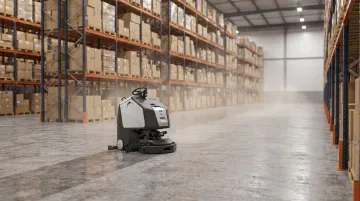
The Gausium Scrubber 75 handles oily manufacturing floors with a dedicated Oil Cleaning Mode. Automotive shops, food processors, and industrial plants where standard wet-scrubbing falls short are its primary targets.
What to Consider When Choosing a Cleaning Robot
Navigation Quality and Space Compatibility
Evaluate whether the robot's mapping technology handles your specific floor plan — narrow corridors, multi-floor buildings, high-traffic areas, and mixed flooring types. A showroom demo won't reveal how the robot handles your actual facility. Ask for a proof-of-concept deployment before committing.
Cleaning Mode Versatility
Will one robot handle all your cleaning tasks, or will you need a combination of models? Key functions to map against your facility's needs:
- Sweeping and dry debris collection
- Wet scrubbing and mopping
- Edge cleaning along walls and fixtures
- Air filtration (H13 HEPA, relevant for healthcare and food service)
The Gausium lineup covers the full range — from the Phantas for small-to-midsize commercial spaces up to the Marvel for large, complex facilities. Matching the right model to your space directly shapes the ROI calculation.
Service, Support, and Local Expertise
A commercial cleaning robot is a capital asset. Ongoing operational performance depends on:
- Scheduled preventive maintenance
- Software updates and sensor calibration
- OEM parts replacement
- Multi-robot fleet management under a single contract
Everwise Business Solutions, as the authorized Gausium distributor in Texas, provides on-site service from factory-trained technicians across San Antonio, Pharr, Austin, Dallas, Houston, and the Rio Grande Valley. That coverage — and the ability to consolidate fleet service under one contract — is what separates a functional long-term deployment from one that degrades within the first year.
Frequently Asked Questions
How much does an AI cleaning robot cost?
Gausium pricing through Everwise is handled by custom commercial quote, as costs vary by model, capability, and deployment size. Evaluate total cost of ownership — labor savings, maintenance, and tax incentives like Section 179 — not sticker price alone. Contact Everwise at 210.884.0559 for a custom ROI model and quote.
Do cleaning robots really work?
Modern commercial robots deliver reliable, systematic cleaning through AI navigation, surface-specific cleaning modes, and real-time obstacle avoidance. They perform best as part of a broader strategy — robots handle repetitive floor cleaning while staff cover specialized tasks that require judgment.
Can cleaning robots replace janitorial staff entirely?
Robots are best viewed as a labor conversion tool, not a wholesale replacement. They handle high-frequency floor cleaning so staff can focus on restrooms, detail work, and tasks that genuinely require human judgment.
How do autonomous cleaning robots navigate around people and obstacles?
Robots use real-time sensors — including LiDAR, 3D depth cameras, and ultrasonic sensors — to detect both stationary and moving objects and reroute automatically. The Gausium Omnie is specifically designed for high-dynamic environments with constant, unpredictable foot and equipment traffic.
What industries benefit most from autonomous cleaning robots?
Healthcare, hospitality, retail, manufacturing, and commercial offices see the strongest returns — particularly environments with consistent hygiene requirements, large floor areas, or scheduling constraints that make human-only cleaning difficult to sustain reliably at scale.