The challenges compound quickly: chronic labor shortages in the custodial sector, passengers who now expect visible cleanliness (not just behind-the-scenes cleaning), and growing pressure to reduce water and chemical consumption. Autonomous cleaning robots address all three simultaneously.
This guide covers how airport cleaning robots actually work, what features separate good options from great ones, what real deployments at Frankfurt and Zurich have demonstrated, and how to evaluate and deploy robots at your own facility.
Key Takeaways
- Airport terminals span hundreds of thousands of square meters and require continuous cleaning that traditional staffing cannot reliably deliver
- Autonomous robots use LiDAR, 3D depth cameras, and AI path planning to navigate crowded, dynamic environments in real time
- Full autonomy navigation outperforms teach-and-repeat systems in airports, where crowds, obstacles, and layouts shift constantly
- Frankfurt Airport cleaned 1.6 million square meters in six months using autonomous robots — Zurich Airport's 26-robot fleet projects ROI in under two years
- Robot selection and local technical support directly determine whether a deployment scales or stalls
Why Airports Need Autonomous Cleaning Robots Now
The Scale and Labor Problem
Major terminals are relentlessly active. Manual cleaning crews working fixed shifts cannot maintain consistent coverage across hundreds of thousands of square meters while passengers, baggage carts, and temporary barriers constantly shift the landscape.
The labor picture compounds the problem. ISSA reported in 2025 that demand for cleaning services keeps rising while qualified workers remain hard to find and retain. The BLS pegs median pay for janitors and building cleaners at $17.27/hour as of May 2024, yet custodial turnover ranks among the highest in the service sector — making workforce stability a persistent headache for airport facility teams.
The Passenger Expectation Shift
The post-pandemic period permanently reset what passengers consider acceptable. A Brain Corp/RetailWire survey found that 72% of respondents did not anticipate any reduction in cleanliness expectations even after vaccines became widely available. Airports felt this directly: the ACI-NA's guidance on passenger confidence during COVID specifically framed visible cleaning as central to rebuilding traveler trust — a shift that moved cleaning from a background function to a front-of-house priority.
Visibility and Sustainability Pressures
Airports have moved from cleaning primarily during off-peak hours to deploying cleaning staff and equipment during peak passenger times. This creates a visible reassurance effect, but it also generates congestion and operational complexity for human crews — robots handle the same coverage without adding to the foot-traffic problem.
On the sustainability side, Fraport's Frankfurt Airport sustainability reporting documents active programs to cut chemical dependency and shift to lower-impact products. Autonomous scrubbers with onboard water-recycling filtration and precision chemical dosing fit squarely into those goals. The water savings are measurable:
- TASKI reports up to 70% water savings through its IntelliFlow system
- Gausium's Scrubber 50 Pro claims roughly 80% freshwater reduction through multi-stage filtration
How Autonomous Airport Cleaning Robots Work
The Core Technology Stack
Enterprise airport cleaning robots combine multiple sensor types and AI systems to perceive and respond to their environment continuously:
- LiDAR — scans the surrounding area to build and update real-time environmental maps
- 3D depth cameras — provide spatial awareness for precise obstacle detection and floor surface identification
- Ultrasonic sensors — detect obstacles at close range and prevent collisions with low-profile objects
- AI path planning — continuously optimizes cleaning routes based on current conditions, not just pre-programmed paths
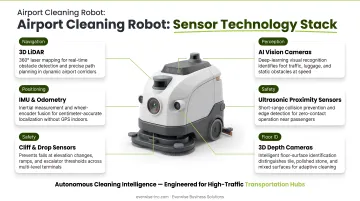
The Gausium Scrubber 50, for example, integrates 2D LiDAR, a 3D depth camera, an RGB camera, and anti-collision sensors, using deep-learning algorithms and sensor fusion for precise environmental perception.
Navigation Philosophy: Full Autonomy vs. Teach-and-Repeat
This distinction matters especially in airports, where gate configurations and passenger flows shift constantly throughout the day.
Teach-and-repeat systems require a human operator to manually walk a robot through its route once. The robot memorizes that path and repeats it. When something changes — a temporary gate barrier, a crowd queuing at security, a maintenance cart parked mid-concourse — the robot may stop, fail, or require re-teaching.
Full autonomy systems build a map of their environment and use real-time path planning to route around whatever they encounter. If a passenger queue blocks the usual corridor, the robot finds an alternative path and continues cleaning. Tennant's BrainOS Clean 2.0 eliminates manual route training entirely, allowing robots to plan and optimize cleaning paths dynamically.
For airports, where the environment changes hour by hour, full autonomy is a baseline operational requirement — not an optional upgrade.
Cleaning Modalities and Autonomous Workstations
Airports typically need more than one cleaning modality because terminal zones vary significantly:
| Zone Type | Recommended Modality |
|---|---|
| Open concourses (hard floors) | Autonomous floor scrubber |
| Carpeted gate lounges | Autonomous vacuum with HEPA filtration |
| Mixed-surface areas | Multi-function units with intelligent floor identification |
| Confined/congested spaces | Compact AMR units |
Gausium's Vacuum 40 handles mixed environments through Intelligent Floor Identification — 3D cameras and AI automatically detect surface type (hardwood, stone, carpet) and adjust brush height and cleaning mode without operator input.
Autonomous workstations complete the picture for facilities aiming to minimize manual intervention. These docking stations automatically refill clean water, drain wastewater, and recharge the robot between shifts. Without them, staff must manually service robots during the night — which undercuts the labor savings argument. Zurich Airport's deployment specifically credited autonomous workstation capability (recharging, filling, emptying, and communication with peripheral systems like doors) as a key factor in its success.
Key Features to Look For in an Airport Cleaning Robot
Navigation Intelligence
In an airport, the environment at 6 AM looks nothing like the environment at noon. Robots must remap on the fly, not execute static routes. Prioritize systems with demonstrated full autonomy — not just teach-and-repeat with obstacle avoidance bolted on.
Tank Capacity and Runtime
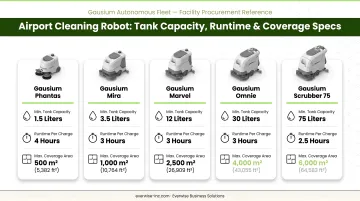
Coverage per shift depends directly on how long a robot can operate before needing service. For reference, airport-grade robots should meet these minimum thresholds:
- Solution tank: 75L or larger to sustain extended runs without mid-shift refills
- Runtime: 4–6 hours per charge on lithium-ion batteries
- Wastewater capacity: Matched to solution tank to avoid premature dump stops
Larger tanks reduce dock trips, and longer runtimes directly increase the square footage you can cover per shift — both matter in terminals that regularly exceed 50,000 square meters of cleanable floor.
H13 HEPA Filtration
HEPA filtration at the H13 grade captures 99.97% of particles at 0.3 microns — the particle size hardest to trap. In airport terminals, where air quality directly affects passenger comfort and health, this matters beyond floor cleanliness. The Gausium Vacuum 40, for example, includes medical-grade H13 HEPA filtration that captures fine dust, allergens, and airborne particles — a meaningful differentiator in high-traffic public environments.
Safety in Passenger-Facing Environments
Robots in airports operate around children, elderly passengers, and travelers with mobility aids. Look for:
- Multi-layer obstacle detection (LiDAR + cameras + ultrasonic sensors)
- Automatic stop functions triggered by proximity
- Audible and visual alerts during operation
- Demonstrated performance in live public deployments (not just lab testing)
Proof-of-Clean Reporting
Airports increasingly need to demonstrate cleaning compliance — to passengers, regulators, and accreditation bodies like GBAC STAR. GBAC STAR certification requires facilities to meet 20 program elements for outbreak prevention — documentation that manual cleaning logs struggle to satisfy reliably. Autonomous robots that generate digital cleaning logs, route maps, and coverage verification reports provide time-stamped proof that specific zones were cleaned to specification. Remote management platforms, like the Gausium Mobile App, let facility managers monitor active cleaning tasks and receive status updates in real time.
Benefits and ROI: Making the Business Case
Labor Reallocation, Not Replacement
The Frankfurt Airport deployment offers the clearest evidence of how this plays out in practice. Tennant's BrainOS-powered T16AMR and X4 ROVR robots took over repetitive large-area floor cleaning — freeing Fraport Facility Services staff to focus on deep cleaning, sanitization, and tasks requiring human judgment. Robots didn't eliminate jobs; they changed what those jobs involved.
Cincinnati/Northern Kentucky International Airport's pre-robot baseline required 24 labor hours and a three-person overnight team for manual floor cleaning — labor that autonomous systems can handle without staffing overhead.
Coverage Consistency at Scale
Unlike human-operated cleaning, robots follow their routes without fatigue, distraction, or variation. At Frankfurt Airport Terminal 1 (over 500,000 square meters), Tennant's autonomous robots cleaned more than 1.6 million square meters in the first six months without interrupting foot traffic or flight schedules. That averages roughly 267,000 square meters per month — maintained without variation across the full deployment period.
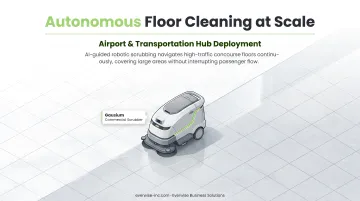
Passenger response at Frankfurt was largely positive — curiosity, photos, and general acceptance rather than disruption complaints.
Sustainability Metrics
Consistent coverage at scale also translates into measurable environmental gains. TASKI's IntelliDose system reports 75% reduction in chemical resource use and a 25-30% reduction in carbon footprint. Water recycling systems on advanced scrubbers further cut freshwater consumption — a documented ESG contribution airports can report against net-zero commitments.
ROI Timeline
Zurich Airport deployed 26 robots (20 TASKI Ecobot 50 and 6 TASKI Phantas) in 2025. TASKI's deployment announcement projects return on investment in less than two years, driven by:
- Autonomous workstations that reduce supervision overhead
- Integrated digital scheduling across the full robot fleet
- Executive alignment ensuring consistent program adoption
- Labor reallocation away from routine cleaning routes
Real-World Airport Deployments
Frankfurt Airport (Fraport Facility Services)
Fraport deployed Tennant T16AMR robots for large high-traffic zones and X4 ROVR units for confined and congested areas across Terminal 1. The results at scale:
- 500,000+ sqm terminal covered
- 1.6M+ sqm cleaned in the first six months
- Fraport redeployed staff into specialized cleaning and sanitization roles
- Passengers engaged positively — treating the robots as a visible quality signal
One night-shift employee became an informal robot trainer for colleagues — a reminder that staff adoption requires attention, not just installation.
Zurich Airport (TASKI)
The Zurich deployment stands out for how completely it eliminated manual robot servicing:
- 26 robots deployed (20 Ecobot 50 + 6 Phantas)
- ROI projected in less than two years
- Fully autonomous workstations for recharging, filling, and emptying
- Integrated with peripheral systems including automatic door communication
Three factors drove the results: autonomous workstations cut manual servicing to near zero, digital scheduling tightened coverage windows, and leadership committed to the program before the first robot arrived.
Transferable Lessons
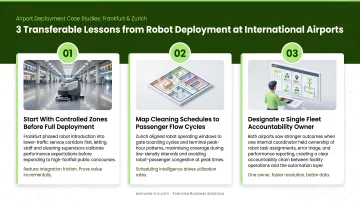
Both deployments point to the same hard-won lessons — ones that apply regardless of which robots you choose:
- Plan staff training before day one. Frankfurt's informal robot trainer emerged organically — most facilities won't be that lucky. Budget for structured communication and training from the start, not as an afterthought once robots are on the floor.
- Start in your easiest zone, then expand. Large open concourses with hard floors are where robots perform best. Prove ROI there before committing to more complex or congested areas.
- Vet vendor support as carefully as the hardware. A robot waiting a week for parts or a technician creates the same coverage gaps you deployed it to solve. Response time and parts availability aren't afterthoughts — they're operational requirements.
How to Get Started: Deploying Robots at Your Airport
The Deployment Framework
A practical implementation follows four phases:
- Facility audit — Map terminal zones by floor type, square footage, foot traffic patterns, and operating hours. Identify which surfaces (polished stone, terrazzo, tile, carpet) are present and where.
- Zone prioritization — Large open concourses with hard floors are typically the easiest starting point. High-traffic, high-visibility areas also deliver the fastest measurable ROI.
- Pilot program — Test one or two robots in a defined zone before fleet commitment. Measure coverage, staff response, and passenger reaction against your baseline.
- Fleet scaling — Use pilot data to define fleet size, coverage schedules, and autonomous workstation placement for full deployment.
Choosing the Right Distribution Partner
Airport robots cannot afford extended downtime. A scrubber sitting idle waiting for parts creates exactly the coverage gaps you deployed it to solve. When evaluating a distribution partner, look for:
- Local technicians who can respond quickly to service calls
- Comprehensive maintenance plans that cover parts and labor
- Hands-on facility assessment before any equipment commitment
- Proven experience with transportation or large commercial environments
Everwise Business Solutions is the authorized Gausium distributor for Texas, with locations in San Antonio and Pharr. Their team supports transportation hubs and large commercial facilities across the state — from initial facility assessments and model selection through long-term technical support.
Frequently Asked Questions
How much does an autonomous airport cleaning robot cost?
Pricing varies by robot type, capabilities, and fleet size — enterprise-grade airport robots are typically quoted on request based on specific requirements. Total cost of ownership, accounting for labor savings and coverage gains, generally projects ROI within one to two years. Reach out for a customized quote based on your facility's needs.
Can autonomous cleaning robots operate safely around airport passengers?
Yes. Enterprise-grade robots use multi-layer obstacle detection combining LiDAR, 3D cameras, and ultrasonic sensors, with automatic stop functions and audible/visual alerts. Passengers at Frankfurt and Zurich deployments have responded with curiosity rather than concern.
Do airport cleaning robots replace human cleaning staff?
Generally no. Robots handle repetitive large-area tasks — floor scrubbing and vacuuming — while freeing staff for high-touch cleaning and roles requiring judgment. At Frankfurt Airport, no positions were eliminated; responsibilities shifted toward higher-value work.
What types of floors can airport cleaning robots handle?
Advanced robots with intelligent floor identification handle polished stone, terrazzo, tile, hardwood, and carpet — automatically adjusting cleaning mode and brush pressure. Multi-function units like the Gausium Vacuum 40 switch between scrubbing and vacuuming modes based on detected surface type.
How long does it take to deploy robotic cleaning at an airport?
Initial facility mapping and pilot setup typically takes a few weeks. Full fleet deployment — including docking station installation, staff training, and route optimization — may take several months depending on terminal size and infrastructure readiness.
What infrastructure does an airport need before deploying cleaning robots?
Core requirements include:
- Dedicated charging/docking stations with standard power access
- Storage space for the robot fleet
- Data connectivity for remote monitoring and reporting
- Minimum aisle widths suited to selected robot models
Pre-deployment facility mapping is typically completed by the vendor before go-live.