Introduction
Labor costs for commercial cleaning staff reached a median of $17.27 per hour in May 2024, according to the U.S. Bureau of Labor Statistics — and that figure keeps climbing. Add heightened hygiene expectations across healthcare, hospitality, and retail, and facility managers are under real pressure to find a more consistent, cost-effective answer than adding headcount.
Autonomous cleaning robots have moved from novelty to operational reality. Hospitals deploy them in corridors overnight, hotels run them through lobbies during low-traffic hours, and warehouses use them to cover acres of concrete across multiple shifts.
The market is now crowded enough that identifying which companies are actually built for commercial-scale deployment is a serious challenge.
The wrong choice means wasted capital, a robot that sits unused after the first month, and an integration headache no one budgeted for.
This article profiles the top cleaning robot companies worth watching, what sets each one apart, and the criteria facility and procurement leaders should apply before making a capital commitment.
Key Takeaways
- The global commercial cleaning robot market is projected to grow from $1.78B in 2024 to $6.4B by 2030 — a 24.3% annual growth rate.
- Commercial robots differ from consumer vacuums in scale, navigation sophistication, and fleet management capability.
- Leading companies are evaluated on navigation intelligence, fleet management capability, sector-specific fit, and total cost of ownership — not hardware specs alone.
- Buyers often over-index on hardware specs and underweight total cost of ownership, local support, and sector fit.
- Texas businesses can source the full Gausium lineup through Everwise Business Solutions, the state's authorized distributor.
The Rise of Cleaning Robots in Commercial Settings
Commercial autonomous cleaning robots are self-navigating machines that use LiDAR sensors, cameras, and mapping algorithms to vacuum, scrub, or sweep large facilities with minimal human supervision. They bear little resemblance to the consumer robot vacuums you'd find in a home — these units carry industrial-grade tanks, navigate complex floor plans in real time, and report cleaning data to cloud-based management platforms.
The market opportunity reflects that distinction. Grand View Research values the global commercial cleaning robot market at $1,777.3M in 2024 and projects $6,415.3M by 2030, a 24.3% compound annual growth rate. North America represents the largest revenue-generating region in this segment.
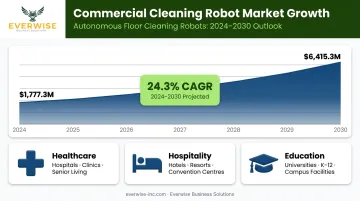
Adoption is still uneven, but it is accelerating. A 2019 ISSA survey found that 27% of commercial facility operators were already using autonomous cleaning equipment — with 89% of those users deploying autonomous scrubbers in large open areas and hallways.
Post-pandemic hygiene expectations then pushed demand sharply higher across three sectors in particular:
- Healthcare — EVS teams facing stricter infection-control standards
- Hospitality — hotels and convention centers managing high guest-volume turnover
- Education — school districts and universities covering large floor areas with shrinking custodial staffing
As the market matures, a handful of companies have separated themselves on technology reliability, real-world deployment scale, and sector-specific capability. The sections below break down who they are and what distinguishes each one.
Top Cleaning Robot Companies to Watch
The companies below were selected based on commercial deployment scale, navigation and AI capability, sector coverage, and relevance across healthcare, hospitality, education, and retail.
Gausium (Gaussian Robotics)
Founded in 2013 and headquartered in Shanghai, Gausium is one of the most established autonomous commercial cleaning brands globally, serving 6,500+ customers across 70+ countries. Their robots clean airports including Heathrow, Singapore Changi, and Doha, alongside major retail chains and corporate campuses.
Their product portfolio spans virtually every commercial use case — compact cleaners like the Phantas for small-to-midsize spaces, the enterprise-tier Marvel for large complex facilities, and the AI-powered Omnie for high-dynamic environments. Foot traffic and floor conditions change unpredictably throughout the day; the Omnie is built to adapt to both.
What sets Gausium apart:
- SLAM navigation with LiDAR and camera-based localization, tested across thousands of global sites
- Auto Spot Cleaning on the Omnie detects spills in real time and adapts routes — rather than following a fixed path
- 3D depth cameras on the Vacuum 40 identify floor type automatically, adjusting for carpet, marble, tile, and hardwood in a single deployment
- H13 medical-grade HEPA filtration on the Vacuum 40 and Beetle captures 99.95% of particles at the most penetrating particle size
- Zero-distance edge cleaning on the Phantas v1.3 reaches 0cm from walls and corners
- Gausium Mobile App handles remote task scheduling, status monitoring, and compliance-grade cleaning logs
| Attribute | Details |
|---|---|
| Key Technology | SLAM navigation with LiDAR/cameras, AI spot cleaning, 3D depth camera floor identification |
| Ideal Sectors | Healthcare, hospitality, retail, corporate offices, warehousing, transportation hubs |
| Notable Capability | AI-powered Omnie for high-dynamic environments; H13 HEPA on Vacuum 40 and Beetle |
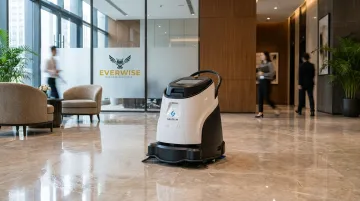
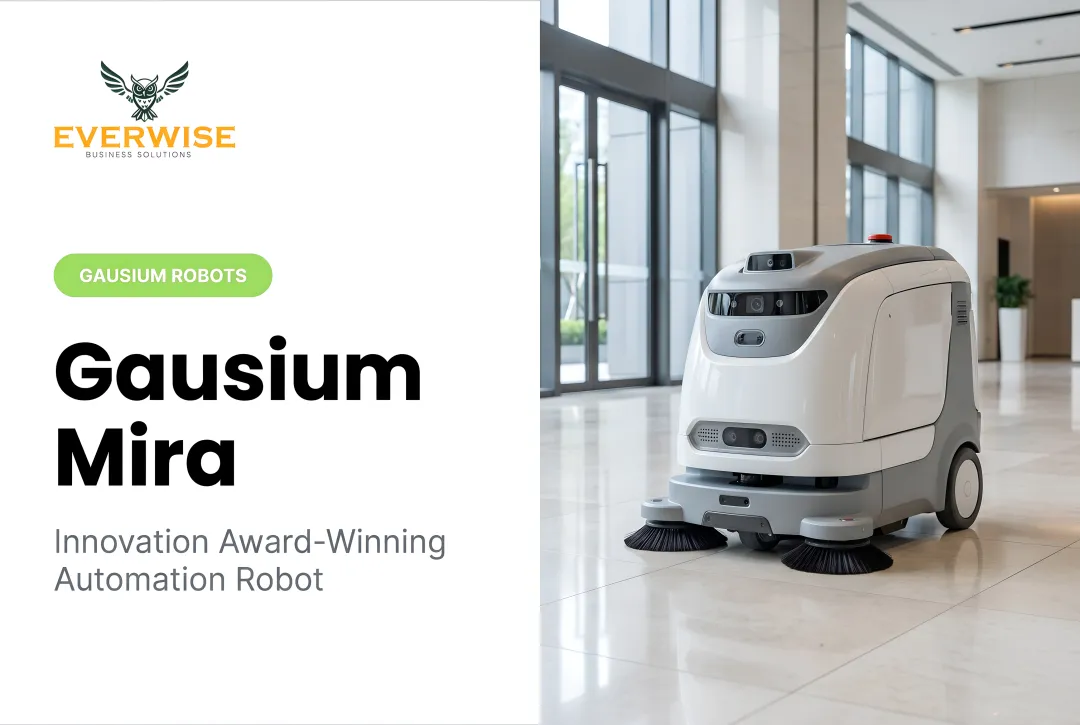
Texas buyers: Everwise Business Solutions is the authorized Gausium distributor for Texas, with operations across San Antonio, Pharr, Austin, Dallas, Houston, and the Rio Grande Valley. The full 2026 lineup — including the Mira, Marvel, and PhanShop — is available for deployment across Texas facilities.
Avidbots
Founded in 2014 and based in Kitchener, Ontario, Avidbots built their entire company around one thing: heavy-duty autonomous floor scrubbing for large commercial and industrial facilities. Their Neo series is purpose-built for high-volume, high-frequency cleaning at scale.
Their cloud-based Avidbots Autonomy platform handles localization, dynamic obstacle avoidance, real-time path planning, and performance reporting through a Command Center dashboard. In documented deployments at Cincinnati/Northern Kentucky International Airport, Neo replaced a manual process that required three people and 24 labor-hours per cycle.
| Attribute | Details |
|---|---|
| Key Technology | LiDAR navigation with Avidbots Autonomy cloud fleet management |
| Ideal Sectors | Airports, warehouses, manufacturing plants, large transportation hubs |
| Notable Capability | Heavy-duty industrial scrubbing with wide cleaning path; DHL facilities reported up to 80% reduction in cleaning labor hours |
Tennant Company
Tennant has been manufacturing commercial cleaning equipment since 1870. In procurement decisions, that longevity translates directly: facility managers already know the brand, maintenance teams are trained on the hardware, and dealer networks are established across North America.
Their T7AMR and T16AMR robotic scrubbers run on Brain Corp's BrainOS autonomous navigation platform. The T7AMR targets retail, education, healthcare, and hospitality. The T16AMR, launched in 2021, extended that reach — it was the industry's first robotic scrubber purpose-built for industrial and logistics applications. Brain Corp reports over 50,000 robots deployed across six continents on its platform — though that figure spans all BrainOS-powered devices, not Tennant units alone.
| Attribute | Details |
|---|---|
| Key Technology | Brain Corp BrainOS on Tennant industrial scrubber hardware |
| Ideal Sectors | Retail, grocery, education, commercial facilities, industrial/logistics |
| Notable Capability | Trusted legacy hardware with autonomous upgrade path; service network widely available in North America |
Pudu Robotics
Founded in 2016 in Shenzhen, Pudu built its reputation on hospitality delivery robots before expanding aggressively into commercial cleaning. Their CC1 model combines sweeping, scrubbing, carpet vacuuming, and dust mopping in one compact unit — a meaningful operational advantage in facilities that would otherwise need multiple machines.
Pudu's strength is in public-facing environments where aesthetics and user interaction matter. Their AI stain detection and intelligent route adaptation make the CC1 well-suited for spaces where cleanliness is visible to guests or customers throughout the day.
| Attribute | Details |
|---|---|
| Key Technology | AI stain detection, 4-in-1 multi-function cleaning, voice and UI interaction |
| Ideal Sectors | Shopping malls, corporate headquarters, hotels, high-traffic public spaces |
| Notable Capability | Sweeping, scrubbing, vacuuming, and mopping in a single compact unit |
SoftBank Robotics (Whiz)
Whiz launched commercially in 2019 through SoftBank Robotics' partnership with Brain Corp. It fills a specific niche: carpeted commercial environments where autonomous vacuuming — rather than scrubbing — is the primary need. Hotels, offices, convention centers, and airports with large carpeted areas are its core deployments. Named reference sites include Sheraton Myrtle Beach, Marriott Denver Tech Center, and Hilton Garden Inn Gilroy.
Whiz differentiates on simplicity. Staff can teach it new routes quickly, and its cloud-connected platform generates cleaning performance reports that give facility managers accountability data without requiring manual tracking.
| Attribute | Details |
|---|---|
| Key Technology | Brain Corp BrainOS with teach-and-repeat routing and cloud analytics |
| Ideal Sectors | Hotels, corporate offices, convention centers, airports (carpeted areas) |
| Notable Capability | Easy route training, remote monitoring, automated cleaning performance reporting; up to 3 hours per battery charge |
What Sets the Best Cleaning Robot Companies Apart
Picking the right company comes down to more than navigation specs on a product sheet. These are the criteria that actually determine whether a deployment succeeds or stalls after 90 days.
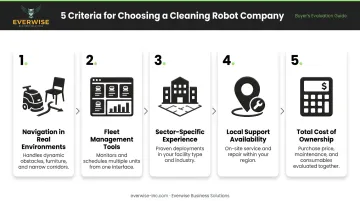
Evaluation Criteria That Matter
Navigation in real environments — not empty warehouses. The meaningful test is whether the robot handles dynamic obstacles, recovers from unexpected interruptions, and completes routes consistently when staff, carts, and visitors are present. Require a live demo in a comparable environment.
Fleet management tools — coverage maps, exception reporting, utilization data, and remote support capability are essential for any multi-unit or multi-site deployment — without them, you're flying blind. A robot you can't monitor is a robot you'll stop using.
Sector-specific deployment experience — surface compatibility, operating hour flexibility, and obstacle profiles differ meaningfully between a hospital corridor and a warehouse. A company that has deployed in your environment before will anticipate problems you haven't thought of yet.
Local support and maintenance availability — response time matters when a robot goes down mid-shift. An overseas manufacturer with no regional support structure will leave you managing downtime yourself. An overseas manufacturer with no regional presence leaves you managing downtime alone. Texas-based distributors like Everwise Business Solutions offer on-site dispatch and scheduled maintenance across San Antonio, Houston, Dallas, and the Rio Grande Valley — a meaningful difference at fleet scale.
Total cost of ownership — hardware is only one line item. Factor in batteries, consumables, software fees, maintenance contracts, and operator time. The ISSA's guidance on autonomous cleaning deployment is clear: treat it as a managed program, not a one-time hardware purchase.
What Buyers Get Wrong
The most common misstep is selecting a robot based on upfront cost or brand recognition, then discovering the support model doesn't fit the facility's operational reality. Common failure patterns include:
- Deploying without a clear route-training plan
- Treating robots as complete labor replacements rather than labor supplements
- Underestimating consumable and maintenance costs at fleet scale
- Choosing a supplier who can't support growth beyond a pilot unit
Before signing anything, ask the vendor for a reference from a facility in your sector — and ask specifically what broke during the first 90 days and how they handled it. That answer tells you more than any spec sheet.
Conclusion
The cleaning robot market has moved well past the pilot phase. Healthcare systems, hotel groups, school districts, and warehouse operators are running these machines across real facilities, real shifts, and real square footage — because the labor math and hygiene consistency case has already been proven at scale.
Choosing the right company means matching technology capability to your specific environment, not just selecting the most familiar name. Three criteria matter most when narrowing your options:
- Evaluate navigation reliability under your actual operating conditions
- Confirm the service model holds up after the sale
- Build your decision around total cost of ownership across three to five years, not the sticker price on the spec sheet
For Texas businesses ready to explore Gausium autonomous cleaning robots, Everwise Business Solutions offers direct access to the complete 2026 Gausium lineup with local deployment support, certified technicians, and statewide maintenance coverage. Contact Everwise at 210.884.0559 or german.zavala@everwise-inc.com (Monday–Friday, 9:00 AM–6:00 PM) to discuss which model fits your facility.
Frequently Asked Questions
What is the difference between commercial and residential cleaning robots?
Commercial robots are built for large-scale, continuous operation across airports, hospitals, offices, and warehouses. They include industrial-grade tanks, LiDAR-based SLAM navigation, fleet management platforms, and multi-shift battery capacity. Light-duty units designed for small offices typically lack these capabilities and aren't built for the runtime, reporting, or coverage demands of commercial facilities.
How do autonomous cleaning robots navigate large commercial spaces?
Most commercial systems use LiDAR sensors combined with cameras and SLAM algorithms to build real-time maps of their environment, detect and avoid obstacles, and optimize cleaning routes across complex floor plans — including spaces where people, carts, and floor configurations change throughout the day.
What industries benefit most from autonomous cleaning robots?
Healthcare (infection control and EVS labor conversion), hospitality (consistent overnight and front-of-house cleaning), retail (high-traffic floor maintenance across multi-store chains), education (reduced custodial labor), and transportation hubs (large-scale, frequent cleaning in high-traffic terminals) see the strongest ROI cases.
Are commercial cleaning robots cost-effective for small and medium businesses?
Upfront investment varies by model and deployment scale, but the ROI case is built on labor savings and reduced contract cleaning dependency. Total cost of ownership over three to five years, factoring in Section 179 tax treatment and maintenance costs, is the more accurate comparison metric than purchase price alone.
How long do commercial cleaning robot batteries typically last per charge?
Battery life varies by model and workload. Most commercial-grade robots deliver 4–8+ hours per charge, with some multi-shift models extending runtime further depending on cleaning mode and floor type. Many units support auto-charging, returning to the dock when low and resuming without staff intervention.
What should I look for when selecting a cleaning robot company?
Evaluate navigation reliability in your actual operating environment, sector-specific deployment experience, fleet management and reporting tools, local service availability, and total cost of ownership — including maintenance, consumables, and software. Support model quality after the sale often matters more than hardware specs.