Introduction
Grocery floors take a beating. Between spilled yogurt, tracked-in mud, and produce leaves scattered across aisle four, a clean floor at 8 a.m. rarely stays that way by noon.
Add a labor market where reliable janitorial crews are hard to find and even harder to keep, and floor care becomes a daily gamble for store managers.
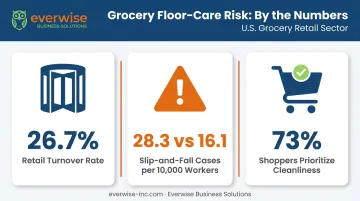
Shoppers notice. 73% of grocery shoppers say a clean, neat store matters when deciding where to shop in person, according to FMI's 2026 U.S. Grocery Shopper Trends report. That ranks above easy checkout and even above examining produce up close.
This article breaks down why intelligent autonomous cleaning matters for grocery operators, how the robots actually work, the operational payoff, and how to pick the right partner for deployment.
Key Takeaways
- AI-driven robots map grocery floors in real time, cleaning continuously during business hours
- Labor shortages and slip-and-fall liability make manual-only cleaning a growing risk for grocery stores
- Robots free staff for restocking and customer service while improving cleaning consistency and safety
- An authorized, experienced Gausium distributor is critical for proper setup, maintenance, and long-term ROI
Why Grocery Stores Need Intelligent Autonomous Cleaning Solutions
Labor Shortages Make Manual Floor Cleaning Unreliable
Retail and wholesale trade posted a 26.7% turnover rate in 2025, the highest of any industry tracked in Mercer's US Turnover Survey. That level of churn makes consistent nightly staffing nearly impossible to guarantee.
For grocery stores, this creates real gaps:
- Overnight and early-morning shifts, when floors need the most attention, are the hardest to staff consistently
- New hires often lack training on proper scrubbing technique or chemical dilution
- A single no-show can leave an entire shift's floor care undone
Manual cleaning schedules built around unreliable staffing simply don't hold up. A robot that shows up every night, on schedule, doesn't call in sick.
Slip-and-Fall Risks Create Costly Liability Exposure
Grocery stores and meat-handling establishments recorded 28.3 slip, trip, and fall cases per 10,000 full-time workers, nearly double the 16.1 per 10,000 across all other private industries, based on NIOSH and BLS data. Same-level falls accounted for 75% of those incidents.
Every incident carries a cost beyond the immediate injury:
- Workers' compensation claims tied to falls drive up insurance premiums long after the incident is closed
- Legal exposure from customer premises-liability claims can drag on for months
- Documented, timestamped cleaning activity is often the difference between a defensible claim and a costly settlement
Consistent floor care functions as risk management, with a dollar figure attached to every missed pass.
Cleanliness Directly Shapes Customer Perception and Loyalty
Shoppers don't separate "clean floors" from "good store." They read cleanliness as a proxy for how well a store is run overall. A visibly dirty entrance or sticky aisle sends a signal that management isn't paying attention, and shoppers respond by shopping elsewhere.
That FMI finding from the introduction, cleanliness outranking even easy checkout, isn't a minor data point. It tells operators that floor care sits closer to the revenue line than most facilities budgets treat it. A store that visibly invests in hygiene earns repeat visits. One that doesn't loses them quietly, one shopper at a time.
How Intelligent Autonomous Cleaning Robots Work
Advanced Navigation with AI and 3D Sensing
Grocery aisles are chaotic by nature: shoppers, carts, seasonal displays, and pallet jacks all moving unpredictably. Autonomous cleaning robots handle this using real-time mapping combined with obstacle detection, adjusting their route on the fly instead of following a rigid, pre-programmed path.
Gausium's Intelligent Floor Identification technology, built into models like the Vacuum 40, uses 3D depth cameras paired with AI processing to automatically detect floor type changes. In a grocery setting, that means transitioning between sealed concrete in the back room, vinyl LVT in the main aisles, and tile near the deli counter, all without a human resetting the machine.
Precision Cleaning Mechanics Built for Grocery Environments
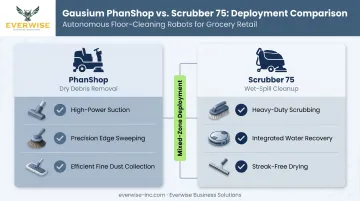
Most grocery floor plans need two kinds of attention: dry debris removal in high-traffic aisles, and wet-spill cleanup near produce and deli sections, where traditional wet mopping leaves puddles for 20+ minutes.
- Dry cleaning coverage: The Gausium PhanShop vacuums, sweeps, and dust mops in a single pass, leaving no residue behind
- Wet-scrub coverage: The Gausium Scrubber 75 runs a scrub, vacuum, and squeegee cycle, leaving floors dry and safe to walk on immediately
- Mixed-zone deployment: Many stores run both robot types on scheduled routes, covering dry aisles and spill-prone zones without added mop crews
The PhanShop's Zero-Distance Edge Cleaning feature uses high-precision sensors and side brushes to clean directly against shelving bases, produce display fixtures, and checkout counters — the exact spots where debris collects and mops typically miss.
Air Quality Enhancement Beyond the Floor
Floor cleanliness isn't the only air quality factor in a grocery store. Produce and deli sections generate airborne particulates that standard HVAC systems don't fully capture.
Select Gausium models include Medical-Grade Air Purification with an H13 HEPA filter, capturing fine dust and allergens as the robot moves through high-traffic zones. It's a secondary benefit that comes bundled with the primary cleaning function, no extra equipment required.
Key Operational Benefits for Grocery Store Operations
Autonomous cleaning affects far more than floor conditions, reshaping staffing schedules, compliance recordkeeping, and shopper perceptions of cleanliness. Retail-specific models like the Gausium PhanShop are built to handle these day-to-day realities in grocery environments.
- Round-the-clock coverage: Robots can clean during restocking hours or overnight, independent of staff availability or shift gaps
- Documented labor savings: One Gausium retail deployment across 25 robots at Greek grocer AB Vassilopoulos reported a 20% reduction in manual floor-cleaning time after rollout
- Compliance-ready logs: Timestamped digital cleaning records through the Gausium Mobile App support health inspections and liability defense in ways handwritten manual logs can't match
- Improved customer perception: Visible robotic cleaning during store hours signals active hygiene management, reinforcing shopper confidence in the store's cleanliness standards
- Data-driven maintenance: Coverage patterns from cleaning sessions help managers spot recurring problem zones, like a leaky freezer case or a high-spill produce table, before they become bigger issues
A single Vilnius grocery pilot with six IKI stores reported robots covering up to 400 square meters per hour with only 10-15 minutes of daily staff maintenance, according to Gausium's own case documentation. That's a small daily time investment for continuous, consistent coverage.
Bringing Autonomous Cleaning Into Daily Store Operations
Robots like the Gausium PhanShop free staff from repetitive scrubbing, letting them shift toward higher-value work:
- Responding to spills the moment they happen
- Restocking shelves during off-peak windows
- Handling customer questions and checkout support
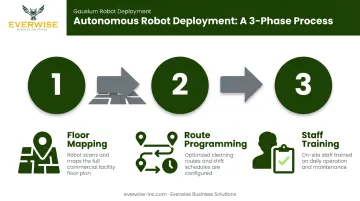
Getting a robot operational typically follows three phases:
- Floor mapping — Everwise's deployment team maps the store layout, marking aisles, fixtures, and no-go zones
- Route programming — cleaning schedules and paths are configured around store hours and traffic patterns
- Staff training — a short session covers daily upkeep, app navigation, and basic troubleshooting
If a robot gets blocked by an obstacle, like a forgotten pallet or a spilled display, it alerts staff through the Gausium Mobile App rather than sitting stuck. Regular technical servicing, including brush and filter checks, keeps performance steady over the robot's working life.
Choosing the Right Autonomous Cleaning Partner for Your Grocery Store
Not every robot fits every store. Before committing, grocery operators should evaluate:
| Criteria | Why It Matters |
|---|---|
| Floor area & layout complexity | Determines whether a compact model or enterprise-tier unit is needed |
| Surface types | Vinyl LVT, tile, and sealed concrete each require different cleaning modes |
| Safety systems | Robots must operate safely around customers during business hours |
| Data reporting | Coverage maps and cleaning logs matter for compliance and liability defense |
Weighing these factors against a vendor's actual product lineup is where many grocery operators get stuck. Everwise Business Solutions is the authorized Texas distributor of Gausium autonomous cleaning robots, serving grocery and retail operators across San Antonio, Austin, Dallas, Houston, and the Rio Grande Valley.
For grocery deployments specifically, Everwise typically recommends the Gausium PhanShop, a retail-channel variant built for supermarket floor plans and high-traffic aisles.
Beyond the sale, Everwise's maintenance program includes:
- Quarterly or semi-annual preventive maintenance visits covering brush wear, HEPA filter replacement, and sensor calibration
- On-demand emergency repair dispatch for fleet customers
- OEM spare parts to protect manufacturer warranty coverage
- Multi-store fleet management for grocery chains operating several Texas locations
Proper upkeep extends robot lifespan and keeps cleaning performance consistent, which matters far more to long-term ROI than the sticker price of the unit.
Frequently Asked Questions
Are the cleaning robots worth it?
For most operators, yes. Labor savings, reduced liability exposure, and consistent cleaning outcomes typically deliver payback within 12-36 months, especially when paired with flexible financing and maintenance support.
How do autonomous cleaning robots navigate a busy grocery store?
They use real-time obstacle detection and AI-based mapping to adjust their route around shoppers and carts without stopping. Models like the Gausium PhanShop are specifically tuned for aisle-and-endcap layouts common in supermarkets.
Do cleaning robots replace human cleaning staff in grocery stores?
No. Robots handle repetitive floor scrubbing, freeing staff to focus on spill response, restrooms, and customer-facing tasks that need a human touch.
How much does a commercial cleaning robot cost for a grocery store?
Costs vary based on robot size, store square footage, and whether you purchase or finance. Contact Everwise for a tailored quote based on your floor plan.
Can cleaning robots operate while the store is open to customers?
Yes. Most autonomous scrubbers include safety systems built for operating around shoppers during business hours, though many stores also schedule overnight runs for full coverage.
How long does it take to install and train staff on a grocery store cleaning robot?
Initial floor mapping and route setup usually take a few days. Staff training follows shortly after, and most stores reach full autonomous operation within one to two weeks.