Introduction
Commercial robotic floor cleaners now run overnight schedules in hospitals, hotels, office buildings, and schools — navigating complex layouts and completing full cleaning cycles without a single staff member present.
The global cleaning robot market was valued at $17.97 billion in 2025 and is projected to reach $41.5 billion by 2030. The International Federation of Robotics reported more than 25,000 professional cleaning robots sold globally in 2024 — a 34% year-over-year increase — with floor cleaning as the dominant application.
Yet most facilities managers evaluating these systems have a limited picture of what actually happens inside the machine. How does a robot decide where to go — and how does it know when the entire floor is done? What separates a commercial unit built for a hospital corridor from a consumer device that costs a tenth of the price?
This guide breaks down the navigation systems, sensor arrays, cleaning mechanics, and fleet management capabilities that drive modern commercial cleaning robots — so procurement decisions are grounded in how these machines actually work.
Key Takeaways
- Robotic vacuums use sensors, onboard AI, and motorized brushes to clean floors autonomously, without human guidance during operation.
- Modern commercial units build real-time spatial maps and follow systematic routes, replacing the random-bounce logic of early models.
- H13 HEPA filtration captures ≥99.95% of particles — a mandatory spec for healthcare and allergen-sensitive environments.
- Auto-recharge-and-resume allows unattended operation across large commercial floor plans.
- Commercial-grade robots deliver AI floor identification, multi-site fleet management, and enterprise-class filtration — capabilities built for facility-scale deployment.
What Is a Robotic Vacuum Cleaner?
A robotic vacuum cleaner is an autonomous floor-cleaning device — onboard sensors, computing, and motorized cleaning mechanisms let it operate without direct human control.
The operational gap it solves is straightforward: routine floor cleaning is labor-intensive, must happen frequently, and is difficult to staff consistently. In large commercial spaces — hotel corridors, hospital lobbies, school hallways — floor maintenance often falls behind schedule or gets deprioritized when staff are short.
What a robotic vacuum is not:
- A replacement for deep scrubbing or wet-floor maintenance (that's a separate machine category)
- A consumer convenience item — commercial-grade units are a different class of equipment entirely
- An early-generation random-bounce device — modern robots map their environment and plan routes systematically
The third point is the one that changes the procurement conversation. Early robots navigated by collision: bump into something, turn, continue. It worked, but coverage was uneven and cleaning times were long. Today's commercial robots operate from a digital map of the space, following planned paths that cover the entire floor efficiently.
Key Components of a Robotic Vacuum Cleaner
Understanding what's inside the machine makes it easier to evaluate specifications — and to know which specs actually matter for a given environment.
Sensors
The sensor array is what allows a robot to perceive and navigate its environment. Three sensor types do most of the work:
- Obstacle sensors (infrared or ultrasonic) detect walls, furniture, and objects in the robot's path
- Cliff sensors use downward-facing infrared beams to detect drop-offs like stairs and loading dock edges
- Dirt sensors (on select models) identify high-debris zones that warrant additional cleaning passes
Camera-based and LiDAR sensors add a layer beyond obstacle detection. Rather than simply reacting to what the robot runs into, these systems build a spatial map of the environment — enabling the robot to plan a route before it starts cleaning rather than figuring things out by collision.
The Gausium Phantas, for example, uses both 2D LiDAR and 3D depth cameras for real-time localization and 3D environmental perception. The Gausium Vacuum 40 v1.6 uses 3D depth cameras combined with AI — not just for navigation, but for its Intelligent Floor Identification system.
Brushes and Suction System
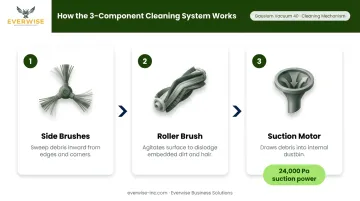
Three components work together during active cleaning:
- Side brushes rotate outward, sweeping debris from edges and corners toward the robot's center intake
- A central roller brush or extractor agitates the floor surface to dislodge embedded dirt and hair
- The suction motor pulls loosened debris into the internal dustbin
Suction power is measured in Pascals (Pa). Higher numbers indicate stronger vacuum pressure. The Gausium Vacuum 40 delivers 24 kPa (24,000 Pa) — strong enough to extract deeply embedded debris from carpet without damaging fibers. Advanced models automatically adjust their cleaning mode based on detected floor type, shifting between carpet vacuuming and hard-floor dust mopping without any manual input.
Filters and Dustbin
What the suction motor collects doesn't stay in the dustbin unchecked — it first passes through a filtration system before air is exhausted back into the room. Filtration specs rarely get the attention they deserve in procurement decisions, but in certain environments they determine whether the robot helps air quality or degrades it.
Standard filters catch larger particles. H13 HEPA filters — classified under EN 1822 at ≥99.95% integral efficiency at the most penetrating particle size (MPPS) — trap fine dust, allergens, bacteria, and airborne particles that standard filters miss.
In healthcare environments, allergen-sensitive offices, and food service spaces, this is not a premium feature — it is a baseline requirement. Both the Gausium Vacuum 40 and the Gausium Beetle carry H13 medical-grade HEPA filtration as standard equipment.
Dustbin capacity varies by model. Some advanced commercial units return to a workstation that automatically transfers debris into a larger reservoir, enabling true unattended multi-hour operation.
How a Robotic Vacuum Cleaner Works
A robotic vacuum operates through four sequential stages: activation, mapping and navigation, active cleaning, and controlled return to dock.
Activation and Setup
A cleaning session starts one of three ways:
- Manual command via app, voice assistant, or physical button
- A preset schedule programmed into the robot's interface
- An automated routine that runs without any trigger from facility staff
Commercial units typically run on overnight or off-hours schedules to avoid disrupting operations. On its first deployment in a new space, the robot conducts an initial mapping pass — scanning the environment and recording the layout before systematic route planning becomes possible.
Navigation and Mapping
Modern robots diverge from their predecessors most dramatically here.
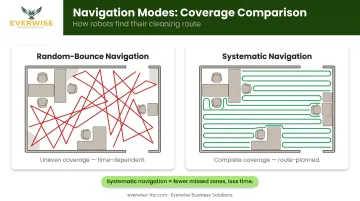
Random-bounce navigation (used in early and low-cost models) works reactively: the robot moves in a direction, hits an obstacle, changes course, and repeats. No map is built. Coverage depends on time rather than planning, and areas get cleaned unevenly.
Systematic navigation builds a digital map first. LiDAR systems emit laser pulses to measure distances and construct room outlines. Camera-based systems use visual landmarks to localize the robot within its map. Once the map exists, the robot plans a structured route — typically a grid or row-based path — that covers the full floor area methodically.
The practical difference: systematic navigation covers a space more completely and leaves fewer missed zones — in less time.
Commercial robots push this further. The Gausium Vacuum 40's 3D depth cameras and AI perform Intelligent Floor Identification in real time — automatically detecting hardwood, stone, marble, vinyl/LVT, and various carpet pile depths, then adjusting cleaning mode and brush height accordingly.
The Gausium Omnie takes a different approach: its AI-powered Auto Spot Cleaning detects spills and high-soil areas as they occur and concentrates cleaning effort there dynamically, rather than following a fixed route regardless of where soil actually exists. In unpredictable, high-traffic environments — hospital corridors during shift change, retail floors during open hours — that distinction drives real outcomes.
Core Cleaning Operation
During active cleaning, the three mechanical components work in coordination:
- Side brushes rotate outward, pulling debris toward the center intake
- The roller brush agitates the surface and loosens embedded dirt and hair
- Suction draws everything into the dustbin
On the Gausium Vacuum 40, this extends to a 3-in-1 operation: the robot simultaneously vacuums, sweeps, and dry-mops in a single pass. On carpet, it activates one of three cleaning intensities — Light, Medium, or Deep — based on detected pile depth and soil level. On hard floors, it shifts to sweeping and dust-mopping mode automatically.
When the robot encounters an obstacle mid-clean, its sensors detect the object, the onboard processor reroutes the path, and cleaning continues without leaving gaps in coverage.
Docking and Recharging
When battery levels fall below a threshold during a session, the robot stops cleaning, navigates autonomously back to its docking station, recharges, and then resumes from where it left off — no manual restart required.
The Gausium Vacuum 40 v1.6 uses its 3D depth camera navigation system to locate and dock with the compatible CD-01 charging dock autonomously. This auto-recharge-and-resume capability is what makes large-scale commercial deployment viable: the robot manages its own power cycle across an extended cleaning cycle without staff intervention.
Where Robotic Vacuums Are Used
Robotic vacuums perform best wherever floor maintenance needs to be consistent, frequent, and low-labor. Large, open floor plans with clear sightlines allow systematic navigation to operate at peak efficiency. Less clutter means fewer rerouting interruptions — and most commercial facilities run a mix of hard surface and low-pile carpet that aligns directly with what commercial-grade units are built to handle.
Environments where commercial robotic vacuums are actively deployed:
| Vertical | Primary Use Case |
|---|---|
| Hospitality | Guest corridors, lobby transitions, back-of-house |
| Healthcare | Corridors, lobbies, waiting rooms, cafeterias |
| Education | High-traffic hallways, classrooms |
| Retail | Store aisles, common areas, shopping center floors |
| Commercial Office | Open-plan floors, corporate campuses |
| Warehousing / Distribution | Large-area aisle cleaning between shifts |
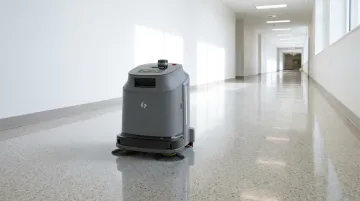
The gap between consumer and commercial-grade equipment is wider than most buyers expect. A Roomba manages a 1,500 sq ft apartment. The Gausium Vacuum 40 — deployed in hotel corridors, hospital lobbies, and multi-floor office buildings — carries H13 HEPA filtration, 24 kPa suction power, multi-surface AI identification, and remote fleet management via the Gausium Mobile App. Those specs exist because the operating environment demands them.
Texas facilities procurement teams working through Everwise Business Solutions — the authorized Gausium distributor for the state — get full deployment, commissioning, OEM spare parts, and ongoing preventive maintenance as part of the package.
Conclusion
A robotic vacuum is a sensor-driven, AI-guided system that maps its environment, plans a cleaning route, adapts to surface conditions, handles obstacles, and manages its own recharge cycle — all without requiring a staff member to supervise any of it.
That understanding changes how procurement decisions get made. A facilities manager who knows the difference between random-bounce and systematic navigation can evaluate coverage quality instead of defaulting to price. Understanding H13 HEPA classification means specifying filtration requirements that actually match a compliance environment. Knowing what auto-recharge-and-resume enables means calculating floor coverage per shift — and building a labor-cost comparison from real numbers rather than vendor claims.
The technology is mature enough to deploy at scale across commercial facilities. What determines deployment success is matching the model, filtration standard, and navigation tier to the specific environment being cleaned — and for Texas facilities evaluating commercial-grade options, that's precisely where the Gausium lineup and Everwise's deployment expertise are worth a closer look.
Frequently Asked Questions
Where does the dirt go in a robot vacuum?
Debris is drawn through the suction intake into an internal dustbin, where it is trapped by a filter before exhaust air returns to the room. The bin requires periodic emptying. On models connected to a self-emptying workstation, contents transfer automatically into a larger reservoir.
Are robot vacuums actually worth it for commercial use?
Commercial models can offset $40,000–$70,000+ in annual FTE costs, with payback periods typically ranging from 18–36 months depending on facility size and shift count. Consistent daily cleaning reduces labor dependency across medium-to-large spaces, making the ROI case straightforward for most operations.
How often should a commercial robot vacuum run?
High-traffic spaces — hospital lobbies, hotel corridors, retail floors — benefit from daily runs, sometimes multiple times per shift. Lower-traffic areas may only need scheduled cleaning a few times per week. Most commercial models support programmable schedules via a remote management app.
How does a robot vacuum know where to go?
The robot uses its sensor array and onboard processor to build a real-time spatial map, then plans a systematic route covering the full area. LiDAR and 3D depth camera systems provide the most accurate navigation. Basic models rely on reactive bump-and-turn logic, which covers space less efficiently.
Can robotic vacuums handle different floor types automatically?
Advanced models use sensors or AI to detect the current surface — hard floor, low-pile carpet, deep-pile carpet — and automatically adjust suction intensity, cleaning mode, and brush height. The Gausium Vacuum 40 v1.6 identifies surface type in real time via 3D depth cameras and AI, shifting between three carpet cleaning intensities without manual input.
How do commercial robotic vacuums differ from consumer models?
Commercial units are engineered for larger coverage areas, longer run times, H13 HEPA filtration, AI navigation, and enterprise fleet management. They also pair with commercial support infrastructure: factory-trained deployment, preventive maintenance contracts, and OEM spare parts.