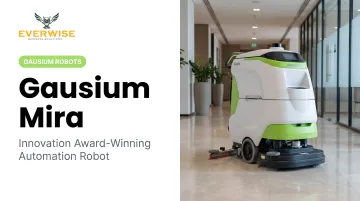
The Gausium Mira was built to reject that compromise entirely. At ISSA Show North America 2025 — the cleaning industry's largest global trade event, drawing more than 600 exhibitors from over 70 countries — Mira won Innovation of the Year in the Automation & Equipment category, validating an architecture that most of the industry hasn't attempted.
This article breaks down what makes Mira different, who it's designed for, and whether it's the right fit for your facility.
Key Takeaways
- Mira uses a dedicated two-stage architecture: dry sweeping happens first, wet scrubbing second — they never overlap
- Fits aisles larger machines can't reach, with a 26-inch minimum pass width that works where full-size scrubbers won't
- The self-cleaning wastewater tank reduces daily maintenance to a single tank drain
- It won ISSA's Innovation of the Year award (Automation & Equipment) at ISSA Show North America 2025
- Texas facilities get local sales and support through Everwise Business Solutions, Gausium's authorized Texas distributor
Gausium Mira: An Award-Winning Leap in Autonomous Cleaning
Gausium built the Mira from the ground up as a purpose-built mid-sized commercial floor scrubber, not a retrofit of an earlier design. Gausium designed it specifically for mid-sized commercial environments: retail stores, supermarkets, healthcare outpatient facilities, logistics hubs, and transportation terminals. These are spaces with tight aisle constraints, mixed debris types, and cleaning schedules that can't depend on consistent staffing.
What the ISSA Award Actually Means
ISSA Show North America is the premier global event for the cleaning and facility management industry. The Innovation of the Year award in Automation & Equipment recognizes technologies that measurably reshape safety, efficiency, hygiene, and sustainability — in a competitive field that includes entries from manufacturers worldwide.
Peter Kwestro, Gausium's Global Strategic Marketing and Business Development Director, stated upon receiving the award: "We're very proud to remain at the forefront in a field filled with innovation."
Mira's recognition built over time. ISSA's Innovative Leaders Program featured "Gausium Mira with Gausium Leaves" in its Innovation Showcase & Theater before the award was announced. Since then, the product has appeared at every major industry platform where facility managers evaluate new equipment:
- CMS Berlin 2025 — European debut for the commercial cleaning sector
- NRF 2026 Retail's Big Show — Booth 2559, Jacob K. Javits Convention Center
- Interclean Amsterdam 2026 — Part of Gausium's full lineup showcase
The Problem Most Cleaning Robots Get Wrong
Most autonomous floor scrubbers on the market use a single cylindrical roller brush that simultaneously sweeps debris and scrubs the surface, often assisted by side brushes. It's a reasonable engineering shortcut — one component does two jobs, the machine stays compact, and it works acceptably in many environments.
The problem surfaces when you look at what actually happens at floor level.
The Wet-Sweep Trap
When a single roller sweeps and scrubs at the same time, water hits the floor at the exact moment the roller is trying to capture dry debris. Dust, crumbs, and fine particles get wet on contact. Instead of being collected cleanly, they form a slurry — wet sludge that's harder to empty, and a recovery tank picking up particulate matter it was never designed to handle.
As Tennant's own brush comparison research notes, cylindrical machines are often preferred in industrial settings for their simultaneous sweep-and-scrub capability — but that convenience is the trade-off. A roller built for sweeping (aggressive bristle action, debris fling) isn't the same tool as one built for scrubbing (consistent downward pressure, surface contact).
That trade-off plays out in predictable ways on the floor:
- Debris tray fills with slurry instead of dry material
- Recovery tank collects particulate matter, increasing contamination
- Squeegees and filters wear faster from particulate-laden recovery liquid
- The floor being "scrubbed" still has wet debris smeared across it
Mira's Two-Stage Cleaning Architecture Explained
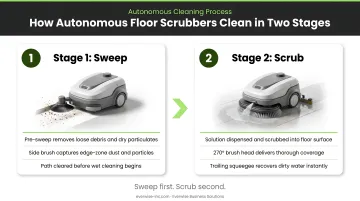
Mira's core engineering decision is deceptively simple: separate the two cleaning functions entirely so each can be optimized on its own terms.
Stage 1 — Dry Sweep: A dedicated front roller brush, fed by side brushes, captures dust, dirt, and loose debris into a built-in debris tray. No water reaches the floor during this stage.
Stage 2 — Wet Scrub: Once the floor has been swept, the rear disc-brush deck applies cleaning solution and scrubs the surface.
Why Disc Brushes for Scrubbing
Gausium's engineering rationale for the scrubbing deck specifically uses disc brushes rather than a cylindrical roller. According to Tennant's independent brush comparison data, disc brushes are preferred for flat surfaces including VCT, sheet vinyl, and polished concrete — the hard floors that dominate commercial environments. Disc brushes provide superior contact-area performance on these surfaces compared to cylindrical rollers, and since the roller in Mira is reserved purely for sweeping, the scrub deck can be optimized entirely for scrubbing.
Published Specifications
| Specification | Measurement |
|---|---|
| Scrubbing width | 400 mm / 15.7 in |
| Sweeping width | 750 mm / 29.5 in |
| Clean water tank | 22 L / 5.8 gal |
| Wastewater tank | 20 L / 5.3 gal |
| Max scrubbing efficiency | 2,016 m²/h / 21,700 ft²/h |
| Min pass width | 660 mm / 26.0 in |
Those numbers reflect what's possible when the cleaning stages don't interfere with each other. Keeping dry debris out of the wet system produces compounding operational benefits:
The Operational Cascade
- Debris tray empties cleanly into a bin (not rinsed slurry)
- Wastewater stays cleaner because fine particles never reach the recovery solution
- Squeegees and filters last longer with cleaner recovery liquid
- The disc brushes scrub a floor that has actually been cleared first
Self-Cleaning Wastewater Tank
One of the most consistent hidden labor costs with autonomous floor scrubbers is the time operators spend rinsing and drying the recovery tank after each use. Mira includes an Auto Tank Flushing and Auto Suction System Rinsing feature that automatically rinses the dirty water tank and suction pathway — reducing dirt buildup, odors, clogs, and residue without operator intervention.
It addresses the daily maintenance burden that operators inherit when they deploy autonomous cleaning equipment — and removes a task that otherwise falls through the cracks between shifts.
Key Features That Set the Gausium Mira Apart
26-Inch Aisle Clearance
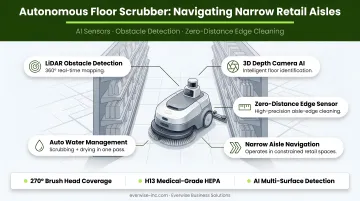
Mira's 660 mm / 26.0-inch minimum pass width lets it operate where larger autonomous machines physically cannot: grocery store aisles, retail end-caps, narrow hospital corridors, and tight logistics pathways. That compact footprint still accommodates the full dual-stage cleaning architecture — a notable engineering constraint to solve at this size.
Gausium Leaves Integration
Mira is optimized to pair with Gausium Leaves, a seaweed-based, water-soluble cleaning sheet system. Each Leaf makes 2.3 L of concentrate, diluted into a 1–2% cleaning solution. The environmental numbers stand on their own:
- Plastic-free, with no microplastics or PVOH content
- 100% biodegradable, zero-waste packaging
- Up to 95% reduction in CO₂ emissions compared to conventional cleaning agents
- Up to 80% cost savings on cleaning chemicals
ISSA's Innovative Leaders Program specifically featured the "Mira with Gausium Leaves" pairing — the sustainability profile was a direct factor in the award judges' decision.
Navigation and AI
Mira navigates using a layered sensor stack designed for dynamic, people-occupied environments:
- 3D perception sensors for spatial awareness in crowded spaces
- LiDAR for precise localization and path planning
- Ultrasonic sensors for close-range obstacle detection
It also supports "Drop & Go" deployment — no professional mapping, complex configuration, or technical expertise required before first use. When a space layout changes, Mira adapts in real time without manual remapping.
For facilities where shelving moves, seasonal displays rotate, or floor traffic shifts regularly, that means no scheduling IT involvement every time the layout changes.
Which Industries and Facilities Benefit Most
Mira is designed for mid-sized commercial spaces where floors receive mixed debris — both dry material and liquid spills. It sits between Gausium's larger Marvel (better suited to large industrial spaces) and compact models like the Phantas (more appropriate for smaller boutique environments).
Primary fit environments:
- Supermarkets and grocery stores
- Retail stores and pharmacies
- Healthcare outpatient facilities and clinics
- School common areas and corridors
- Transportation hubs and airport terminals
Where Mira delivers the clearest value:
- Facilities where staff currently perform a manual pre-sweep pass before running a scrubber (Mira eliminates that step)
- Facilities with 26-inch-wide aisles that have historically excluded autonomous equipment
- Facilities where nightly cleaning must run consistently with minimal staffing
For facilities running multiple cleaning passes per night across thousands of square feet, that labor overhead drops directly when a robot handles routine floor work on its own.
According to BSCAI, labor typically represents 50–80% of the total cost in a commercial cleaning bid. For facilities running multiple cleaning passes per night across thousands of square feet, that labor overhead drops directly when a robot handles routine floor work on its own.
Texas facilities can access Mira through Everwise Business Solutions, the authorized Gausium distributor serving businesses across the state — from hospitals and hotels to retail locations, schools, and manufacturing facilities. Everwise provides local support for deployment, maintenance, and integration. Contact them at 210.884.0559 or german.zavala@everwise-inc.com to evaluate whether Mira is the right fit for your specific space.
The Operational Business Case for Deploying the Gausium Mira
Labor Reallocation
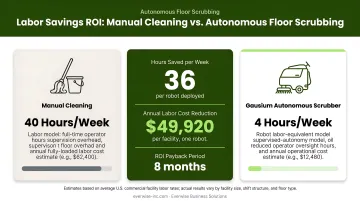
When a robot handles both sweeping and scrubbing — including remote deployment initiation and automatic tank rinsing — staff who previously performed or supervised those tasks can redirect their time toward customer-facing work, detail cleaning, and tasks that require human judgment. The hours that once went to repetitive, schedulable floor care get redirected to higher-value work instead.
The math is real at scale. A Tennant case study from a grocery retailer deploying autonomous scrubbers across roughly 90 stores documented 33,649 cumulative labor hours saved in 2024, with an estimated annual value of $2,120,400. These are benchmark figures from a comparable deployment context — not Mira-specific data — but they illustrate the order of magnitude available when autonomous floor care replaces manual routines at multi-location scale.
Maintenance Economics
Because Mira's two-stage architecture keeps dry debris separate from the cleaning solution, the recovery system, filters, and squeegees operate with cleaner liquid every cycle. Particulate-laden slurry — the byproduct of single-roller wet-sweep systems — accelerates wear on every component it touches. Mira's architecture reduces that contamination load by design, which logically extends the useful life of consumables. For specific maintenance interval data based on your facility type and usage patterns, Everwise Business Solutions can provide direct guidance.
Consistency as a Business Asset
Beyond mechanical and economic factors, there's an operational reliability argument: autonomous robots clean on a predictable schedule, to a consistent standard, regardless of staffing shortages, shift handoffs, or human fatigue. For healthcare facilities where floor hygiene directly affects patient safety and compliance, and for hospitality environments where floor appearance shapes guest perception, that consistency has measurable downstream value that goes beyond labor cost savings alone.
A robot that cleans at 2 a.m. every night — to the same standard it cleaned last Tuesday — removes a category of variability that facility managers currently manage around.
Frequently Asked Questions
How much does the Gausium Mira cost?
Mira pricing is quote-based and varies by market and configuration. There is no published MSRP. Texas facilities should contact Everwise Business Solutions at 210.884.0559 or german.zavala@everwise-inc.com for a quote tailored to their specific space and requirements.
Do Gausium Mira robots clean windows?
No. The Gausium Mira is a commercial autonomous floor scrubber — it sweeps and scrubs hard floor surfaces. Gausium's product portfolio covers floor cleaning applications, not window or façade cleaning.
What floor types is the Gausium Mira compatible with?
Mira is designed for hard floor surfaces common in commercial settings. Its disc-brush scrubbing deck handles tile, polished concrete, VCT, sheet vinyl, and epoxy-coated floors.
How does Mira handle obstacles and people in the space?
Mira uses 3D perception sensors, LiDAR, and ultrasonic sensors to detect and navigate around obstacles and people in real time. Its "Drop & Go" deployment means it adapts to layout changes without manual remapping — no downtime for reconfiguration.
How often does the Gausium Mira need maintenance?
Mira's self-cleaning wastewater tank reduces daily maintenance touchpoints compared to machines that require manual tank rinsing after each use. Everwise Business Solutions provides scheduled maintenance support for Texas customers — contact them at 210.884.0559 to confirm the right service interval for your usage.
Can the Gausium Mira replace manual cleaning staff entirely?
No. Mira handles routine floor sweeping and scrubbing on a consistent, autonomous schedule — freeing staff to focus on detail cleaning, customer interaction, and work that requires human judgment. It removes the repetitive, schedulable floor care tasks from staff workloads, not the staff themselves.