According to CDC data, roughly 1 in 31 U.S. hospital patients has at least one healthcare-associated infection on any given day. That's not a system failure — it's a structural vulnerability baked into manual cleaning's inherent limitations.
Autonomous cleaning robots are changing that equation. Already deployed across major U.S. hospital networks, these machines deliver consistent, precision floor cleaning around the clock — freeing environmental services (EVS) staff to focus where human judgment matters most.
This article covers why traditional cleaning falls short, what hospital cleaning robots actually do, the key benefits and features to prioritize, and how to implement them successfully.
Key Takeaways
- 1 in 31 hospital patients has a healthcare-associated infection on any given day (CDC)
- Only 49% of high-risk objects were cleaned in a landmark 23-hospital audit — robots close that gap through repeatable, documented coverage
- Autonomous robots complement EVS staff; they don't replace them
- H13 HEPA filtration and SLAM navigation are non-negotiable features for hospital environments
- Payback periods of 14–24 months are achievable with the right deployment model
Why Traditional Hospital Cleaning Falls Short
The Staffing Crisis in Environmental Services
Hospital EVS departments are chronically understaffed. The work is physically demanding, turnover is high, and coverage gaps cluster on overnight and weekend shifts — the same hours when infection risk runs uninterrupted. The VHA reported 2,959 severe occupational staffing shortages across its facilities in FY2024, signaling a system-wide labor pressure that extends well beyond any single hospital.
With a national median wage of $16.08/hour for housekeeping cleaners, these roles are difficult to fill and even harder to retain. The result: coverage gaps, stretched teams, and cleaning that gets rushed.
Understaffing alone doesn't explain the full problem. Even when staff are present, fatigue and rushed protocols introduce a separate, measurable risk.
Inconsistency Is the Core Problem
Human fatigue is unavoidable. Rushed protocols, missed surfaces, and inconsistent technique directly create conditions where pathogens survive and spread.
A 23-hospital audit found that only 49% of high-risk objects were cleaned during terminal cleaning. A more recent teaching-hospital study put the overall cleaning rate at 63%, with specific surfaces performing worse:
- Light switches: cleaned only 55% of the time
- Bedrails: 56%
- Bedside table edges: 57%
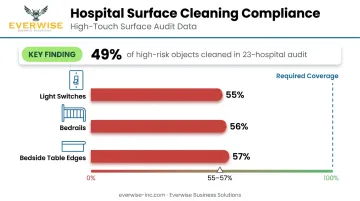
These aren't obscure surfaces — they're the ones patients and staff touch constantly. At those compliance rates, pathogen transfer isn't a theoretical risk — it's a near-daily event.
Operational Pressure Points Unique to Hospitals
Hospitals don't close. ICUs and emergency departments run 24/7, and cleaning protocols shift dramatically between zones — a consultation room requires different handling than a post-surgical area. When EVS coverage falters:
- Infection risk climbs in high-traffic corridors and waiting rooms
- Surgical procedures get delayed due to inadequate room turnover
- HCAHPS cleanliness scores drop, affecting public ratings and reimbursement
- Reputational damage compounds over time
These pressures explain why hospital systems across Texas are looking beyond manual protocols — and why autonomous cleaning robots are entering the EVS conversation.
What Are Hospital Cleaning Robots?
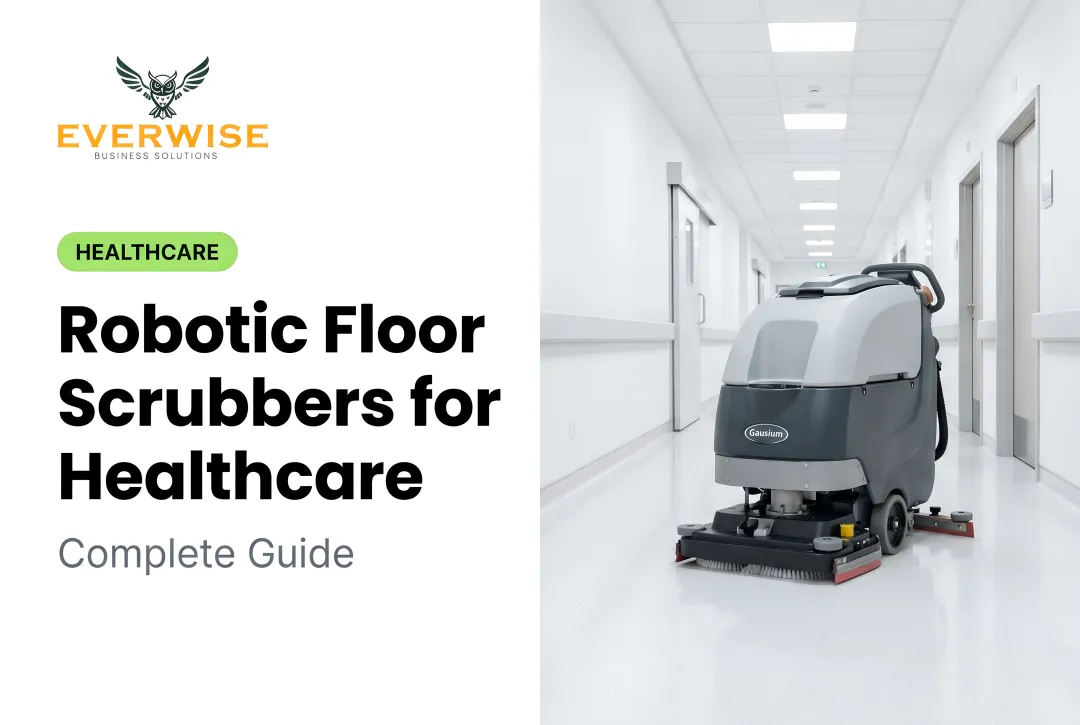
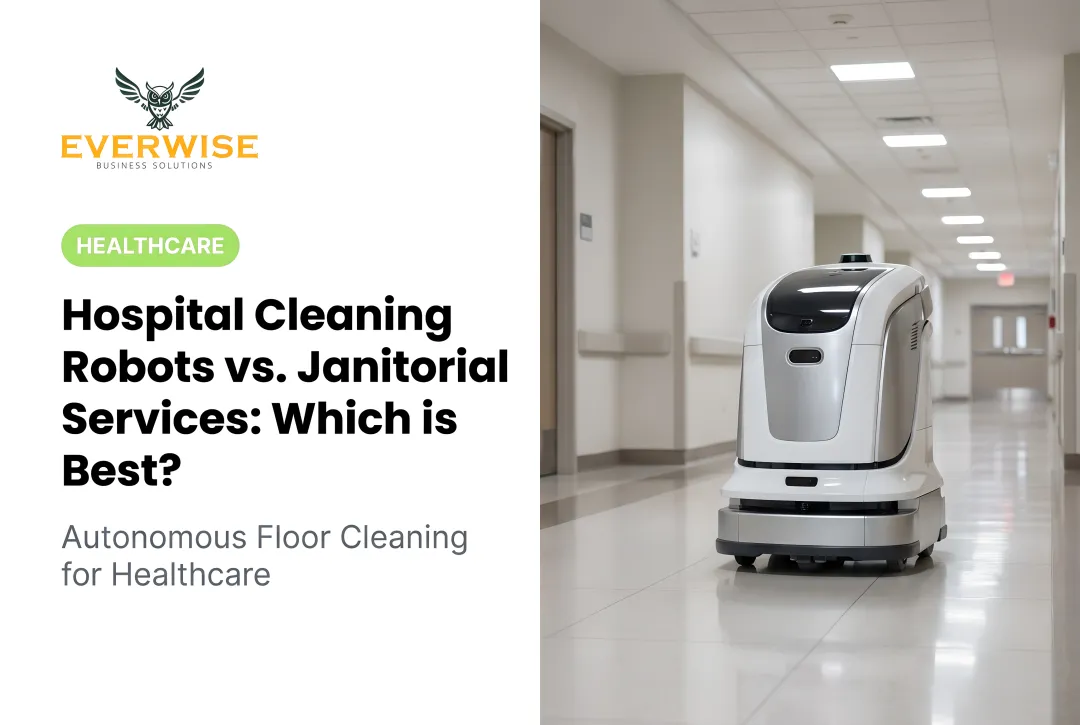
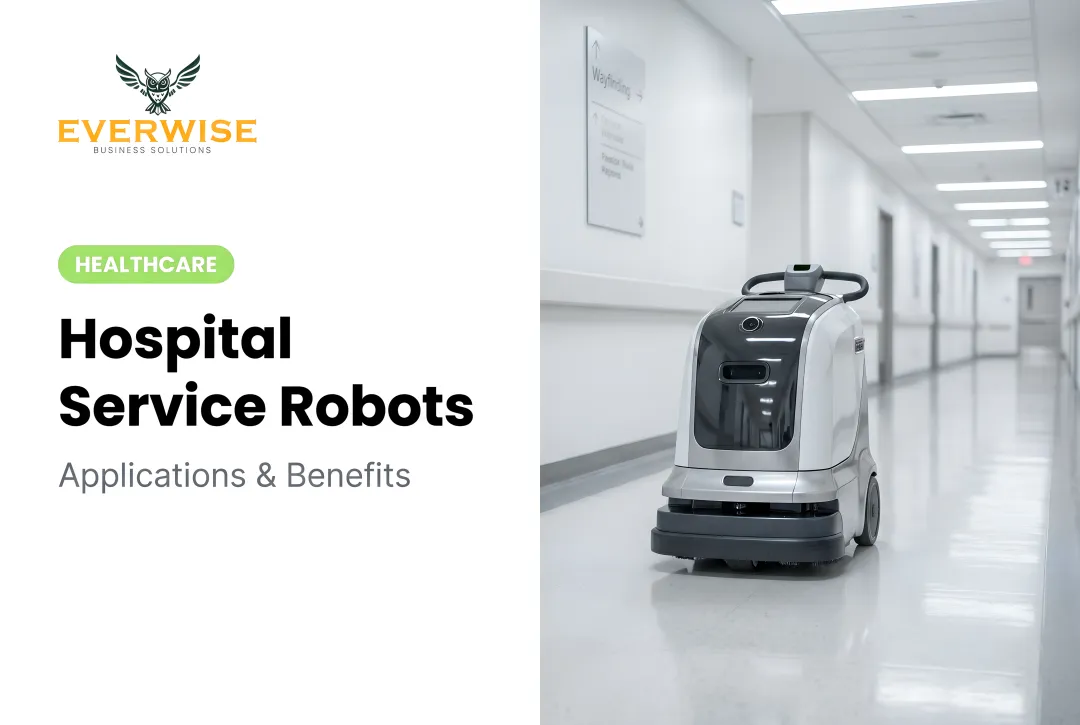
Autonomous hospital cleaning robots are AI-powered machines that use SLAM (simultaneous localization and mapping), 3D depth cameras, and onboard sensors to independently navigate, map, and clean facility floors with no constant human supervision required.
Depending on the model, they can sweep, scrub, vacuum, dry, and filter the air in a single pass. They return to their docking stations to recharge autonomously and resume cleaning tasks once powered back up — enabling multi-shift coverage with minimal staff intervention.
These robots are not designed to replace EVS staff. They handle repetitive floor-cleaning routes, freeing human teams for high-touch surface disinfection, patient room deep cleans, and tasks that require human judgment.
In healthcare, deployment is scoped to specific areas:
- Corridors and lobbies — high-traffic zones suited to automated repeat passes
- Cafeterias and waiting rooms — large open floors with predictable layouts
- Back-of-house areas — service corridors and utility passages
Patient rooms and operating theaters fall outside this scope. Those environments require sterile-field protocols that autonomous floor robots are not designed for.
Key Benefits of Robotic Cleaning in Hospitals
Consistent, Around-the-Clock Performance
Robots follow identical programmed cleaning paths every shift — whether it's 2 PM or 2 AM. There's no fatigue, no shortcuts, and no variance caused by a short-staffed overnight crew.
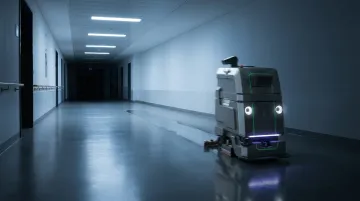
A top-five U.S. hospital network deployed robotic scrubbers and reduced human floor-scrubbing hours by 50% while covering approximately 50,000 sq ft per shift, per third-party deployment data. Industry benchmarks show robotic floor cleaners can operate up to 13 hours a day, with automated scrubbing running up to 64% faster than traditional mop-and-bucket methods.
For EVS directors, this translates directly into measurable coverage data — not assumptions.
Smarter Labor Allocation
The financial case for robots isn't just about labor savings — it's about labor redeployment. When a robot handles corridor floor cleaning across three shifts, EVS staff can concentrate on:
- High-touch surface disinfection (bedrails, IV poles, sink handles)
- Patient room turnover between admissions
- Specialized cleaning in clinical areas requiring human oversight
Distributor modeling from Imperial Dade projects a 16.5-month payback on a $58,000 autonomous scrubber deployment (assuming a $32.50/hour loaded labor rate and 35,000 sq ft cleaned twice daily), with a seven-year ROI of $238,100. Bunzl Canada's analysis cites a 14–24 month payback range with robotic coverage rates of 98–99.5% versus humans missing approximately 15% of space.
These figures are distributor models — any hospital should recalculate using local loaded labor rates and actual route sizes.
Reduced Chemical and Water Use
Robotic scrubbers apply cleaning solution only where needed, controlling dispensing precisely and recovering dirty water in a single pass. Industry data from Imperial Dade indicates autonomous scrubbers use 40–70% less water than traditional autoscrubbers — which cuts both runoff and chemical disposal costs in one operational change. The Gausium Scrubber 75, for example, is engineered specifically for this type of high-frequency, controlled-dispensing deployment in large commercial facilities.
HCAHPS Cleanliness and Patient Confidence
The operational gains above have a direct patient-facing consequence: cleanliness scores. Cleanliness isn't just a hygiene issue — it's a patient experience metric. CMS includes cleanliness directly in HCAHPS scoring, and a 2024 peer-reviewed study found that as the percentage of patients reporting their room was "never" clean increased, hospital HAC scores increased (r = 0.175).
Robots cleaning lobbies and corridors during peak hours make cleanliness observable — and observable cleanliness influences how patients rate their experience. For hospital systems tied to HCAHPS reimbursement thresholds, that's a measurable financial exposure, not just a reputation concern.
Essential Features to Look for in a Hospital Cleaning Robot
Not all autonomous floor cleaners are built for healthcare environments. These are the features that separate a capable hospital robot from a commercial floor cleaner repurposed for healthcare.
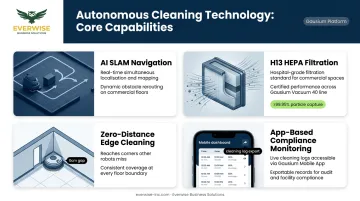
AI-Powered SLAM Navigation
Hospital corridors don't stay static. Nursing carts, patient transport, visitor foot traffic, and staff movement create a constantly shifting obstacle landscape, especially during shift changes.
Robots must use SLAM combined with real-time AI navigation to remap dynamically, detect obstacles, and reroute without stopping or requiring human intervention. Static, pre-programmed path robots struggle in live hospital environments. Look for models specifically designed for high-dynamic environments.
The Gausium Omnie, available through Everwise Business Solutions in Texas, is purpose-built for exactly this scenario. Its AI-powered Auto Spot Cleaning detects spills and high-soil areas in real time and concentrates cleaning there— not a fixed route that may be blocked or already clean.
H13 HEPA Medical-Grade Filtration
Standard vacuum motors recirculate fine particles back into the air. In a hospital, that means redistributing allergens, mold spores, and bacteria through corridors and waiting areas.
H13 HEPA filters capture ≥99.95% of particles at MPPS (most penetrating particle size) under EN 1822 classification. This threshold matters for respiratory units, ICUs, and high-traffic clinical corridors. The CDC recommends HEPA-equipped vacuums for high-risk healthcare areas specifically.
For hospital buyers: require vendors to document the filter class, test standard, and whether the system uses a sealed air path that keeps all airflow through the filter, not around it.
The Gausium Vacuum 40 carries H13 medical-grade HEPA filtration as a standard feature, not an optional add-on.
Zero-Distance Edge Cleaning
Floors along walls, room perimeters, and corners are prime zones for pathogen accumulation: exactly where many robots underperform. A robot that cleans 98% of open floor but misses every wall edge creates a predictable, repeatable contamination risk.
Look for high-precision sensors and side brushes that clean flush against walls. The Gausium Phantas achieves documented 0cm-from-edge cleaning — the most specific edge gap specification in the Gausium lineup.
Intelligent Floor Identification
Hospital common areas frequently transition between tile, vinyl, LVT, and carpet within a single corridor. A robot that requires manual reconfiguration at each transition isn't viable for multi-shift autonomous operation.
Robots with AI-powered floor identification automatically detect surface type and adjust brush height, suction, and cleaning mode accordingly. The Gausium Vacuum 40 uses 3D depth cameras and AI to detect hardwood, stone, multiple carpet pile depths, vinyl, and tile, switching modes without staff intervention.
Real-Time Monitoring and Cleaning Documentation
Facility managers need more than a clean floor. They need documented proof of what was cleaned, when, and with what coverage — verifiable records that hold up during Joint Commission surveys, CMS compliance reviews, and internal audits.
Robots with app-based management should generate cleaning logs that function as compliance records. Gausium's Mobile App, available across the Omnie, Vacuum 40, Scrubber 75, and Marvel, covers the full EVS documentation workflow:
- Real-time cleaning status monitoring from any device
- Remote scheduling across single or multi-robot deployments
- Automated status alerts for interruptions or task completion
- Cleaning log export for Joint Commission and CMS reporting
How to Successfully Implement Cleaning Robots in Your Hospital
Step 1: Conduct an Operational Assessment
Before purchasing, document your current EVS workflows:
- Identify the highest-traffic zones (main corridors, lobbies, cafeterias, waiting rooms, and back-of-house areas) where robots will deliver the fastest measurable impact
- Map floor types across each zone — tile, vinyl, carpet, concrete
- Establish baseline metrics: labor hours per shift, cleaning completion rates, chemical and water usage per route
Compare this baseline against post-deployment results to calculate ROI.
Step 2: Run a Structured Pilot Before Full Rollout
Deploy robots in one defined zone first. A pilot gives you:
- Real navigation performance data on your specific floors and layouts
- Staff feedback on workflow integration
- Measured cleaning outcomes to validate vendor claims
- Route optimization data before scaling facility-wide
Address staff concerns upfront. Robots handling corridor floors free EVS teams for higher-value tasks like terminal cleaning, restocking, and patient-area support. That's a concrete, defensible message to lead with.
Step 3: Calculate Total Cost of Ownership
The purchase price is one line item. The full TCO calculation includes:
| Cost Component | Notes |
|---|---|
| Purchase or lease price | CapEx or OpEx treatment; Section 179 and bonus depreciation typically apply — confirm with your tax advisor |
| Maintenance contracts | Quarterly or semi-annual PM visits, OEM parts, HEPA filter replacement |
| Software updates | Included in ongoing support with authorized distributors |
| Staff training | Factor in initial onboarding and ongoing EVS team training |
| Projected labor savings | Based on local fully-loaded EVS labor rates |
| Chemical and water reduction | Measure in pilot; robots consistently achieve 40–70% water reduction in documented pilots |
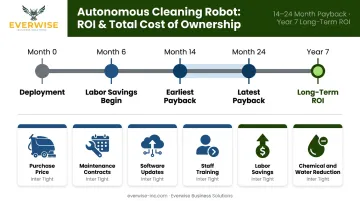
Documented payback ranges of 14–24 months are achievable, but recalculate with your facility's actual numbers rather than industry averages.
Choosing the Right Robot and Partner for Your Hospital
Selecting the right robot is only half the decision — the implementation partner determines whether that robot delivers long-term results or collects dust in a supply room.
Hospitals need a vendor who provides site assessment, staff training, ongoing maintenance, emergency repair dispatch, and parts availability. An authorized distributor also ensures manufacturer-certified support, OEM spare parts, and access to the latest software updates.
Everwise Business Solutions, headquartered in the Rio Grande Valley (Pharr) with statewide operations across San Antonio, Austin, Dallas, and Houston, is the authorized Texas distributor of Gausium autonomous cleaning robots. Their maintenance program covers hospital deployments under a single service contract:
- Scheduled preventive maintenance visits
- H13 HEPA filter replacement
- Sensor calibration and battery health checks
- Fleet management support for multi-unit deployments
- On-demand emergency repair dispatch and OEM parts replacement
For Texas hospital systems evaluating autonomous floor cleaning, Everwise offers onsite healthcare demos and proof-of-concept deployments, with custom pricing available for multi-facility rollouts. Contact them directly:
Phone: 210.884.0559 Email: german.zavala@everwise-inc.com Hours: Monday–Friday, 9 AM–6 PM
Frequently Asked Questions
Are there robots that clean hospital floors?
Yes — autonomous cleaning robots are actively deployed across U.S. hospital networks today. They handle floor scrubbing, vacuuming, and common-area cleaning in corridors, lobbies, cafeterias, and waiting rooms. Patient rooms and sterile environments require different protocols and fall outside the typical deployment scope.
What is a hospital cleaning robot called?
The most common terms are autonomous floor scrubber and robotic floor cleaner. Some manufacturers use co-botics to highlight human-robot collaboration, while others use AMR (autonomous mobile robot) or environmental services robot depending on their product positioning.
How much do hospital cleaning robots cost?
Costs vary based on size, features, and capabilities. Distributor models place entry points around $58,000 for a single autonomous scrubber, with payback periods of 14–24 months under realistic labor assumptions. Evaluate total cost of ownership — including maintenance, parts, and training — alongside projected labor and chemical savings.
Do hospital cleaning robots replace human cleaning staff?
No. Robots are designed to complement EVS teams, not replace them. They handle repetitive floor-cleaning routes so environmental services staff can focus on high-touch surface disinfection, patient room turnover, and tasks requiring human judgment and accountability.
How do cleaning robots help reduce healthcare-associated infection risk?
Robots eliminate the variability caused by human fatigue and short-staffing by following identical cleaning protocols every shift — including commonly missed zones. H13 HEPA-equipped models also capture fine airborne particulates that standard vacuums recirculate, reducing the airborne particulate load in corridors adjacent to patient care areas.
What should hospitals look for when choosing a cleaning robot?
Key features to evaluate:
- AI-powered SLAM navigation for dynamic, high-traffic hospital corridors
- H13 medical-grade HEPA filtration for airborne particulate control
- Zero-distance edge cleaning for thorough perimeter coverage
- Intelligent floor identification across mixed-surface corridors
- App-based monitoring with cleaning logs for Joint Commission and CMS compliance support