Introduction
Hotels are under pressure from multiple directions at once. Labor costs per available room rose 11% in 2024, with room-attendant overtime increasing another 4.9% in 2025. Meanwhile, 76% of surveyed hotels report staffing shortages, and 79% can't fill open positions — numbers that haven't meaningfully improved since 2022.
Guests haven't adjusted their expectations to match. Response times and cleanliness still drive reviews — and a staffing gap on a busy night shows up directly in ratings the following morning.
Hotel service robots are often treated as a novelty — something to photograph in a lobby. The real case for them is more practical: they absorb the repetitive, high-volume tasks that strain understaffed teams, and they do it consistently regardless of the hour or how busy the property gets.
This article covers what hotel service robots actually do, which operational advantages connect to measurable outcomes, and where they deliver the clearest return on investment.
Key Takeaways
- Hotel service robots handle repetitive tasks — cleaning, delivery, guest inquiries — so staff can focus on meaningful guest interactions.
- Operational consistency, labor cost control, and faster service delivery are the primary gains hotels see from robotic adoption.
- Cleaning robots address one of the costliest, hardest-to-staff functions in hotel operations.
- Robots handle the operational load so human staff can deliver the kind of service guests actually remember.
- Delayed adoption shows up fast — slower service, higher overtime costs, and inconsistent standards when demand peaks.
What Are Hotel Service Robots?
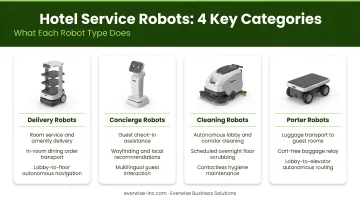
Hotel service robots are autonomous or semi-autonomous machines built to perform specific, repeatable tasks — physical robots that move through the property and AI-powered systems that handle communication.
The main categories:
- Delivery robots — transport amenities, room service items, and supplies between floors and guest rooms
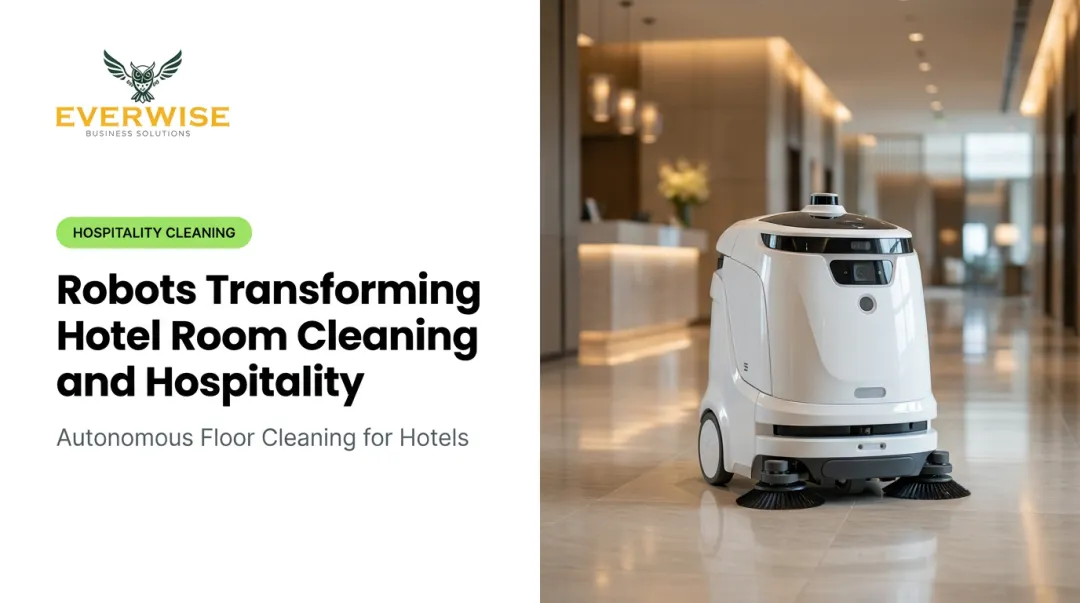
- Cleaning and housekeeping robots — autonomous vacuums and floor scrubbers that maintain corridors, lobbies, and public areas
- Concierge robots — handle check-in assistance, wayfinding, and guest inquiries at the front desk or in high-traffic areas
- F&B service robots — deliver food and beverages in dining areas and to guest rooms
Where they're deployed:
- Lobbies and corridors
- Guest floors
- Back-of-house and F&B areas
- Front desk zones during peak check-in periods
These robots aren't positioned as hospitality replacements — they absorb workload so that human staff can focus on the judgment-intensive, relationship-driven work that guests remember.
Key Advantages of Hotel Service Robots
The three advantages below are grounded in operational outcomes hotels actually track — not abstract claims about technology. Each connects directly to cost, consistency, efficiency, or guest satisfaction.
Operational Consistency Across High-Traffic Areas
Consistency is one of the hardest things to maintain in hotel operations. During peak hours, overnight shifts, and high-occupancy periods, the quality of cleaning and service delivery can vary significantly depending on who's on shift and how stretched they are.
Automation removes that variability. A cleaning robot running a scheduled corridor route at 2 a.m. performs the same task to the same standard it did at 2 p.m. — no fatigue, no skipped sections, no shift-change gaps.
The stakes are measurable. J.D. Power's 2025 hotel study found that housekeeping issues and odors contributed to a 217-point drop in satisfaction when guests encountered problems — from 677 to 460 on a 1,000-point scale. Operational misses aren't just inconveniences; they're review events.
The review economics reinforce this. Cornell/ReviewPro research found that a single-point increase in a hotel's Global Review Index correlated with 0.89% ADR, 0.54% occupancy, and 1.42% RevPAR gains. Protecting cleanliness standards isn't a housekeeping issue — it's a revenue issue.
This advantage matters most during:
- Peak occupancy and event periods
- Overnight shifts with minimal staff coverage
- Multi-floor properties where manual delivery creates delays
- High-traffic public areas requiring continuous upkeep
Autonomous floor cleaning robots — such as Gausium scrubbers and vacuums distributed by Everwise Business Solutions across Texas — are designed specifically for this kind of consistent, scheduled operation. The Gausium Vacuum 40, for example, uses AI-powered floor identification to automatically adjust cleaning mode when transitioning between lobby stone floors and carpeted guest corridors, maintaining effective cleaning without manual reconfiguration.
Measurable Labor Cost Control Without Reducing Service Quality
Labor is the largest operating cost in most hotels. In 2024, labor cost margins reached 34.4%, with F&B labor rising nearly 15%. Salaries, wages, and benefits climbed 4.8% that same year — even as total hours worked remained below 2019 levels.
Higher wages, fewer staff, and rising demand arriving together is precisely the scenario where automation creates measurable value.
How it works in practice:
- A delivery robot completing 50+ amenity runs per shift eliminates multiple manual trips by housekeeping or front desk staff
- An autonomous vacuum running corridor routes overnight frees daytime housekeepers to focus on occupied guest rooms
- SoftBank Robotics reports that hotel cleaning robots can improve team efficiency by up to 25%, with staff gaining 50% more time for deep cleaning (manufacturer-reported data from hospitality deployments)
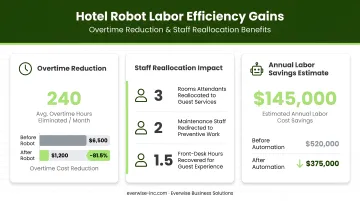
The impact isn't just efficiency — it's margin protection. Reduced overtime, fewer emergency staffing costs, and better shift allocation across a property add up without degrading the guest experience. Staff aren't eliminated; they're redirected to higher-value work.
KPIs this affects:
- Labor cost as a percentage of revenue
- Overtime hours logged by housekeeping
- Cost per cleaning cycle or delivery run
- Profit margin per occupied room
When this advantage matters most: high-volume periods like holidays and peak season, properties in tight labor markets, and night-shift operations where full staffing isn't viable.
Enhanced Guest Experience Through Speed and Availability
Guest expectations around response time have moved faster than most staffing models can accommodate. A guest requesting extra towels at midnight doesn't want to wait 45 minutes while a single overnight staff member handles the front desk, a check-in, and two other requests simultaneously.
A delivery robot dispatched at any hour reaches the guest's floor in minutes — no queue, no wait for staff to free up. A concierge robot stationed in the lobby answers wayfinding questions instantly, and multilingual capability helps international travelers get clear answers without relying on a specialized staff member being available at that moment.
A 2024 study analyzing online reviews across 44 robot hotels found that positive service robot performance drove higher overall customer satisfaction scores. Robots that perform reliably become a feature, not a curiosity.
Academic research from UCF Rosen College found that both practical value and hedonic (enjoyment) value shape how hotel guests perceive service robots and their intention to use them. Younger, digitally-oriented travelers often engage with the novelty and share the experience online.
That said, guests in premium or high-touch environments still tend to prefer human interaction. The most effective deployments combine both — robots handling speed-sensitive, repeatable tasks while staff focus on relationship-driven service moments.
KPIs this affects:
- Net Promoter Score (NPS)
- Response time per service request
- Guest satisfaction index
- Social media engagement and organic brand mentions
What Happens When Service Robots Are Ignored
Skipping automation doesn't just slow operations — it creates a chain of problems that show up directly in guest scores, staff retention, and margins.
- Understaffed shifts produce inconsistent housekeeping standards — the same pattern J.D. Power links to a 217-point satisfaction score drop
- Overtime costs rise during peak occupancy without a proportional gain in service quality, squeezing margins at the worst time
- Late-night request delays go straight into reviews — guests with unmet expectations are the most likely to report them publicly
- Scaling occupancy requires proportional headcount increases when workflows stay manual, making quality hard to sustain
- Nearby properties running automation are already delivering faster, more consistent service at lower cost — the gap widens every quarter
Left unaddressed, these issues reinforce each other: higher costs lead to leaner staffing, which drives lower scores, which accelerates staff turnover. Service robots interrupt that cycle before it compounds further.
How to Get the Most Value from Hotel Service Robots
Deployment alone doesn't guarantee results. Robots deliver measurable, sustained value when integrated into existing workflows rather than treated as standalone additions.
Maximum value comes when:
Robots are matched to the right task category : cleaning robots for large-surface floor maintenance, delivery robots for room service and amenity runs, concierge robots for high-traffic lobby areas. Mismatched deployments reduce impact and slow ROI.
Performance is tracked against baseline KPIs : cleanliness scores, delivery times, and labor hours per shift. Without before-and-after data, real improvements stay invisible on paper.
Human staff are retrained deliberately to shift their time toward guest-facing, judgment-intensive tasks that robots cannot replicate — conflict resolution, personalized service, and relationship-building.
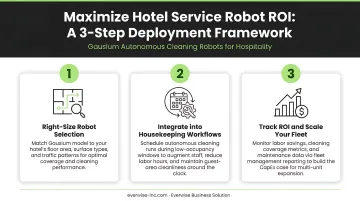
For Texas hotels putting this into practice, Everwise Business Solutions distributes the Gausium Vacuum 40 and Scrubber 75, both built for the mixed-surface environments found in hotel lobbies, corridors, and public areas. Both models include remote management through the Gausium Mobile App, so operations managers can monitor cleaning status, track task completion, and adjust schedules across multiple floors from a single interface.
Conclusion
Hotel service robots address present-day operational pressure — not a theoretical future. Staffing shortages are ongoing. Labor costs are climbing. Guest expectations haven't softened to match.
Operational consistency, labor cost control, and faster guest service compound over time when robots are deployed with a clear purpose and tracked against real performance metrics. Hotels that treat this as a strategic operations decision — rather than a tech experiment — are the ones that see lower labor costs and consistent service delivery.
For hotels specifically, autonomous cleaning robots address one of the most persistent gaps: floor-level cleanliness across high-traffic areas, maintained without adding headcount. That's a gap most properties can't afford to leave open indefinitely.
Frequently Asked Questions
What are the robots used in hotels?
The main types are delivery robots (room service and amenity transport), cleaning robots (autonomous vacuuming and floor scrubbing for corridors and public areas), concierge robots (check-in assistance, wayfinding, guest inquiries), and F&B service robots (food and beverage delivery in dining areas). Each handles a distinct function within hotel operations.
How much do hotel service robots typically cost?
Costs vary by type and capability. Commercial cleaning robots typically range from $20,000 to $40,000+ depending on size and features, while delivery and concierge robots vary widely by specification. Most vendors require a custom quote for hospitality deployments — contact them directly for current pricing.
Do hotel service robots replace human staff?
No. Robots handle repetitive, low-complexity tasks — cleaning corridors, delivering amenities, answering basic wayfinding questions — which frees human staff to focus on guest engagement and the kind of personalized service that drives satisfaction scores and repeat bookings. The human interaction stays; the manual burden decreases.
Which hotel departments benefit most from service robots?
Housekeeping benefits most, particularly for corridor and public-area floor maintenance. Room service and delivery operations see significant efficiency gains. Front desk teams benefit during high-volume check-in periods, and overnight shifts — where staffing is thinnest — see some of the clearest impact.
Are hotel service robots worth the investment for smaller properties?
Whether robots pay off depends on occupancy volume and local labor costs. Cleaning robots often offer the clearest case for smaller properties because floor maintenance is a consistent daily requirement regardless of size. A robot covering corridors and lobby areas overnight reduces overtime without requiring full-scale automation across the property.
How do hotel guests typically respond to service robots?
Response is generally positive, particularly among younger and tech-forward travelers who engage with the novelty and often share the experience. Guests in premium or high-touch environments may prefer human interaction for certain services. A hybrid approach works well for most property types: robots handle task-based requests while staff manage relationship-driven moments.