Introduction
Hospital floors can harbor bacterial pathogens on nearly every surface tested, and infection-control audits consistently flag floors as one of the most contaminated surface types in a facility, even after routine cleaning.
That's a problem for infection control teams and a budget problem for environmental services (EVS) departments running tight staffing models. The right floor cleaning machine does double duty: it lowers bioburden and cuts labor hours spent on repetitive scrubbing.
This guide compares the top hospital floor cleaning machines heading into 2026, from traditional walk-behind scrubbers to autonomous robotic cleaners now running unattended shifts in hospital corridors.
Key Takeaways
- Dedicated scrubbers, robotic cleaners, and HEPA vacuums cut cross-contamination risk that mops and buckets spread.
- Autonomous robotic scrubbers are the fastest-growing category, delivering continuous cleaning coverage without added labor hours.
- Compare machines on HEPA filtration, noise output, water/chemical efficiency, and touchless operation.
- This guide ranks five leading machines/brands and the exact criteria used to score them
Overview of Floor Cleaning Machines in the Healthcare Industry
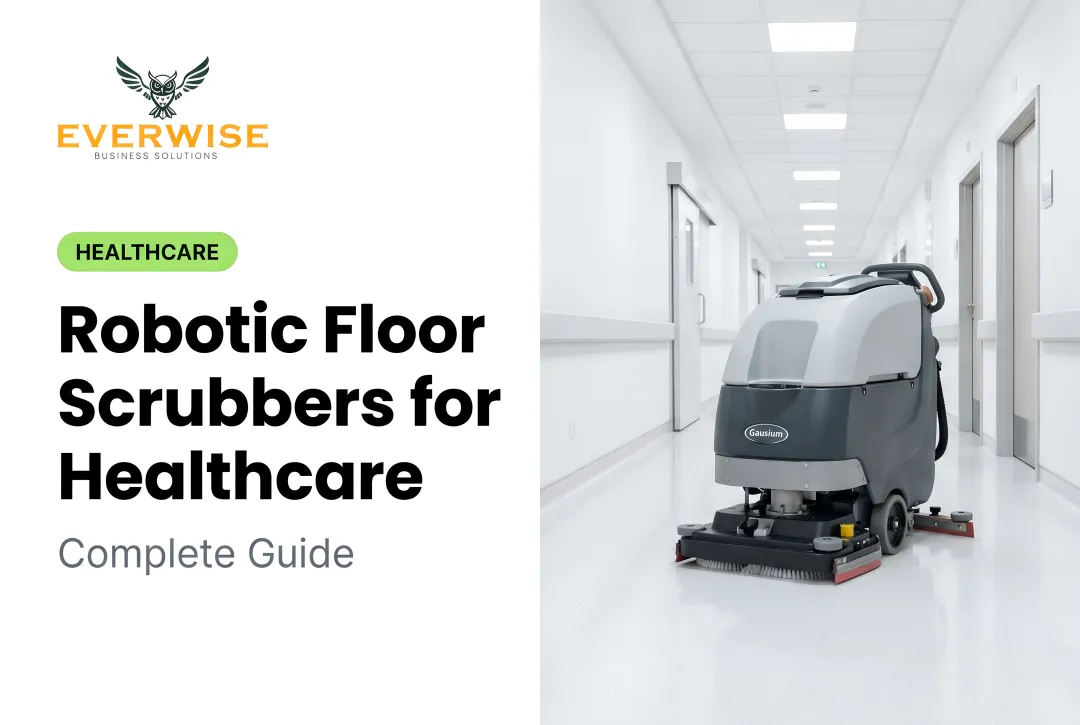
Hospital-grade floor equipment falls into four categories: automatic scrubber-dryers, autonomous or co-botic robotic scrubbers, burnishers, and HEPA-filtered vacuums. Each does a different job: a burnisher restores gloss, a scrubber-dryer removes soil, a robotic unit does both without an operator standing over it.
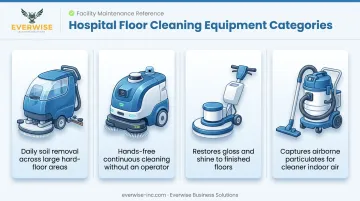
That equipment shift is replacing mops and buckets for good reason. CDC environmental infection-control guidance flags reused cleaning solution and cloths as a contamination pathway. The agency recommends fresh mop heads and solution every one to two hours, or immediately after isolation rooms. That cadence is nearly impossible to enforce manually across a large facility.
The scale of the problem:
- Hospital corridors see continuous foot traffic from staff, patients, visitors, and equipment carts
- Floor surfaces vary widely within a single facility: vinyl in wards, terrazzo in lobbies, epoxy in back-of-house areas
- C. difficile spores can survive more than five months on dry hospital surfaces, meaning a single missed cleaning cycle has lasting consequences
- Healthcare-associated infections affect more than 1 million U.S. patients annually, adding billions in avoidable cost
That combination — constant traffic, mixed surfaces, and pathogens that don't die quickly — is exactly why the machine selection below weighs infection-control performance as heavily as speed or price.
Top Hospital Floor Cleaning Machines for 2026
Every machine on this list was evaluated against four filters: infection-control performance, noise and patient comfort, labor savings versus manual scrubbing, and manufacturer service support. Here's how the leading options stack up.
Gausium Autonomous Scrubbers (via Everwise Business Solutions)
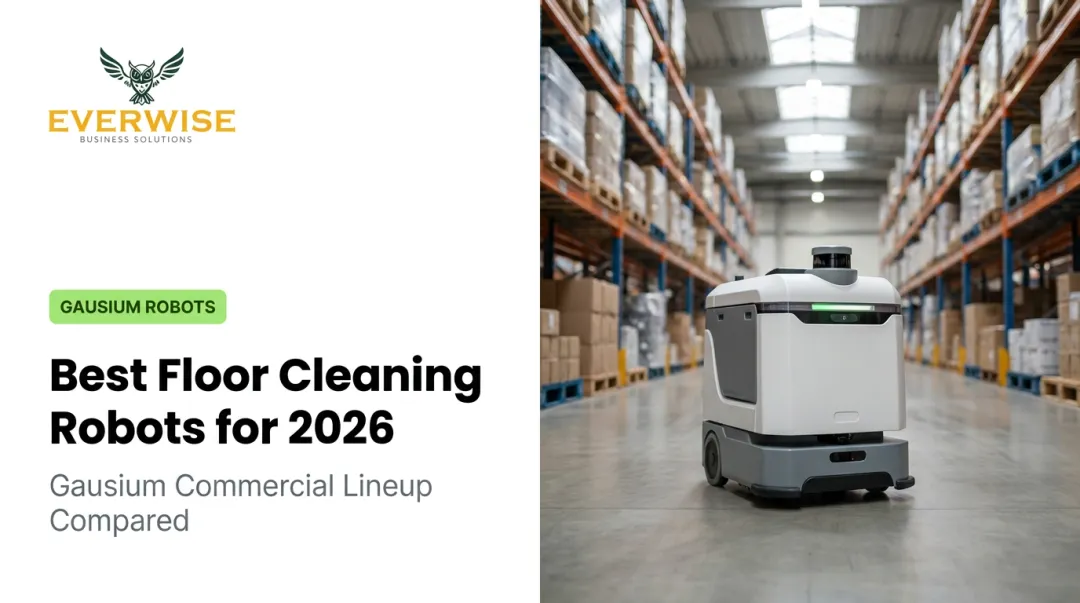
Gausium builds one of the more advanced autonomous cleaning robot lineups on the market, and Everwise Business Solutions is the authorized Texas distributor bringing these units into local hospitals, clinics, and eldercare facilities.
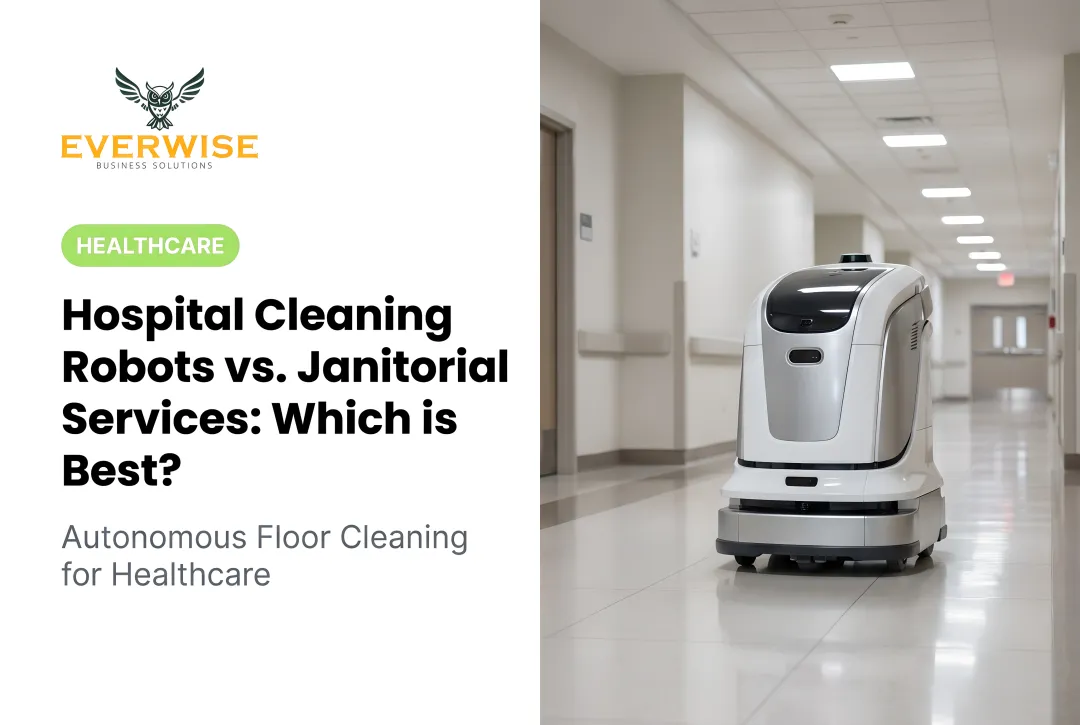
For healthcare corridors specifically, two models do most of the work. The Gausium Omnie uses AI navigation built for high-dynamic zones, such as shift-change corridors where carts, staff, and visitors move unpredictably. It auto-detects spills to concentrate cleaning where needed, rather than following a fixed route.
The Gausium Vacuum 40 pairs 3D depth-camera floor identification (adjusting brush height across tile, LVT, hardwood, and carpet automatically) with standard H13 medical-grade HEPA filtration and zero-distance edge cleaning along walls and equipment bases.
| Category | Details |
|---|---|
| Key Features | AI navigation (Omnie), 3D depth-camera floor identification, H13 HEPA filtration standard on Vacuum 40, zero-distance edge cleaning |
| Best Suited For | Large corridors, wards, and high-traffic zones needing 24/7 autonomous coverage |
| Support | Texas-based factory-trained technicians (San Antonio and Pharr), scheduled preventive maintenance, OEM parts |
Tennant Company – T-Series & ec-H2O Scrubbers
Tennant has decades of history in commercial and healthcare floor care, and its T-Series remains a benchmark for operator-driven scrubbing.
The T600's Quiet-Mode brings sound down to 62.2 dBA at the operator's ear, compared to roughly 69 dBA in standard operation, making it useful for cleaning near patient areas without adding disruption. Its ec-H2O system electrically converts tap water for detergent-free cleaning, and Smart-Fill automates battery watering to extend equipment life.
| Category | Details |
|---|---|
| Key Features | Quiet-Mode, ec-H2O tap-water cleaning, Smart-Fill battery maintenance |
| Best Suited For | Facilities prioritizing chemical reduction and battery longevity |
| Notable Tech | IRIS portal tracks usage, location, and maintenance needs across the fleet |
Nilfisk – Liberty SC50 Autonomous Scrubber
Nilfisk's Liberty SC50 (often referenced under earlier naming as "A50") pairs autonomous navigation with a sensor suite built for safety-first environments like hospitals.
Its EcoFlex mode adjusts water and detergent delivery to the job, supporting water-only cleaning when appropriate. Route mapping comes in two flavors: CopyCat, which repeats a route the operator drives once, or an independently calculated interior route. Both suit the repetitive geometry of hospital corridors.
| Category | Details |
|---|---|
| Key Features | Layered safety-sensor system, EcoFlex green cleaning modes, CopyCat and calculated-route mapping |
| Best Suited For | Hospitals seeking flexible autonomous coverage of large open areas |
| Efficiency | Low-flow, detergent-free green start-up mode by default |
i-team – i-mop XL / i-walk Robotic Add-on
i-team's range spans manual scrubber-dryers to co-botic add-ons, giving hospitals a middle path between manual labor and full autonomy.
The i-mop XL uses counter-rotating brushes at 350 RPM across a 46 cm path, scrubbing and drying in a single pass. This eliminates the mop-and-bucket handoff that spreads contamination between rooms. The i-walk attachment converts any i-mop XL made from 2014 onward into a route-repeating semi-autonomous unit.
| Category | Details |
|---|---|
| Key Features | High RPM brush speed, single-pass scrub-and-dry, i-walk co-botic conversion |
| Best Suited For | Mid-to-large facilities wanting flexibility between manual and autonomous modes |
| Runtime | Extended battery life supports long shifts without a recharge break |
Diversey – TASKI SWINGOBOT
Diversey has supplied hygiene equipment to hospitals worldwide for years, and its current TASKI SWINGOBOT line (2000 and 3000 series) replaced the older "Intellibot" branding.
These units run fully autonomous cleaning across large open areas using mapped or teach-and-repeat navigation, freeing EVS staff to focus on high-touch disinfection rather than repetitive floor passes.
| Category | Details |
|---|---|
| Key Features | Autonomous mapped or teach-and-repeat navigation, hands-free operation |
| Best Suited For | Hospitals with expansive common areas such as lobbies and cafeterias |
| Labor Impact | Reduces manual labor demand for repetitive large-area cleaning |
How We Chose the Best Machines
Price alone is the most common mistake we see healthcare buyers make. A cheaper walk-behind scrubber can end up costing more over three years once labor hours, chemical use, and downtime are factored in — a real total cost of ownership, not just a sticker price.
Here's what actually went into the rankings:
- Compliance alignment: how well the machine supports CDC and Joint Commission cleaning-frequency expectations
- Technological capability: AI navigation quality, HEPA filtration availability, and floor-type adaptability
- Noise and disruption: configuration-specific dBA levels near patient areas, not just marketing claims
- Water and chemical efficiency: tank capacity, detergent-free modes, and runtime per charge or fill
- After-sales support: training availability, parts access, and local service response time
Machines that scored well across most of these categories made the list. Machines that only won on one dimension, usually price, did not.
Conclusion
There's no single "best" hospital floor cleaning machine. The right choice depends on your facility's square footage, floor mix, and where infection control ranks against labor savings on your priority list.
Before finalizing a purchase, evaluate how each option performs over time and whether it scales across departments. Factor in labor and maintenance costs too, not just the invoice total.
If you're a Texas healthcare facility exploring autonomous cleaning, Everwise Business Solutions offers onsite demos of the Gausium lineup, including the Vacuum 40 and Omnie, tailored to your corridors and common areas. Reach the team at 210.884.0559 or german.zavala@everwise-inc.com to start with a complimentary ROI assessment.
Frequently Asked Questions
How do hospitals clean their floors?
Most hospitals run daily automatic scrubbing and disinfection in high-traffic zones, spot-clean spills as they happen, and schedule periodic deep cleaning or burnishing. Many facilities now supplement this with autonomous robotic scrubbers for consistent overnight coverage.
What kind of floor cleaner do hospitals use?
Hospitals rely on EPA-registered, hospital-grade disinfectant solutions matched to both their scrubber type and their flooring material, whether that's vinyl, epoxy, or terrazzo. Compatibility with the machine manufacturer's specs matters as much as the disinfectant's label claims.
What are hospital floor cleaning machines called?
Common terms include automatic floor scrubbers, scrubber-dryers, autonomous or robotic floor scrubbers, and burnishers. Each serves a different zone — burnishers restore shine in lobbies, while scrubber-dryers handle daily soil removal in corridors and common areas.
How often should hospital floors be cleaned or scrubbed?
High-traffic and clinical areas typically need daily or multiple-times-daily scrubbing, while common areas often follow a scheduled zonal cleaning plan. Staff usually clean procedure rooms before and after every use, on top of end-of-day service.
Are autonomous cleaning robots safe for use in hospitals?
Modern robots use sensor suites and AI navigation to detect people and obstacles, rerouting in real time rather than following a fixed path blindly. Most also include a manual emergency-stop button and operate only in corridors and common areas, not clinical spaces.
How much does a hospital floor scrubber cost?
Pricing varies widely between walk-behind, ride-on, and autonomous robotic models, and most manufacturers require a custom quote rather than listing public prices. Buyers should weigh total cost of ownership, including labor savings and maintenance, rather than comparing upfront price alone.