Service robots aren't a future-state solution to these problems. They're already operating in hospital corridors, delivering medications, scrubbing floors, and running UV disinfection passes in facilities across the country. The real question for hospital administrators and facility managers isn't whether the technology works — it's whether their facility is using it.
Key Takeaways
- Hospital service robots take over cleaning, disinfection, supply delivery, and logistics — freeing staff from non-clinical tasks that drain time away from patient care
- Consistent cleaning protocols from autonomous robots reduce the human-error gaps that contribute to infection control failures
- Staff workload relief translates directly into more time for patient-facing duties and lower physical fatigue
- Long-term savings come from reduced overtime, faster task completion, and fewer error-driven operational costs
- Value compounds with consistent, facility-wide deployment — not one-off pilots that never scale
What Are Hospital Service Robots?
Hospital service robots are autonomous or semi-autonomous machines that handle non-clinical, logistical, and environmental tasks inside healthcare facilities. Unlike surgical or diagnostic systems, they operate in the background — keeping facilities clean, stocked, and running without pulling staff away from patient care.
The primary categories in active hospital use:
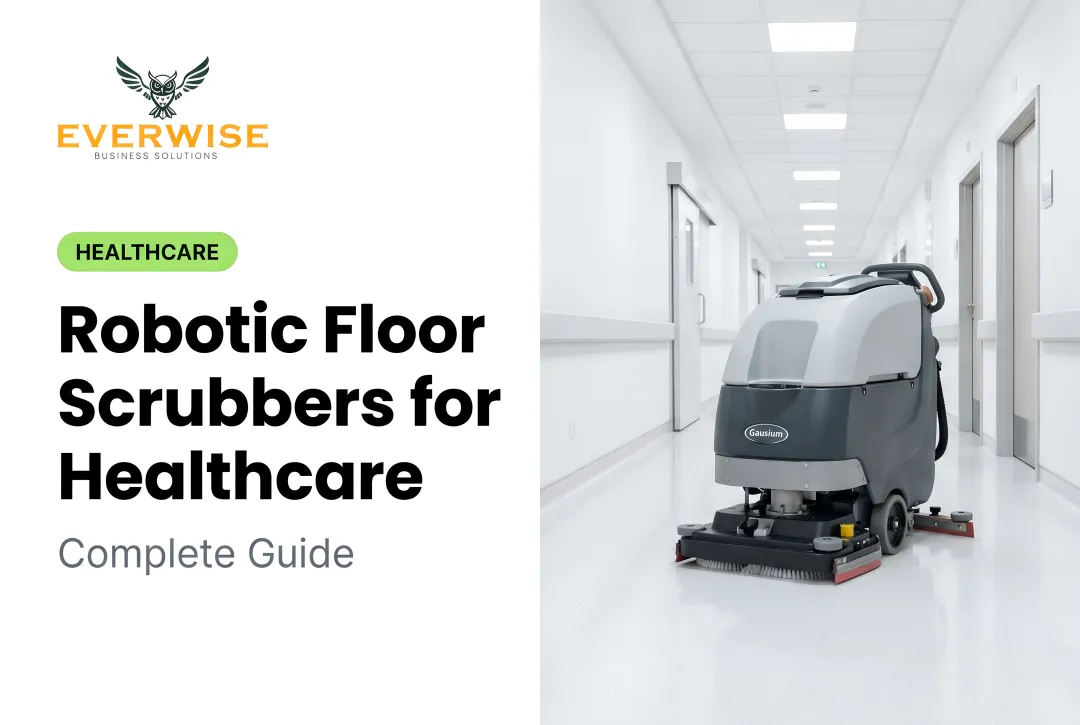
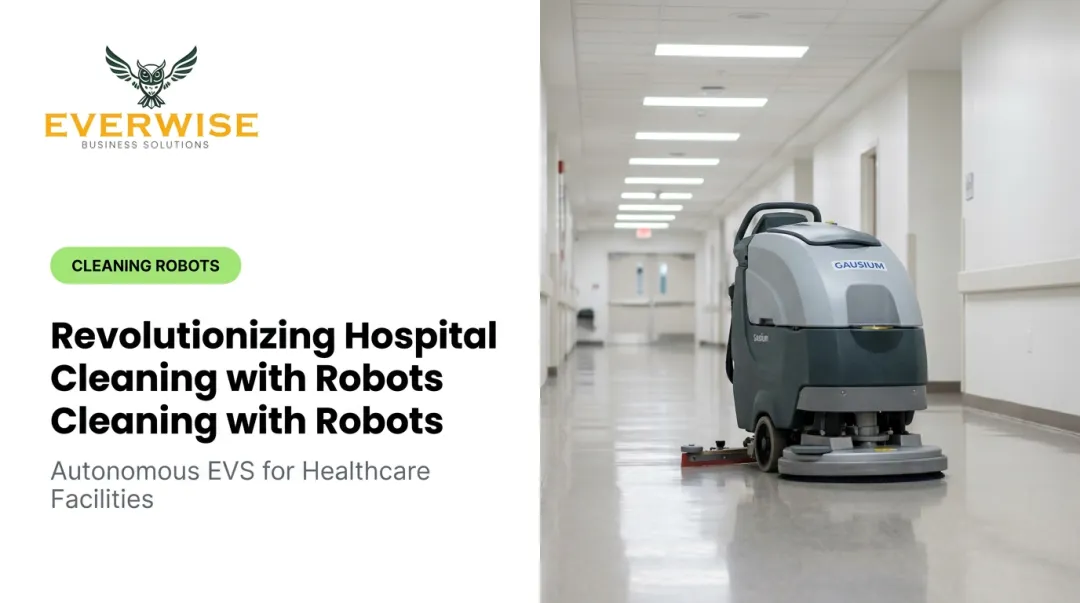
- Autonomous floor cleaning robots — navigate corridors, patient rooms, and high-traffic zones on pre-programmed schedules
- UV disinfection robots — supplement manual cleaning with UV-C light passes to reduce surface contamination
- Delivery and logistics robots — transport medications, lab specimens, linens, and supplies between departments
- Waste and materials transport robots — move soiled linens, waste, and bulk materials without pulling clinical staff away from care areas
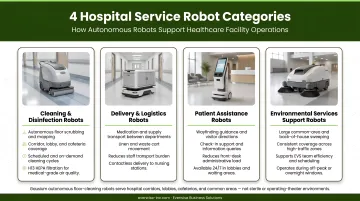
Each category targets a specific operational gap — and understanding where they fit helps healthcare facilities decide which deployments make the most impact.
Key Benefits of Hospital Service Robots
The advantages below focus on outcomes that hospital administrators and facility managers can actually track: infection rates, staff hours, operational costs, and compliance consistency.
Consistent Infection Control and Hygiene Standards
According to AHRQ, 1 in 31 hospital inpatients had a healthcare-associated infection (HAI) at any given time as of 2015 — and conditions worsened under pandemic pressure, with CLABSI rates rising 37.2% and MRSA rates rising 47.0% from 2020 to 2021.
The cleaning reliability problem is well-documented. A 2025 scoping review found that visual inspection of manual cleaning has a sensitivity of only 60% to 70% compared to objective monitoring. A 27-ICU study cited in the same review found cleaning thoroughness improved from 49% to 82% only after structured feedback was introduced.
Autonomous cleaning robots address this differently. They apply the same protocol to the same zones every cycle — no rushed passes, no shift-change handoff gaps, no variation caused by fatigue.
In practice:
- Robots navigate hospital corridors and patient rooms on defined schedules using sensors that detect obstacles and maintain coverage completeness
- UV disinfection robots supplement manual cleaning in high-risk zones with targeted surface treatment
- Cleaning performance becomes auditable rather than assumed
Gausium autonomous cleaning robots, available through Everwise Business Solutions for Texas-based healthcare facilities, are equipped with H13 HEPA filtration and intelligent floor identification technology. Gausium autonomous cleaning robots, available through Everwise Business Solutions for Texas-based healthcare facilities, carry H13 HEPA filtration and intelligent floor identification technology. Both matter in clinical settings where air quality and surface hygiene face regulatory scrutiny.
KPIs affected: HAI rates, surface contamination scores, cleaning audit pass rates, regulatory compliance scores
Where this matters most: ICUs, emergency departments, post-surgical recovery areas, and any unit facing increased infection prevention scrutiny.
Staff Workload Relief and Burnout Reduction
More than 30% of nurses reported thinking about leaving direct patient care in a 2023 McKinsey survey. Physical workload and non-clinical task burden are consistent contributors to that figure.
The problem isn't just burnout — it's time displacement. Every hour a nursing aide spends transporting linens, running supply deliveries, or moving waste is an hour not spent on patient-facing work. Service robots absorb those tasks.
How this plays out in practice:
- Delivery robots navigate hospital corridors autonomously to transport medications, specimens, and supplies between departments
- Cleaning robots operate on scheduled loops without supervision, removing repetitive physical labor from human workflows
- Transport robots handle linen and waste movement, particularly during night shifts when staffing is thinnest
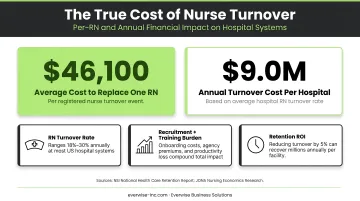
NSI reports the cost of each RN turnover at $60,090, with the average hospital facing $5.19 million in annual RN turnover costs. Reducing physical workload — and the fatigue that comes with it — is a documented retention lever.
KPIs affected: Staff hours redirected to patient care, absenteeism rates, employee satisfaction scores, turnover and recruitment costs
Where this matters most: Skeleton-crew overnight shifts, large campuses with significant transport distances, and facilities experiencing chronic turnover in support roles.
Operational Efficiency and Long-Term Cost Reduction
Service robots don't call out sick, don't require overtime pay, and don't slow down when fatigued. In high-volume hospital environments, that kind of consistent output directly reduces labor costs for non-clinical operations.
Real-world deployments point to the same pattern. Children's Hospital Los Angeles reports that Moxi handles deliveries so clinical teams can focus on patient-facing care. Upstate describes Aethon TUG robots managing material delivery to free critical staff time. Neither published hard ROI figures, but both cite the same core benefit: clinical staff spending less time on logistics.
The cost math over time:
- Robots operate extended hours without rest requirements, reducing overtime and shift-overlap costs for non-clinical duties
- Automated delivery reduces inter-departmental wait times for medications and supplies
- Consistent cleaning schedules reduce the risk of compliance failures that carry their own cost consequences
On the infection side, the financial stakes of inaction are substantial. AHRQ data shows that hospital stays involving an HAI can carry median costs many times higher than comparable stays without one — in some diagnostic categories, the difference exceeds $75,000 per case.
KPIs affected: Labor hours per task, overtime costs, delivery turnaround times, total cost of operations per patient day. This section is most relevant to large campuses with high daily task volumes and facilities pursuing cost reduction without proportional headcount growth.
What Happens When Hospitals Rely Entirely on Manual Processes
Relying entirely on manual processes for routine hospital tasks doesn't just slow things down — it introduces overlapping operational risks that compound over time.
- Uneven hygiene across units — missed zones and rushed passes rarely get caught in visual audits until infection data surfaces
- Repetitive physical tasks accumulate into staff fatigue, which translates into higher absenteeism, injury rates, and turnover — each with a direct cost
- When someone calls out, non-clinical tasks either go undone or pull clinical staff away from patient care
- Overtime becomes structural rather than occasional, especially during high-census periods when demand spikes and headcount doesn't
Together, these gaps don't stay isolated — they reinforce each other. Facilities running with lean support staffing feel the pressure most, and that description fits a growing share of hospitals facing sustained workforce shortages.
Getting the Most Value from Hospital Service Robots
A robot purchased, briefly tested, and left to run without structure delivers a fraction of the value of one integrated deliberately into facility operations. The difference comes down to deployment discipline.
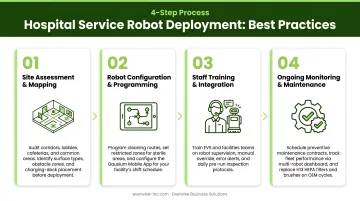
What good deployment looks like:
- Define zones and schedules before go-live — Identify which areas the robot covers, at what frequency, and during which hours. High-traffic corridors, patient rooms, and post-procedure areas each carry different cleaning requirements.
- Review performance data regularly — Cleaning coverage logs, task completion rates, and alert histories aren't just diagnostic tools; they're how you catch gaps before they become compliance problems.
- Train staff to work alongside robots — The transition from manual-only to human-robot workflows requires orientation. Staff who understand what the robot does — and doesn't do — integrate it more effectively.
- Treat it as an operational layer, not a one-off pilot — Consistent deployment across 12 months compounds value in ways a six-week pilot simply cannot.
Choosing the right hardware matters as much as how you deploy it. For clinical environments, that means prioritizing medical-grade air filtration, intelligent surface detection, and edge-cleaning precision — the features most directly tied to infection control outcomes.
The Gausium Vacuum 40, available through Everwise Business Solutions for Texas healthcare facilities, includes H13 HEPA filtration, 3D depth camera-based floor identification, and zero-distance edge cleaning. Together, these features address the specific hygiene demands of high-risk clinical spaces where standard commercial equipment falls short.
Conclusion
The operational case for hospital service robots is no longer speculative. Consistent cleaning protocols, staff workload relief, and long-term cost reduction are measurable outcomes. The hospitals already running autonomous cleaning and delivery systems aren't treating them as pilots — they've made them part of standard operations.
A robot deployed consistently over a full year delivers measurably more value than one tested and shelved after a few months. Sustained deployment — not the technology itself — is what drives results.
For Texas-based healthcare facilities exploring where to start, Everwise Business Solutions is an authorized Gausium distributor serving hospitals and clinical environments with autonomous floor cleaning platforms that include H13 HEPA filtration and AI-driven navigation. Contact their team at 210.884.0559 or german.zavala@everwise-inc.com to discuss what deployment looks like for your facility.
Frequently Asked Questions
Are service robots used in healthcare?
Yes. Service robots are widely deployed in hospitals and healthcare facilities today for autonomous floor cleaning, supply delivery, medication transport, and UV disinfection. These are distinct from surgical or diagnostic medical robots and focus entirely on operational and logistical tasks.
What robots are used in hospitals?
The main categories include autonomous cleaning and disinfection robots, delivery and logistics robots for medications, linens, and lab specimens, and in some facilities, social or concierge robots. Service robots handle operational functions; medical robots assist with clinical procedures requiring physician oversight and regulatory clearance.
How much do hospital service robots cost?
Costs vary significantly by type and capability. Autonomous cleaning robots like the Gausium Scrubber 50 Pro are publicly listed from around $43,000, with robotics-as-a-service options also available. Factor in labor savings, reduced HAI-related costs, and efficiency gains over the robot's lifespan to assess true ROI.
How do service robots help hospital staff?
Service robots take on physically demanding, repetitive non-clinical tasks — transport, delivery, floor cleaning — so clinical and support staff can redirect that time toward patient care. Reduced physical burden also lowers fatigue and contributes to better retention.
Can cleaning robots reduce hospital-acquired infections?
Autonomous cleaning robots improve hygiene consistency by applying the same protocols across every zone, eliminating gaps caused by manual fatigue or shift changes. Models with H13 HEPA filtration add airborne particle control, strengthening their role within a validated, multimodal cleaning program.
What is the difference between a service robot and a medical robot in a hospital?
Medical robots — such as surgical systems — assist in clinical procedures requiring precision, regulatory clearance, and physician oversight. Service robots handle operational and logistical work: cleaning, delivery, transport. Both improve outcomes, but in completely separate areas of hospital function.