Introduction
The robot vacuum market has split into two distinct worlds. Consumer models handle home floors. Commercial autonomous robots — a fundamentally different category — run multi-shift operations across warehouses, hospital corridors, hotel lobbies, and retail floors covering tens of thousands of square feet per shift.
With hundreds of models available, the wrong choice means wasted budget, inconsistent cleaning results, and ongoing frustration. A hospital facility manager and a studio apartment renter need fundamentally different machines, yet both face the same overwhelming product landscape.
This guide is built for facility and operations decision-makers — the procurement buyers, facility managers, and operations directors evaluating autonomous commercial cleaning robots for hotels, warehouses, healthcare facilities, retail chains, and commercial buildings. The six factors covered here connect technical specifications directly to real-world cleaning outcomes, so you can match the right robot to your facility's actual requirements.
Key Takeaways
- Match your robot to your environment — floor type, space size, and cleaning frequency drive the decision more than brand or price
- LiDAR-based navigation outperforms random bump-and-turn systems in coverage efficiency and predictability
- Commercial environments require purpose-built autonomous robots, not scaled-up consumer devices
- Total cost of ownership matters more than unit price — factor in filters, brushes, and (for commercial) software and ongoing service
- Professional cleaning robot sales grew 34% to over 25,000 units in 2024 — autonomous floor care is now an established operational category, not an experiment
What Is a Robot Vacuum Cleaner?
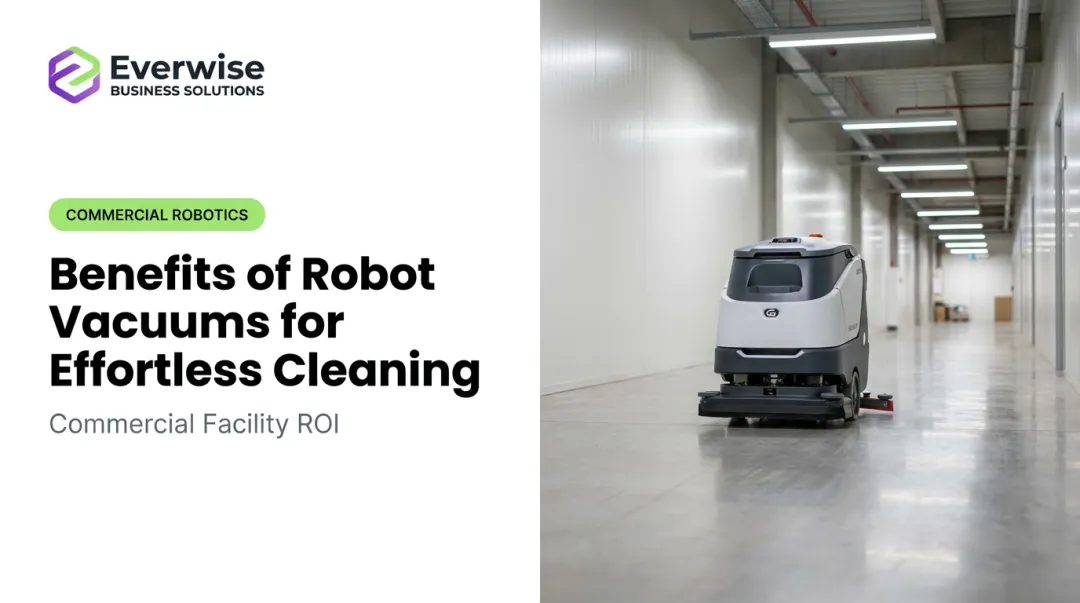
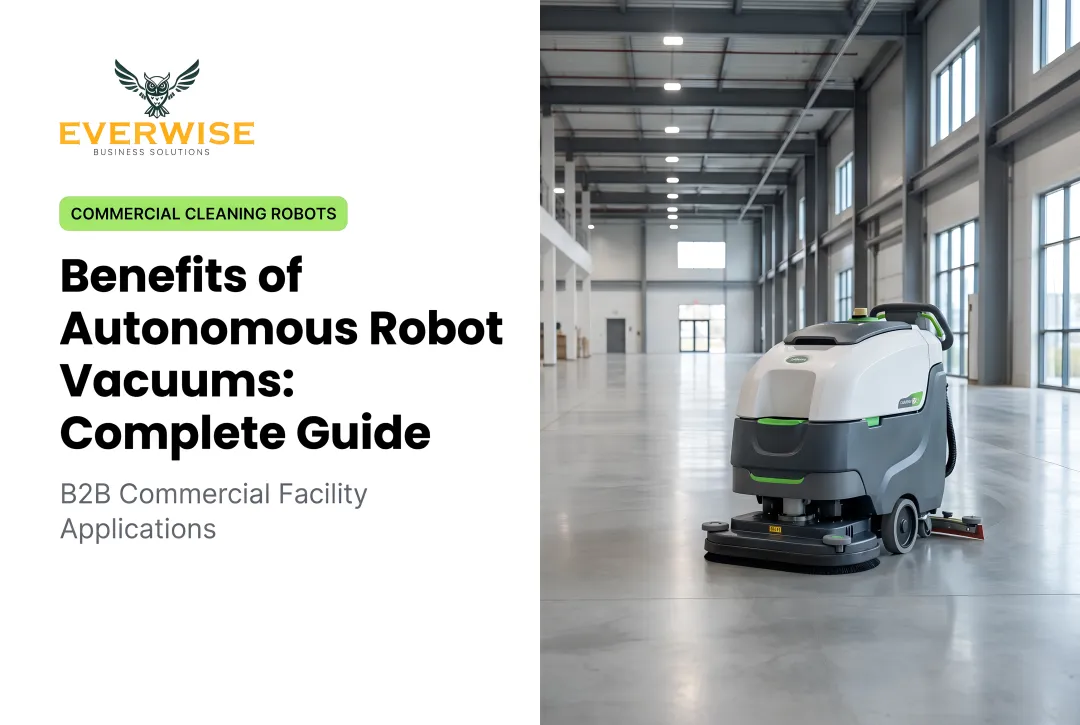
A robot vacuum is a self-propelled, autonomous cleaning device equipped with sensors, motors, brushes, and software that navigates a space and removes dust, debris, and particles from floors — without manual operation. Commercial-grade units go well beyond basic suction: they use LiDAR mapping, AI-driven obstacle avoidance, and enterprise fleet software to clean large, high-traffic facilities across multiple shifts with no staff intervention.
Three Types of Robot Vacuums
| Type | Best For | Key Features |
|------|----------|--------------|
| Light commercial | Small retail, offices, clinics | Basic navigation, scheduled runs, manual emptying |
| Smart consumer | Mid-size homes | LiDAR or camera mapping, app scheduling, self-emptying |
| Commercial autonomous | Offices, hospitals, hotels, warehouses | Enterprise software, multi-shift operation, industrial durability |
Core Benefits
- Time savings — automated scheduling runs cleaning without human oversight
- Consistent coverage quality that doesn't vary by shift or staffing levels
- Allergen reduction — continuous floor maintenance reduces airborne dust and allergen levels
- Commercial units can replace 1–3 FTE per shift, depending on facility size
- Off-hours operation — robots clean during closed periods, freeing staff for higher-value tasks
Key Factors to Consider When Choosing a Robot Vacuum Cleaner
Robot vacuums vary significantly across environments. These six factors connect technical specs to real-world cleaning outcomes — whether you're buying for a home or a commercial facility.
Navigation Technology and Obstacle Avoidance
Navigation determines how thoroughly and efficiently a robot covers a space.
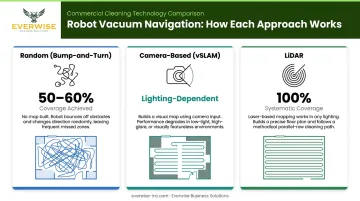
The three main approaches:
- Random (bump-and-turn): reactive movement with no persistent map; simulations show only 50–60% coverage in the same moves that planned systems use to reach 100%
- Camera-based (vSLAM): visual feature tracking; effective in well-lit, structured spaces but sensitive to low light and repetitive corridors
- LiDAR: laser scanning builds accurate geometric maps; strong for large or changing environments, though buyers should still test glass and reflective surfaces
For commercial environments, obstacle avoidance intelligence matters as much as mapping. AI systems using 3D depth cameras can classify objects in real time and route around furniture, cables, or moving people — reducing mid-cycle stalls that require human intervention.
Practical tip: Don't buy from sensor labels alone. Run a proof-of-concept on your actual space before committing to a platform.
Suction Power and Floor Type Compatibility
Suction is measured in Pascals (Pa). Required levels vary by surface:
- Hard floors (tile, LVT, polished concrete): lower suction needed; brush roll design matters more
- Low-pile carpet: 2,500–5,000 Pa is a common benchmark
- High-pile carpet: 4,000–6,000+ Pa needed to lift embedded debris
Important caveat: Pa ratings alone are not a reliable predictor of real-world performance. Brush roll design, airflow efficiency, and roller type all affect pickup rates. Independent outcome testing — measuring actual debris removal by weight on your specific floor types — is more useful than comparing maximum Pa specs between models.
Battery Life and Coverage Area
Runtime determines how much floor area a robot completes per cycle.
| Space Size | Recommended Runtime |
|---|---|
| Under 1,000 sq ft | 60–75 min typically sufficient |
| 1,000–5,000 sq ft | 90–120 min; verify recharge-and-resume |
| Over 5,000 sq ft | Auto-resume function essential; validate full-route completion |
Consumer models generally run 60–120 minutes per charge. Commercial autonomous robots are engineered for continuous operation — the Gausium Scrubber 75, for example, is built for multi-shift operation across large industrial and enterprise floors without mid-cycle interruption. Always ask for published runtime data on your specific floor type before finalizing a commercial purchase.
Auto-resume (dock → recharge → continue) is a critical feature for any space where a single charge won't cover the full floor plan.
Cleaning Modes and Mopping Capability
Most mid-range and commercial models offer multiple cleaning modes:
- Auto: full scheduled coverage on a set route
- Spot: targeted cleaning for high-traffic areas
- Edge: wall and corner focus
- Quiet: reduced suction for occupied hours
Vacuum-and-mop hybrids offer real advantages for hard-floor-heavy environments. One pass vacuums debris and mops light stains simultaneously. Before buying a hybrid, confirm whether the mop pad automatically lifts when transitioning to carpet — cross-contaminating carpet with a wet mop pad is a common flaw in lower-tier models.
Maintenance and Self-Emptying Features
Maintenance frequency is one of the most underestimated cost factors. Key considerations:
Self-emptying docks: transfer debris automatically into a larger container, reducing user contact and extending time between manual empties (the iRobot Clean Base, for example, holds 60 robot bins before a bag change)
Anti-tangle brush rolls: cut maintenance time in pet-heavy or long-hair environments
HEPA filtration: U.S. HEPA requires 99.97% removal at 0.3 microns; EN 1822 H13 certification requires 99.95% at the most penetrating particle size
For healthcare or allergen-sensitive spaces, require the specific filter class and ask for whole-machine leakage test evidence — media-level specs alone don't confirm system-level containment.
Mop pads: need washing or replacement on a regular cycle — factor in ongoing consumable cost before committing to a hybrid model
Budget and Total Cost of Ownership
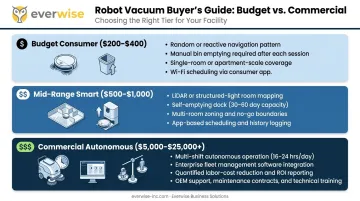
Sticker price covers only part of the investment. Map your budget across three tiers:
- Budget consumer models ($200–$400): light daily maintenance in small spaces; random navigation; manual emptying
- Mid-range smart models ($500–$1,000): LiDAR mapping, self-emptying, app scheduling; moderate homes and small offices
- Commercial autonomous robots ($5,000–$25,000+): justifiable through measurable labor savings, multi-shift operation, and round-the-clock coverage at scale. Gausium's commercial lineup — including the Beetle for warehouses and the Omnie for high-traffic environments — falls in this tier.
For commercial buyers, also factor in: software licensing, service contracts, OEM parts availability, and technician support. Before signing any commercial purchase, verify that the vendor has authorized local service coverage in your region. A robot without nearby technical support can cost more in downtime than the price difference between models.
Consumer vs. Commercial Robot Vacuums: What Businesses Need to Know
Consumer robot vacuums are built for residential convenience: typically 500–2,000 sq ft, periodic user interaction, and a single daily cycle. For a facility manager evaluating autonomous cleaning for commercial operations, that baseline is the wrong starting point entirely — the performance requirements, durability standards, and compliance obligations are categorically different.
Where the Performance Gap Widens
| Factor | Consumer Robot | Commercial Autonomous Robot |
|---|---|---|
| Coverage per shift | 500–2,000 sq ft | Tens of thousands of sq ft |
| Runtime | 60–120 min | Multi-cycle with auto-resume |
| Durability | Residential use | Multi-shift industrial duty cycle |
| Navigation | LiDAR or camera | Multi-layer LiDAR + 3D depth cameras + AI |
| Reporting | App map logs | Fleet dashboards, missed-area reports, compliance documentation |
| Filtration | Basic to HEPA | Medical-grade H13 available |
Industry-Specific Requirements
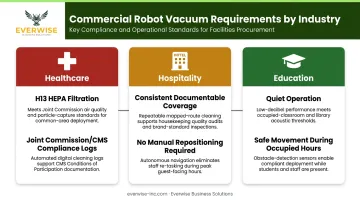
That gap in the table maps directly to compliance obligations. Healthcare, hospitality, and education each carry cleaning standards consumer models cannot meet:
- Healthcare corridors, lobbies, and cafeterias require medical-grade filtration and documented cleaning logs for Joint Commission and CMS compliance — neither of which consumer units produce
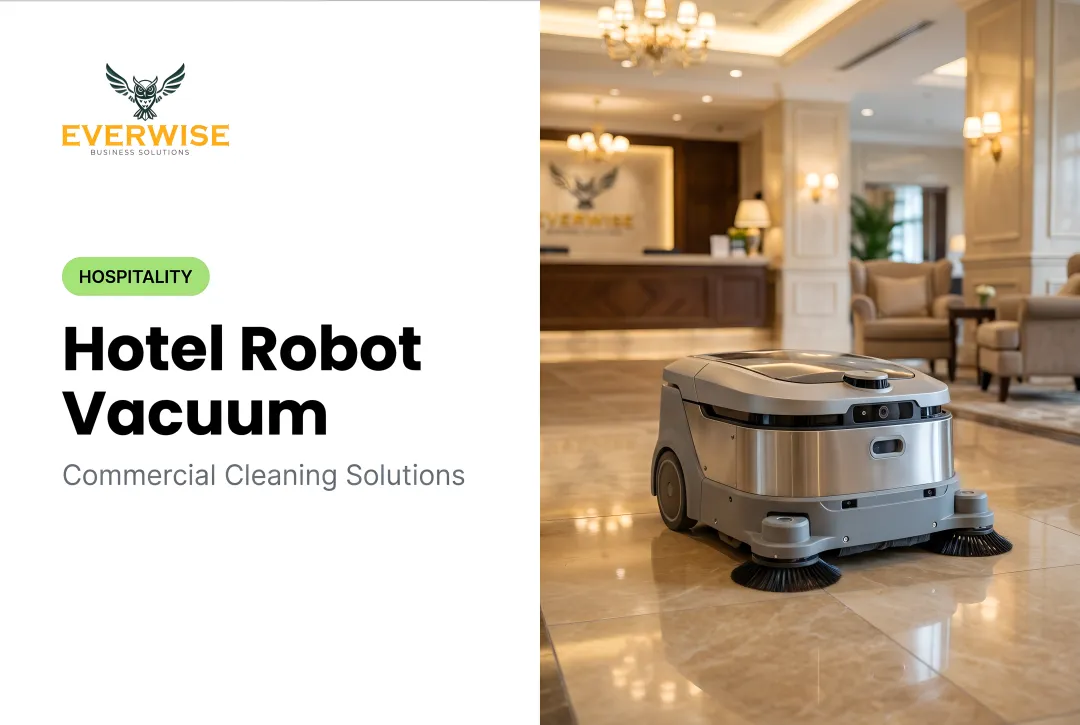
- Hotels need consistent, documentable coverage between guest stays; a robot that misses corners or requires manual repositioning introduces operational variability
- Schools require safe, quiet operation during occupied hours, where noise and unpredictable movement are disqualifying factors
The Commercial ROI Case
Those compliance and coverage requirements translate into a financial model worth building. Published fleet deployments show commercial autonomous robots averaging 21,000 sq ft of coverage per unit daily, with multi-unit school district deployments recovering close to 35 labor hours per day. Industry payback estimates for facilities cleaned daily run 14–24 months.
These figures come from manufacturer-published case studies, not independent audits. Treat them as modeling inputs: plug in your actual square footage, shift count, and labor cost to build a facility-specific ROI case rather than relying on published averages as guaranteed outcomes.
How Everwise Business Solutions Can Help
Texas facility managers evaluating commercial autonomous cleaning robots have one authorized Gausium source in the state: Everwise Business Solutions, headquartered in San Antonio with operations across Pharr, Austin, Dallas, Houston, and the Rio Grande Valley.
Gausium robots are engineered from the ground up for commercial environments — not consumer devices adapted for larger spaces. That means heavier-duty components, multi-shift run times, and compliance-grade filtration built in from the start.
What Sets Gausium Apart
- Intelligent Floor Identification: The Vacuum 40 uses 3D depth cameras and AI to detect surface type in real time — automatically adjusting cleaning mode, brush height, and suction intensity across hardwood, stone, vinyl/LVT, marble, and varying carpet pile depths from a single autonomous pass. No manual reconfiguration between floor zones.
- Zero-Distance Edge Cleaning: The Phantas achieves a documented 0cm-from-edge cleaning standard along walls and corners. Standard robots leave a gap of several centimeters that accumulates debris and requires manual follow-up.
- Medical-Grade H13 HEPA Filtration: The Vacuum 40 and Beetle carry H13-rated filters for environments with strict airborne particulate requirements — healthcare corridors, allergen-sensitive offices, and industrial facilities with EH&S compliance obligations.
- Auto-Resume for Large-Space Coverage: All Gausium models autonomously dock, recharge, and resume cleaning mid-task without staff intervention, enabling true multi-shift operation.
Everwise Distributor Advantages
- Authorized Texas distributor — OEM parts, factory-trained technicians, and full manufacturer warranty support
- Scheduled preventive maintenance contracts (quarterly or semi-annual) and on-demand emergency repair dispatch for fleet customers under service contract
- Centralized fleet management via the Gausium Mobile App with compliance-ready cleaning logs
- ROI modeling and business case development at no cost on initial procurement engagements
- Financing available: operating lease (OpEx) and capital lease (CapEx), with Section 179/bonus depreciation eligibility to discuss with your accountant
- Complete 2026 Gausium lineup covered: Phantas, Vacuum 40, Omnie, Scrubber 75, Beetle, plus newly launching Mira, Marvel, and PhanShop models
Contact Everwise: 210.884.0559 | german.zavala@everwise-inc.com | Monday–Friday, 9:00 AM–6:00 PM
Conclusion
A studio apartment and a 50,000 sq ft hospital wing need completely different machines. Buyers who evaluate navigation quality, battery life, maintenance requirements, and true total cost of ownership make a more durable investment than those who lead with sticker price alone.
For commercial facilities, matching the right robot to the right environment delivers measurable returns: lower labor costs, consistent cleaning cycles, and documented hygiene compliance. The selection decision has real operational consequences — a mismatched unit creates retraining costs, coverage gaps, and accelerated wear.
Review cleaning performance periodically as spaces evolve. What works for a 10,000 sq ft retail floor today may not scale to a multi-wing expansion in two years. Build flexibility into your procurement criteria now.
Texas facilities evaluating the Gausium commercial robot lineup — from the compact Phantas for midsize spaces to the Scrubber 75 for industrial floors — can contact Everwise Business Solutions for site assessments and deployment planning across San Antonio, Houston, Dallas, Austin, and the Rio Grande Valley.
Frequently Asked Questions
How do you choose a robotic vacuum cleaner?
Assess your floor type, space size, navigation technology needs, and maintenance preferences first — then match those requirements to a model's suction power, battery life, and smart features. Choosing based on brand recognition or price alone typically leads to a poor fit for the actual environment.
Which robotic vacuum cleaner is best?
The right model depends on your facility's size, floor type, and operational demands. For small-to-midsize commercial spaces, a compact autonomous floor cleaner with LiDAR navigation handles daily cycles effectively. For large facilities, enterprise-grade robots with AI navigation, industrial durability, and H13 HEPA filtration consistently deliver better coverage and reliability across multi-shift operations.
What is the difference between a consumer and a commercial robot vacuum cleaner?
Consumer models handle residential spaces up to roughly 2,000 sq ft with periodic user interaction and daily cleaning cycles. Commercial autonomous cleaning robots are built for continuous multi-shift operation across large or complex facilities, with stronger sensors, greater durability, and integration with facility management reporting systems.
How long do robot vacuum batteries typically last per charge?
Runtime per charge matters less than full-route completion in commercial settings. Most commercial autonomous cleaning robots support auto-resume — returning to the dock mid-cycle, recharging, and continuing without manual intervention — so the relevant metric is whether the robot finishes its assigned route across a shift, not raw battery minutes.
Are robot vacuums worth the investment for businesses?
For businesses managing large or high-traffic spaces, commercial autonomous cleaning robots deliver measurable ROI through reduced labor hours, consistent coverage, and lower operational costs over time. Multi-shift facilities see the strongest returns, where robots cover shifts that would otherwise require additional staffing.
What maintenance does a robot vacuum cleaner require?
Routine tasks include emptying the dustbin, cleaning or replacing filters, removing debris from brush rolls, and washing or replacing mop pads. Models with self-maintenance features reduce how often staff need to intervene. For commercial deployments, scheduled preventive maintenance contracts with OEM-trained technicians — such as those offered through Everwise Business Solutions for Gausium robots — extend equipment life and protect uptime.