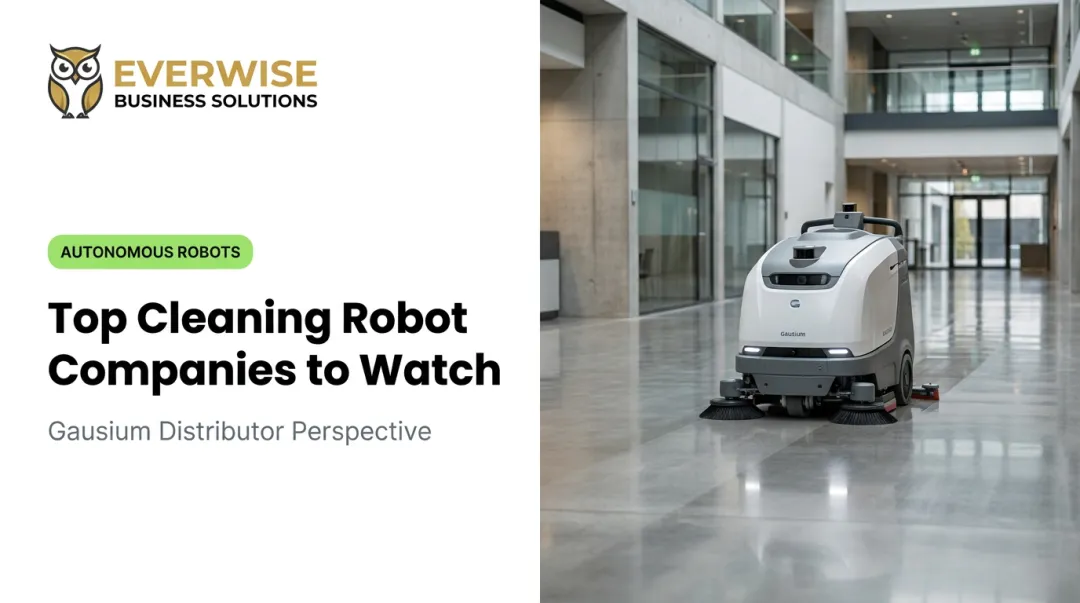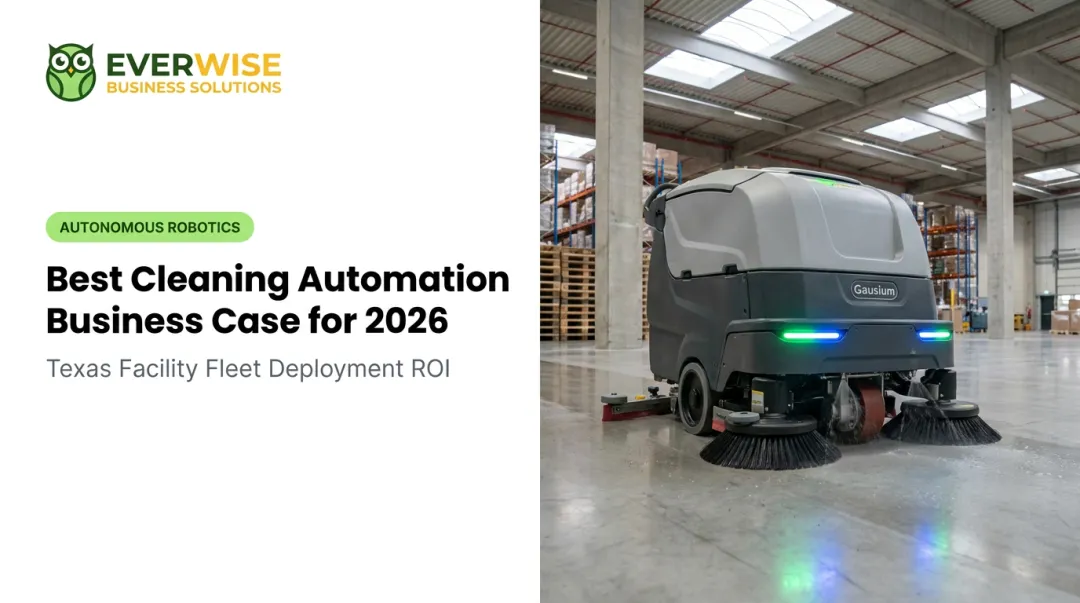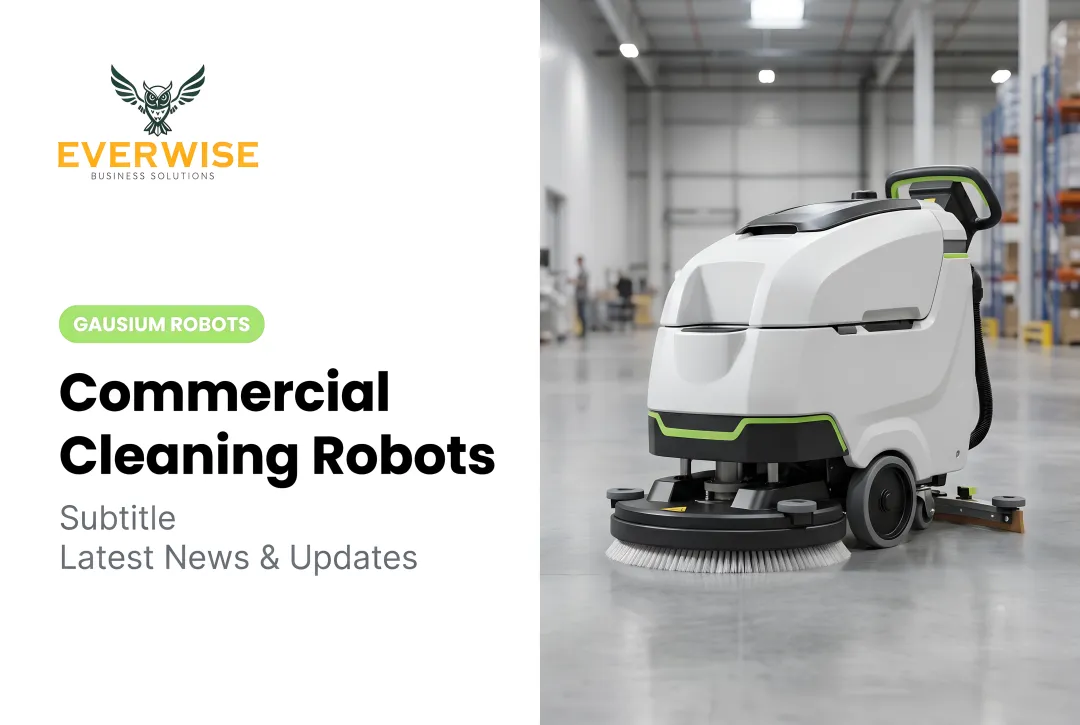
This isn't a niche trend anymore. Professional cleaning robot sales grew 34% year-over-year, with more than 25,000 units sold in the most recent reporting period, according to the International Federation of Robotics. That growth reflects a real shift in how hospitality, healthcare, education, retail, and office operators think about floor care.
For Texas facility managers, the question isn't whether to automate. It's picking the right robot for the right floor. This guide ranks the five commercial floor cleaning robot brands worth evaluating in 2026.
TL;DR
- Commercial robots are industrial-grade scrubbers, not oversized household vacuums
- They cut labor costs, boost consistency, and free staff for higher-value tasks
- Navigation tech, cleaning capacity, filtration, and vendor support separate top performers
- This guide ranks Gausium, Tennant, Kärcher, Avidbots, and ICE Cobotics for 2026
- Texas businesses can get Gausium robots through Everwise, an authorized regional distributor
Overview of Floor Cleaning Robots in the Commercial Cleaning Industry
Commercial floor cleaning robots aren't scaled-up versions of the vacuum sitting in your living room. They're engineered for buildings measured in tens of thousands of square feet, with cleaning demands far beyond a typical household room.
The differences show up everywhere:
- Tank size: Commercial units carry gallons of solution, not cups
- Runtime: Multi-hour operation across full shifts, with auto-charging built in
- Navigation: Industrial-grade LiDAR and 3D depth cameras instead of basic bump sensors
- Scrubbing power: Rotating brush heads and scrubber-dryer combos designed for sealed concrete, tile, and vinyl
These capabilities matter most to a specific buyer profile. Facility managers in hospitality, healthcare, education, retail, manufacturing, and commercial offices are the primary buyers, and their properties share a common problem: large hard-floor footprints, tight labor budgets, and rising hygiene expectations from guests, patients, and regulators alike.
The Technology Driving 2026 Deployments
Three technologies define this generation of robots:
- LiDAR and 3D depth-camera navigation: maps facilities in real time and reroutes around obstacles without human input
- AI-based floor identification: automatically detects hardwood, tile, vinyl, or carpet and adjusts cleaning mode accordingly
- HEPA filtration and edge-cleaning sensors: capture airborne particulates while eliminating the gap along baseboards that older scrubbers always missed
Below, we rank the five Gausium models leading this space for US businesses in 2026.
Top 5 Best Commercial Floor Cleaning Robots for Businesses in 2026
We ranked these five on navigation reliability, cleaning capacity, technology innovation, industry adoption, and the strength of vendor support behind the machine.
Gausium
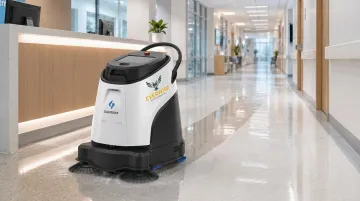
Gausium is a global leader in autonomous commercial cleaning robots, and Everwise Business Solutions serves as its authorized distributor across Texas for hospitality, healthcare, education, retail, and office markets.
What sets Gausium apart is a set of engineering details other brands haven't matched:
- Intelligent floor identification: 3D depth cameras paired with AI detect hardwood, stone, vinyl, or carpet pile depth, then adjust brush height and cleaning mode automatically
- Zero-distance edge cleaning: Reaches directly against walls and corners, leaving no missed strip along baseboards
- Medical-grade H13 HEPA filtration: Available on the Vacuum 40 and Beetle, capturing 99.95% of airborne particles at the most penetrating particle size, per EN 1822 filter classification standards
| Category | Details |
|---|---|
| Technical Specs | 3D depth-camera + AI navigation, smart real-time rerouting, multi-shift autonomous operation with auto-return charging (CD-01/CD-04 docks) |
| Key Features | AI floor-type detection, 0cm edge cleaning, H13 medical-grade HEPA filtration on select models, three carpet-intensity cleaning modes |
| Ideal For | Hospitals, hotels, schools, offices, and retail spaces with mixed hard-floor surfaces |
Tennant Company
Tennant is a long-established US manufacturer of commercial floor care equipment that has expanded into autonomous scrubber technology for large facilities.
The company is known for rugged build quality and its BrainOS-powered fleet management dashboard, which lets multi-site operators track every unit's cleaning coverage from one screen. Its X4 ROVR is purpose-built for mid-sized spaces, while the T7AMR handles far larger footprints.
| Category | Details |
|---|---|
| Technical Specs | X4 ROVR: 10-gallon tank, 2.5-hour runtime, up to 20,000 sq ft/tank. T7AMR: 26-inch cleaning path, 29-gallon tanks, up to 45,760 sq ft coverage, 4–6.5 hour runtime |
| Key Features | BrainOS navigation and reporting, fleet management dashboard, obstacle avoidance |
| Ideal For | Large industrial floor plans and multi-site retail operators |
Kärcher
A globally recognized German cleaning equipment brand, Kärcher entered the autonomous scrubber space with its KIRA series.
Strong brand trust and an established service network back its precision scrubbing, engineered to meet both European and US commercial standards. KIRA units are safety-certified under IEC 63327 for use in occupied public areas, a detail that matters for facilities with heavy foot traffic during cleaning hours.
| Category | Details |
|---|---|
| Technical Specs | KIRA CV 50 (vacuum): 13.7-inch width, 1.18-gallon container, 5,651 sq ft/hr theoretical output. KIRA BR 50 (scrubber): 22-inch brush width, 14.5-gallon tanks, 25,457 sq ft/hr theoretical output |
| Key Features | Customizable cleaning patterns, remote monitoring, IEC 63327 safety certification |
| Ideal For | Airports, shopping malls, and large retail environments |
Avidbots
Avidbots is a robotics company specializing in commercial floor scrubbing robots designed for very large indoor spaces.
Its Neo 2 is recognized for high-capacity coverage and a Command Center platform that generates cleaning verification reports, productivity tracking, and sector-level coverage maps for facility managers who need proof of service, not just a clean floor.
| Category | Details |
|---|---|
| Technical Specs | Up to 42,000 sq ft/hr max coverage, 28.8-gallon solution tank, 35.7-gallon recovery tank, up to 6-hour runtime, 10 onboard sensors for 360-degree visibility |
| Key Features | Cleaning verification reporting, multi-robot fleet coordination, warehouse-specific obstacle detection |
| Ideal For | Warehouses, airports, and convention centers |
ICE Cobotics
Based in the US, ICE Cobotics built its reputation on collaborative robot ("cobot") scrubbers designed to work alongside human cleaning staff.
Its Cobi 18 offers both semi-autonomous and fully autonomous modes, giving facilities flexibility as they transition into automation gradually rather than all at once. The i-SYNERGY IoT system delivers daily performance reports and malfunction alerts straight to a manager's dashboard.
| Category | Details |
|---|---|
| Technical Specs | 18-inch scrubbing path, 2.6-gallon solution tank, 2.9-gallon recovery tank, 5,380–8,500 sq ft/hr productivity |
| Key Features | Location Codes for home positioning, up to 60 saved routes, i-SYNERGY IoT monitoring, semi-autonomous training mode |
| Ideal For | Mid-sized retail stores and educational facilities |
How We Chose the Best Commercial Floor Cleaning Robots
Most buyers make the same mistake: they shop on price alone. A cheap unit that can't navigate a hotel's marble lobby or a hospital's mixed carpet-and-tile corridors ends up costing more in downtime and manual touch-ups than it saves.
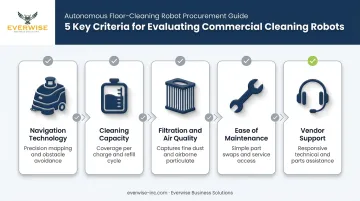
We weighed five factors instead:
- Navigation technology — LiDAR and 3D depth-camera systems reduce missed spots and manual re-cleaning
- Cleaning capacity — tank size and coverage rate determine how much square footage a robot handles per cycle
- Filtration and air quality — H13 HEPA-rated units matter most in healthcare and allergen-sensitive spaces
- Ease of maintenance — parts availability and service network affect uptime
- Vendor support — proximity to a certified technician determines how fast your robot gets back online after a breakdown
Each factor ties to a measurable outcome: better navigation means fewer labor hours spent on touch-ups, and solid vendor support translates directly into faster payback.
According to Cleaning & Maintenance Management, large-scale robotic scrubber investments typically achieve payback within 12 to 18 months when facilities plan their fleet workload correctly and get proper vendor training from day one.
Conclusion
Choosing the right commercial floor cleaning robot partner comes down to matching technology capabilities to your actual operational needs, not just picking the most recognizable name.
Before finalizing a purchase, evaluate:
- Evaluate ongoing maintenance and service support in your region
- Confirm scalability across multiple sites, not just your current location
- Calculate total cost of ownership, including consumables, parts, and financing
Texas-based facility managers ready to explore autonomous floor care can contact Everwise Business Solutions, the authorized Gausium distributor for Texas, for a consultation or onsite demo.
Frequently Asked Questions
Do floor cleaning robots actually work?
Yes. Commercial-grade autonomous robots consistently maintain cleaning results in high-traffic facilities. They work best as part of a broader maintenance program, not as a standalone replacement for a cleaning team.
What is the best robot vacuum with mopping?
For commercial spaces, commercial scrubber-dryer robots like the Gausium Scrubber 75 outperform household mop-vacuum combos in coverage, tank capacity, and durability across multi-hour shifts.
How much do commercial floor cleaning robots cost?
Pricing varies by model and facility size, with most vendors quoting on request. Leasing, subscription, and distributor financing options (including Section 179 depreciation benefits) are often available.
What is the ROI or payback period for an autonomous cleaning robot?
Payback is typically calculated from labor-hour savings, and industry benchmarks point to a 12 to 18 month payback window for large-scale deployments. Actual timelines depend on shift count and facility size.
Do commercial cleaning robots require staff supervision?
Most modern robots operate autonomously with minimal daily oversight. Initial site mapping and periodic maintenance checks are still needed to keep navigation and cleaning quality consistent.
Can floor cleaning robots handle large commercial spaces effectively?
Yes. Robots like the Gausium Beetle Pro and Gausium Marvel use LiDAR and 3D mapping specifically designed to cover tens of thousands of square feet per cleaning cycle.