Autonomous robot floor scrubbers don't solve every problem. But for the specific challenge of floor care — the most time-intensive, repetitive task in most cleaning programs — they deliver outcomes that are measurable, consistent, and compounding.
This article covers five concrete benefits that maintenance teams and operations managers actually track when they deploy autonomous scrubbers.
Key Takeaways
- Robots handle repetitive floor scrubbing, freeing staff for higher-value work
- Programmed routes deliver consistent coverage that manual cleaning can't reliably match
- Labor costs drop when robots cover floor care shifts with fewer dedicated operators
- Cord-free, battery-powered operation with built-in obstacle detection cuts slip and trip hazards
- Schedules run as planned — no disruptions from call-outs, turnover, or staffing gaps
What Are Autonomous Robot Floor Scrubbers?
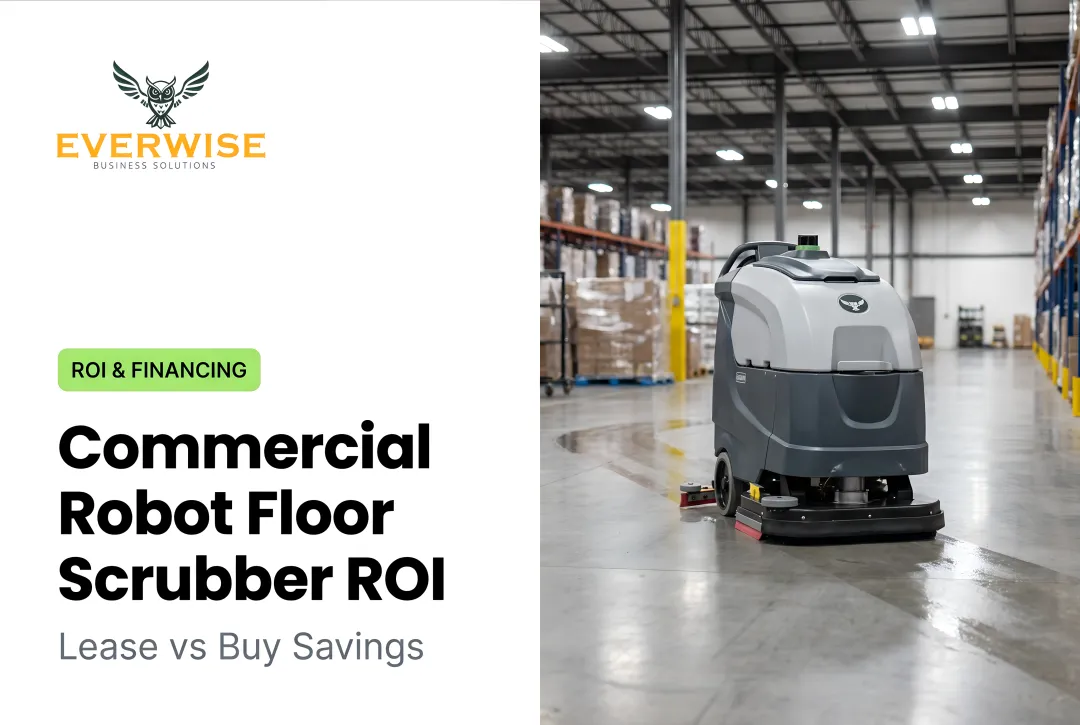
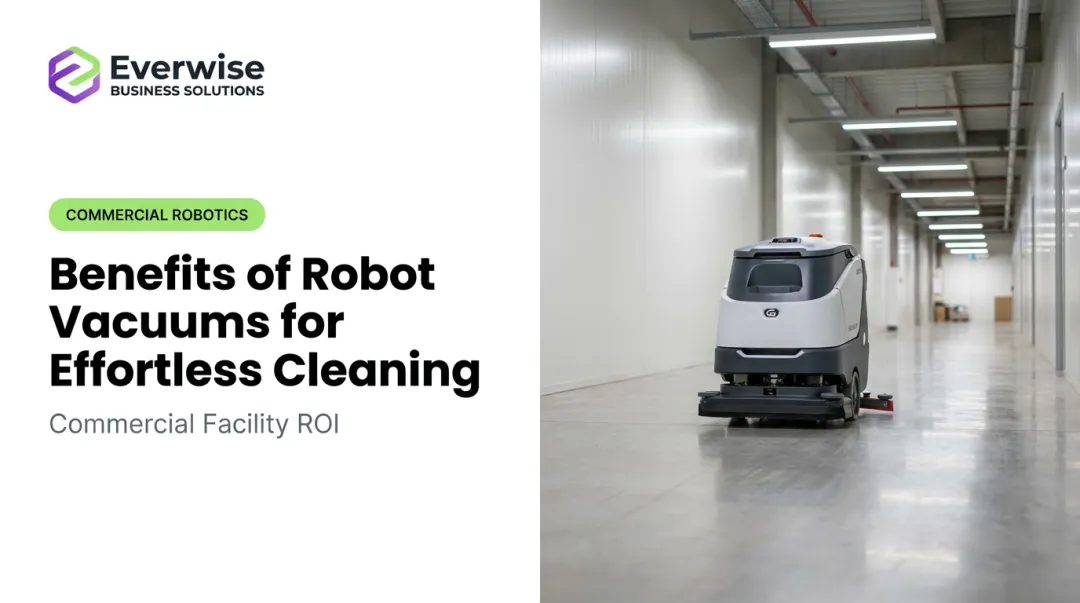
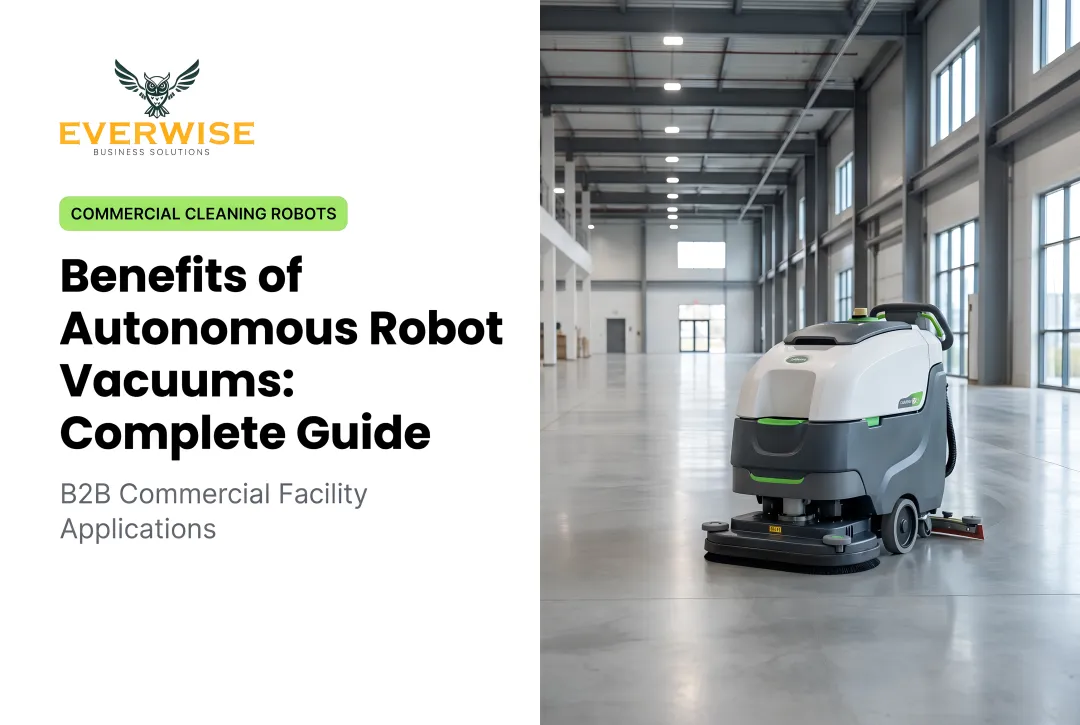
Autonomous robot floor scrubbers are battery-powered commercial cleaning machines that scrub and dry hard floor surfaces without a human operator guiding them in real time. They use LiDAR, 3D cameras, ultrasonic sensors, and AI to map spaces, follow programmed cleaning routes, and reroute around obstacles.
They're built for large indoor hard-floor environments — hospitals, hotels, warehouses, schools, airports, and retail centers — where daily floor maintenance is a non-negotiable operational requirement.
The Gausium Scrubber 75 — available through Everwise Business Solutions across Texas — is one example built for this work. It handles large floor areas autonomously, with operators monitoring and scheduling cleaning runs remotely through the Gausium Mobile App.
5 Benefits of Autonomous Robot Floor Scrubbers for Maintenance
Each benefit below connects to KPIs maintenance teams and facility managers actively measure — labor hours, cost per square foot, incident reports, cleaning coverage, and schedule adherence.
Benefit 1: Greater Staff Productivity Through Task Redeployment
Floor scrubbing is the single most time-consuming task in most commercial cleaning programs. It ties an operator to a machine for the bulk of a shift, leaving less time for sanitizing high-touch surfaces, restocking supplies, or handling visitor-facing needs.
Autonomous scrubbers remove that bottleneck. A cleaning route is mapped once, then the robot repeats it autonomously each shift. Setup and periodic oversight replace constant supervision, freeing staff for sanitizing, supply runs, and the visitor-facing tasks that actually require a human presence.
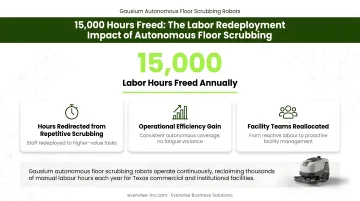
The redeployment effect is documented in real deployments. Tennant reports that FlagShip Facility Services — managing airport cleaning operations — reallocated more than 15,000 labor hours in the first year of robotic scrubber deployment, while the machines cleaned up to 115,000 sq ft per overnight shift.
This matters most in:
- Hospitals and hotels with large floor footprints where scrubbing consumes entire shifts
- Convention centers and airports where cleaning windows are short and floor areas are vast
- Any facility where staffing is lean and every labor hour needs to count
Benefit 2: Consistent, Measurable Cleaning Quality
Manual floor scrubbing is inherently inconsistent. Fatigue sets in. Routes drift. High-traffic areas near doorways get over-cleaned while corridors and corners get skipped. There's no data trail — just the results of whoever worked that shift.
Autonomous scrubbers follow programmed paths that cover the same area the same way, every time. Sensors map the space, detect zones, and can be configured with different cleaning intensities for high-traffic versus low-traffic areas. Nilfisk reports that route-mapping technology on its Liberty SC50 and SC60 models delivers 98% to 99.5% floor coverage — a benchmark that manual methods can't consistently approach.
KPIs directly affected:
- Cleaning coverage rate
- Rework frequency
- Facility inspection pass rates
- Visitor and patient satisfaction scores
For healthcare and food service environments, the stakes are regulatory, not just operational. CDC guidance states that floors in healthcare facilities should be cleaned daily, with more frequent cleaning in higher-risk situations. Inconsistent manual coverage creates compliance gaps that autonomous systems are built to eliminate.
Benefit 3: Reduced Labor and Operational Costs
According to APPA, labor accounts for approximately 90% of custodial costs, with supplies making up the remaining 10%. That ratio means any reduction in floor care labor hours has an outsized impact on the overall maintenance budget.
In practice, one autonomous scrubber can handle floor care during off-hours or alongside a reduced crew, cutting the number of dedicated floor care operators needed per shift. The savings compound: fewer hours at $17–$18/hour, across five or seven shifts per week, adds up fast.
Nilfisk's ROI model for a 45,000 sq ft facility — running a robot seven days per week at a $22.50/hour labor cost — projects annual labor savings of $24,570 and a payback window of 14 to 36 months depending on machine cost and usage intensity.
Those numbers scale with facility size and operating frequency. The advantage is strongest when:
- Floor areas exceed 20,000 sq ft
- Cleaning runs multiple shifts per week
- Wage inflation or chronic understaffing is straining the janitorial budget
- Leadership needs to scale cleaning capacity without adding headcount
Beyond labor, some models extend savings further. Gausium scrubbers distributed by Everwise Business Solutions use 3D depth cameras and AI to identify floor types and adjust chemical and water output accordingly, which trims supply costs on top of the labor reduction.
Benefit 4: Improved Workplace Safety
Two of the most common causes of cleaning-related injuries are wet floors left behind by mop-and-bucket methods, and cord-related trips from traditional electric scrubbers. OSHA's hospital eTool explicitly identifies wet floors and clutter as primary slip, trip, and fall hazards — and BLS data shows falls, slips, and trips accounted for 479,480 days-away-from-work cases across all industries in 2024.
Autonomous scrubbers address both hazards directly:
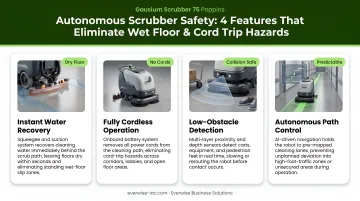
- Dry floors after every pass — scrubbing and drying happen in a single cycle, not separately
- No power cords — battery-operated machines eliminate trip hazards entirely
- Obstacle detection — LiDAR, 3D cameras, and ultrasonic sensors stop or reroute the machine when a person enters its path
- No operator fatigue — repetitive physical pushing and turning is removed from the human workload
This benefit carries the most weight in high-traffic areas — hospital corridors, hotel lobbies, retail floors — where wet surfaces and moving foot traffic intersect during cleaning windows. The metrics that move: worker injury rate, OSHA incident logs, workers' compensation claims, and absenteeism tied to cleaning-related injuries.
Benefit 5: Operational Continuity, Independent of Staffing Gaps
When a cleaning staff member calls out sick, manual floor scrubbing simply doesn't happen. The route stays undone until someone covers the shift — or it doesn't get done at all.
This isn't a minor inconvenience. BLS projects 351,300 average annual openings for janitors and building cleaners through 2034, and CMM has reported turnover rates in cleaning contracting that occasionally hit 300%. A cleaning operation built entirely on human availability is one call-out away from a missed route.
Autonomous scrubbers run on programmed schedules. Call-outs don't affect them. Turnover doesn't affect them. The floor gets cleaned because the machine is scheduled to clean it — not because the right person happened to show up.
Denver Public Schools deployed Tennant robotic floor scrubbers between 2021 and 2024 specifically to address staffing gaps alongside productivity goals, with each unit running autonomously roughly 90 minutes per day and covering approximately 21,000 sq ft.
KPIs impacted:
- Cleaning schedule adherence
- Facility inspection readiness
- Manager escalations for missed cleaning
- Overtime costs to cover staffing gaps
What Happens When Autonomous Cleaning Is Skipped or Delayed
Skipping routine floor maintenance doesn't just mean a dirtier floor today. It means a harder, more expensive problem tomorrow.
Grime accumulates in grout lines, finish degrades under foot traffic, and surface buildup eventually requires deep-cleaning interventions — strip and refinish work that costs $0.30–$0.60 per sq ft compared to routine maintenance rates. Deferred maintenance doesn't save money — it shifts costs forward and amplifies them.
Beyond the cleaning budget, skipping floor care creates compounding operational exposure:
- OSHA compliance exposure — dirty and wet floors violate walking-working surface standards
- Healthcare inspection risk — CDC daily cleaning requirements go unmet
- Customer perception damage — ISSA's 2025 global survey found 100% of respondents agreed a visibly dirty facility reflects poorly on the establishment
- Injury liability — skipped cleaning leaves hazardous surfaces unaddressed
When floor care depends entirely on manual labor, staffing gaps, variable effort, and human error make these risks unpredictable. Autonomous systems run on a fixed schedule regardless of staffing levels — keeping floors clean, compliant, and documented without relying on individual follow-through.
How to Get the Most Out of Your Autonomous Floor Scrubber
Autonomous scrubbers work best as part of a structured maintenance program, not as standalone equipment left to run without oversight.
Practical steps for maximizing results:
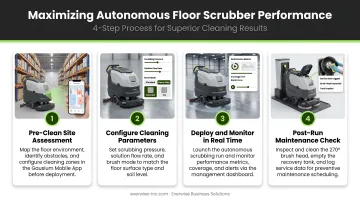
- Train staff on setup and route programming — operators should know how to initialize a route, troubleshoot basic issues, and recognize when to escalate maintenance needs
- Review machine logs regularly — cleaning coverage data reveals gaps in route coverage, areas the machine consistently avoids, and scheduling inefficiencies
- Adjust for seasonal or operational changes — high-traffic zones shift with tenant changes, events, and seasonal foot traffic; routes should be updated accordingly
- Schedule preventive maintenance proactively — regular inspections, brush replacements, and sensor checks prevent small issues from becoming costly repairs and keep the machine running at full coverage capacity
Most facilities see measurable gains within the first 60–90 days as routes stabilize and staff build routines around the machine's schedule. Floor care costs per square foot trend down steadily from there. Everwise Business Solutions supports this process as an authorized Gausium distributor in Texas, offering maintenance services and technical support to keep machines performing at spec.
Conclusion
The five benefits of autonomous robot floor scrubbers — productivity gains, cleaning consistency, cost reduction, workplace safety, and operational continuity — each represent a measurable improvement to daily maintenance operations. None of them require waiting for some future version of the technology. They're available now, in commercial-grade equipment built for exactly the environments Texas facility managers operate.
For Texas facilities ready to move from reactive floor care to a reliable automated standard, Everwise Business Solutions is the authorized Texas distributor of Gausium Autonomous Cleaning Robots — with locations in San Antonio and Pharr.
Contact them at 210.884.0559 or german.zavala@everwise-inc.com to find out which robot fits your facility's floor area and cleaning requirements.
Frequently Asked Questions
What are the benefits of autonomous robot floor scrubbers?
The core benefits are labor savings, consistent floor coverage, reduced workplace injuries, and the ability to maintain cleaning schedules even when staff call out. Over time, reduced rework and lower per-square-foot cleaning costs add up to meaningful budget impact.
What is the life expectancy of an autonomous robot floor scrubber?
Commercial-grade models are built for multi-year operation under regular use. Lifespan varies by brand, usage intensity, and maintenance practices — regular brush, pad, and battery care can significantly extend functional life. Everwise Business Solutions provides maintenance services and can advise on manufacturer-specific service schedules for Gausium models.
How much can autonomous floor scrubbers reduce labor costs?
Savings scale with floor area, cleaning frequency, and local labor rates. Nilfisk's model projects roughly $24,570 in annual labor savings for a 45,000 sq ft facility running seven days per week. Larger facilities with multiple daily shifts see proportionally larger reductions.
Are autonomous floor scrubbers safe to use around people?
Yes. Commercial autonomous scrubbers use LiDAR, 3D cameras, and ultrasonic sensors to detect obstacles — including people — and stop or reroute before contact. They're designed for occupied commercial spaces and are used routinely in hospitals, hotels, and airports.
What types of facilities benefit most from autonomous floor scrubbers?
Facilities with large hard-floor areas and high daily foot traffic see the strongest return — hospitals, hotels, warehouses, schools, airports, and retail centers. Higher cleaning frequency and larger floor footprints both accelerate the payback period.
How do autonomous floor scrubbers compare to traditional manual scrubbers?
Manual scrubbers require a dedicated operator and deliver results that vary with operator skill, fatigue, and route adherence. Autonomous scrubbers follow consistent programmed routes, cover more floor area per shift, and generate data logs. That reporting gives facility managers operational visibility that manual cleaning simply can't match.