That gap between "robots are running" and "robots are performing" is exactly what fleet management solves.
This guide covers what cleaning robot fleet management actually is, why the business case is stronger than most facility managers realize, the system features worth paying for, the metrics that reveal true performance, and how to scale from a pilot deployment to a multi-location operation.
Key Takeaways
- Fleet management means centralized control of multiple robots, not simply owning them
- The commercial cleaning robot market is projected to grow from $1.78B to $6.4B by 2030
- Five metrics matter most: autonomous usage rate, coverage area, route completion, operator assists, and battery trends
- Fleet management becomes essential at 2-3+ robots or any multi-location deployment
- Gausium robots include built-in remote management tools, making fleet oversight accessible from a single mobile app
What Is Cleaning Robot Fleet Management?
Cleaning robot fleet management is the centralized monitoring, scheduling, coordination, and optimization of multiple autonomous cleaning robots operating across one or more facilities. Most facilities that "deploy robots" are actually just running individual machines in isolation — which isn't the same thing.
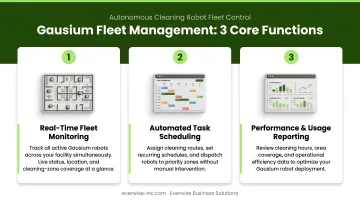
The Three Core Functions
A genuine fleet management system does three things that basic robot monitoring doesn't:
- Real-time status monitoring — exact location, current task, and active alerts for every robot in the fleet, updated continuously
- Active task and route modification — changing assignments, rerouting robots, or canceling tasks remotely without touching the machine
- Resource allocation optimization — distributing cleaning coverage intelligently across robots, zones, and time windows to meet facility-wide cleanliness goals
What fleet management is not: a vendor app that shows battery percentage and a green/red status light. That's basic telemetry. Fleet management gives a single manager centralized, actionable control across multiple robots and sites — with the tools to respond, reassign, and resolve issues without leaving the dashboard.
Why Businesses Are Investing in Cleaning Robot Fleets
The numbers tell a straightforward story. According to Grand View Research, the global commercial cleaning robot market was valued at $1.78 billion in 2024 and is projected to reach $6.4 billion by 2030 — a 24.3% compound annual growth rate. Three operational pressures are driving that adoption:
- Labor costs — The BLS reports approximately 2.4 million janitors employed in 2024 at a median hourly wage of $17.27, with just 2% projected growth through 2034 — the labor pool isn't expanding to meet demand
- Retention challenges — Janitorial roles carry some of the highest turnover rates in any service sector, creating chronic coverage gaps that robots don't have
- Post-pandemic cleanliness expectations — Facilities across hospitality, healthcare, and education face ongoing pressure to document cleaning compliance, not just perform it
The Cost of Operating Without Fleet Management
Facilities that run robots without structured fleet management consistently face:
- Unplanned robot downtime from missed preventive maintenance
- Coverage gaps that go undetected until a complaint surfaces
- Higher total cost of ownership due to reactive rather than proactive maintenance
The DOE's Operations and Maintenance Best Practices Guide estimates preventive maintenance reduces costs 12–18% compared to reactive maintenance — a ratio that applies directly to cleaning robot operations. A robot that stops mid-shift because a brush motor failed costs more to fix than one maintained on a schedule.
That cost equation shifts quickly as deployments grow. The threshold for needing fleet management is typically 2–3 robots or any multi-location deployment — the point where manual oversight becomes operationally unsustainable without centralized tools.
Core Features of a Cleaning Robot Fleet Management System
Not all fleet management platforms are equal. Here's what separates useful systems from overpriced dashboards.
Real-Time Status Monitoring
A unified dashboard should display, for every robot in the fleet:
- Current location within the facility map
- Operational status (running, docked, paused, error state)
- Battery charge level and estimated runtime remaining
- Active error codes with severity indicators
- Route completion percentage for the current shift
The value here is consolidation. Without it, a manager overseeing four locations is logging into four separate vendor portals and doing mental math. That's reactive monitoring, not proactive management.
Intelligent Task and Route Scheduling
Good fleet management software assigns cleaning routes based on:
- Facility layout and zone definitions
- Traffic patterns and operating hours
- Robot availability and battery status
- Zone priority (high-traffic areas vs. back-of-house)
The system should prevent scheduling conflicts — two robots assigned to the same zone, or a robot scheduled during peak foot traffic when it will be interrupted constantly.
Automated Maintenance Alerts
Calendar-based maintenance schedules don't account for actual usage — and that gap costs facilities in downtime and premature wear. A robot running 14 hours a day needs brush and filter replacement far sooner than one running 4 hours a day.
Effective systems trigger preventive maintenance work orders based on operating hours, not dates. This protects battery health, navigation sensor accuracy, and overall reliability.
Performance Analytics and Reporting
Reporting capabilities should cover:
- Autonomous usage rate per robot per shift
- Square footage cleaned vs. assigned target
- Operator assist frequency by location and time window
- Route efficiency trends over time
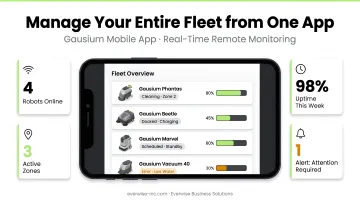
Gausium's autonomous cleaning robots — distributed across Texas by Everwise Business Solutions — include built-in remote management through the Gausium Mobile App. Models such as the Vacuum 40, Omnie, Scrubber 75, and Marvel support this functionality, letting operators monitor tasks, check status, and adjust schedules from any location. Contact Everwise at 210.884.0559 for details on multi-unit fleet configurations.
Key Performance Metrics to Track
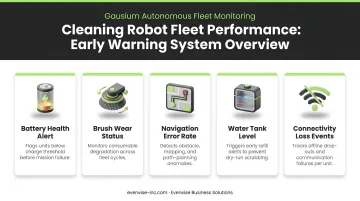
The metrics you monitor determine whether your fleet runs on insight or on guesswork. These five indicators give facility managers an early warning system — before problems surface as complaints or downtime.
Autonomous Usage Rate
Measures how much of the robot's operating time is spent in autonomous mode vs. manual mode. The goal is maximizing autonomous operation — a robot that requires frequent manual intervention isn't delivering its core value.
Low scores typically point to route design problems, inadequate staff training on when not to intervene, or environmental conditions that weren't accounted for during mapping.
Daily Coverage Area
Square footage cleaned per robot per shift, measured against the assigned target. Gaps in coverage maps reveal specific problem zones — areas where obstacles, tight corridors, or poor route design is causing robots to skip sections repeatedly.
Route Completion Rate
A declining route completion rate is an early warning signal. A drop from 97% to 85% over two weeks suggests one of three things:
- Sensor calibration drift requiring maintenance
- Map data that no longer matches the current floor layout
- Persistent debris or obstacles interfering with the navigation system
Catching this trend at week one beats catching it after a tenant complaint.
Operator Assist Count
Every time a human intervenes to help a robot complete a task, it should be logged. High assist counts at specific locations or during specific time windows reveal:
- Route design issues in those zones
- Environmental conditions (wet floors, heavy foot traffic, temporary equipment) creating repeated bottlenecks
- Training gaps where staff are over-intervening instead of letting the robot handle normal navigation challenges
Battery Health and Discharge Rate Trends
Rather than waiting for runtime to drop below acceptable thresholds, track discharge rate per operating hour over time. A battery that once ran 6 hours per charge and now delivers 4.5 hours signals early battery degradation — often months before it causes a mid-shift shutdown. Catching that curve early is what extends battery lifespan and keeps routes on schedule.
How to Set Up and Scale Your Cleaning Robot Fleet
Laying the Groundwork: Mapping and Deployment
Before a robot cleans a single square foot, the environment needs to be accurately mapped. Gausium robots use 3D depth cameras and AI navigation to build and maintain facility maps. Stale or inaccurate maps are one of the most common causes of route completion failures — a map that doesn't reflect a new partition wall or relocated equipment will produce route errors every shift until corrected.
During initial deployment, every robot should be registered as a tracked asset with:
- Serial number and firmware version
- Deployment location and assigned zones
- Warranty expiry date
- Operating hour baseline at deployment
This documentation makes warranty claims, capital planning, and maintenance history tracking possible.
Setting Goals and Training Your Team
Define KPI targets before going live — not after. Establish specific benchmarks for:
- Autonomous usage rate target per shift
- Daily square footage coverage expectation per robot
- Maximum acceptable operator assists per shift
Train facility staff on the distinction between supporting robots (clearing unexpected obstacles, refilling solution tanks, returning a robot to its dock) and over-supervising them. The goal is designing routes and environments that minimize intervention — not creating a new layer of manual work on top of an automated system.
Scaling from Pilot to Multi-Location Fleet
When expanding beyond a pilot, the mapping and registration process must be repeated for each new location — not assumed to transfer. Each site has its own layout, traffic patterns, and cleaning environment.
Those differences are exactly why cross-site visibility matters. Multi-site fleet management delivers its full value when managers can compare performance metrics across all locations from a single view — identifying which site has a declining route completion rate and addressing it before coverage degrades noticeably.
Texas facilities deploying Gausium robots across multiple sites can reach Everwise Business Solutions at 210.884.0559 for help with site mapping, fleet registration, and multi-location configuration.
Industries That Benefit Most
Some facility types see faster, more measurable returns from fleet management than others. Here's where the impact is most pronounced.
Hospitality and retail — Hotels, airports, malls, and large retail stores operate extended hours with near-zero tolerance for visible cleanliness issues. Fleet management enables:
- Scheduling during low-traffic windows without manual oversight
- Remote zone verification across multiple properties
- Consistent standards without adding supervisory staff
Frankfurt Airport's Terminal 1 is a concrete example of this working at scale across a high-footprint, high-traffic environment.
Healthcare and education — Hospitals, clinics, schools, and university campuses must document cleaning compliance across many distinct zones. Brain Corp's deployment at Scripps Health facilities demonstrated how robotic scrubbers provide visible proof of cleaning alongside real operational efficiency. Route completion and coverage data give facility managers what they need to verify standards are being met.
Commercial office and manufacturing — Large office buildings and manufacturing facilities need to coordinate robots across floors and zones, prevent traffic conflicts, and scale up after high-demand periods. Veritiv's deployment of T16AMR robotic scrubbers across 23 facilities — cleaning over 470 million square feet autonomously — shows what fleet operations look like at full scale.
Frequently Asked Questions
What is cleaning robot fleet management?
It's the centralized system for monitoring, scheduling, and optimizing multiple autonomous cleaning robots across one or more facilities. Rather than managing each robot individually, fleet management gives you actionable control from a single interface.
How many robots do I need before fleet management becomes necessary?
Fleet management becomes valuable at 2–3 robots, or whenever you're managing robots across more than one location — at that scale, tracking individual machines manually becomes impractical without centralized tools.
Can cleaning robot fleets be managed remotely?
Yes. Cloud-based fleet management platforms push real-time status updates, performance metrics, and alerts directly to mobile devices. The Gausium Mobile App, for example, lets managers verify cleaning completion and flag issues from anywhere — no on-site presence required.
What metrics should I track to measure fleet performance?
The five that matter most: autonomous usage rate, daily square footage covered, route completion rate, operator assist count, and battery discharge trends. Tracked together, these metrics tell you where robots are underperforming and where facility conditions need attention.
How does fleet management software reduce cleaning costs?
Fleet management software cuts costs in three ways:
- Proactive maintenance alerts prevent unplanned downtime before it disrupts operations
- Utilization optimization means robots cover more area per shift with less idle time
- Multi-location oversight lets managers handle more facilities without adding supervisory staff
What industries benefit most from cleaning robot fleet management?
Hospitality, healthcare, education, retail, and commercial office environments see the highest value — particularly where consistent cleaning standards, multi-location management, and compliance documentation are ongoing operational requirements.