Key Takeaways
- HAIs affect 1 in 31 hospital patients daily, making consistent floor hygiene a serious infection control issue
- Robotic floor scrubbers automate large-area cleaning, freeing EVS staff for high-touch surface work
- Key healthcare features to prioritize: H13 HEPA filtration, AI obstacle detection, zero-edge cleaning, and compliance reporting
- ROI comes from labor reallocation, reduced chemical use, and consistent cleaning outcomes
- Everwise Business Solutions distributes Gausium robotic scrubbers to healthcare facilities across Texas
Why Hospital Floors Are a Real Infection Risk
Healthcare facilities face a cleaning challenge most commercial buildings don't. According to the CDC, on any given day approximately 1 in 31 hospital patients has at least one healthcare-associated infection (HAI). AHRQ estimates these infections add $28–$33 billion in excess healthcare costs annually.
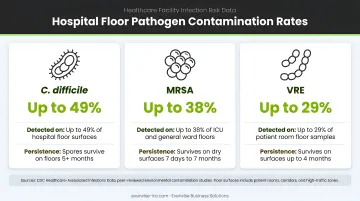
Floors are a bigger part of the problem than many assume. A study of 120 floor sites across four hospitals found 72% tested positive for C. difficile, 22% for MRSA, and 33% for VRE. A separate AJIC study of 318 floor sites in 159 patient rooms confirmed that contaminated floors routinely transfer pathogens to hands, socks, bedding, and nearby objects — creating a direct transmission pathway.
The EVS Staffing Reality
Despite the stakes, Environmental Services departments are stretched thin:
- 1 in 5 healthcare workers left their organizations in 2023, per AHA's 2025 Workforce Scan
- Up to two-thirds of EVS employees report working in chronically understaffed positions
- Pandemic-era cleaning protocols increased workloads without proportional staffing increases
Accreditation and Documentation Requirements
Accreditation standards add a documentation burden that manual cleaning struggles to meet. CDC environmental cleaning guidance requires:
- Written cleaning schedules with assigned staff responsibilities
- Cleaning frequency logs for each area or surface type
- Verification records through ATP testing or fluorescent markers
The Joint Commission mirrors this through infection prevention standards that mandate evidence-based cleaning practices. For EVS teams already running lean, generating and maintaining that paper trail manually creates real compliance risk.
How Robotic Floor Scrubbers Work in Healthcare Settings
An autonomous floor scrubber applies cleaning solution, agitates the surface with brushes or pads, then vacuums up the dirty water — all without a human operator during the cleaning cycle. Understanding how these systems navigate and integrate with your EVS team helps set realistic expectations before deployment.
Navigation and Mapping
Modern healthcare robotic scrubbers use a combination of sensors and onboard AI to map and navigate complex environments:
- LiDAR creates a precise floor-level map of corridors, rooms, and obstacles
- 3D depth cameras detect changes in elevation and objects at varying heights
- AI processing optimizes cleaning paths and updates the map in real time
During initial setup, a technician guides the robot through the facility to establish a baseline map. Cleaning zones, schedules, and routes are then programmed from that foundation.
For facility managers evaluating this technology, Gausium robots distributed by Everwise Business Solutions use this same navigation framework. The Gausium Mobile App provides remote monitoring and schedule management — so staff can check cleaning status, adjust routes, and receive alerts without being on-site.
The Human-Robot Collaboration Model
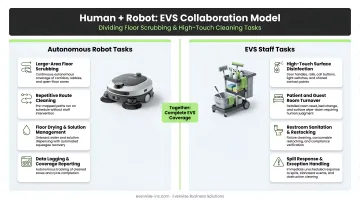
Robots cover what they do consistently well: repetitive, large-area floor cleaning at scheduled intervals. Human EVS staff focus on what requires judgment — patient rooms, high-touch surfaces, isolation areas, and spill response.
The result is a division of labor where neither side is stretched thin. Staff spend less time on rote floor passes and more time on tasks that genuinely need human attention.
Key Benefits for Healthcare Facilities
Infection Control Through Consistency
Manual cleaning quality varies. Staff fatigue, time pressure, and inconsistent technique create gaps — and pathogens fill those gaps. Robotic scrubbers eliminate that variability. Every scheduled cleaning run covers the same area with the same pressure, solution concentration, and pass pattern.
Reusing traditional mop heads has been shown to increase bacterial contamination on floors. Robotic scrubbers use contained recovery tanks, meaning dirty water never re-contacts the floor surface — reducing cross-contamination risk between zones.
Around-the-Clock Coverage
Robots don't need breaks, and scheduling a 2 AM cleaning run is as simple as a few taps in the management software. Key operational advantages:
- Overnight runs clean high-traffic areas before the next day's patient activity
- Off-peak scheduling keeps wet floors out of busy corridors during peak hours
- Multi-zone programming allows different areas to be cleaned at different frequencies within the same facility
Reduced Chemical and Water Consumption
Robotic scrubbers use precision-controlled dispensing, applying only the solution volume required for the floor area being cleaned. There's no over-diluting, no excessive application on already-clean sections, and no wasted solution from bucket changes.
For healthcare facilities tracking EPA Safer Choice compliance or Green Seal standards, this consistency also supports documentation of responsible chemical use.
Staff Empowerment, Not Displacement
Removing repetitive floor scrubbing from EVS daily tasks has clear workforce benefits:
- Reduced physical strain from pushing heavy scrubbers across large floor areas
- Lower burnout risk from monotonous, physically demanding work
- Time redirected to disinfecting high-touch surfaces, restrooms, and patient rooms
- Ability to maintain cleaning quality without increasing headcount
Patient Perception and HCAHPS
Cleanliness is an explicit item on the HCAHPS survey — CMS asks patients directly how often their room and bathroom were kept clean, and results feed into Hospital Value-Based Purchasing scores. Research shows room cleanliness correlates with overall hospital ratings. A visibly active cleaning robot in a lobby or corridor also sends a clear signal to patients and visitors that hygiene is a priority, not an afterthought.
Must-Have Features for Healthcare Environments
Not all robotic scrubbers are built for healthcare. Here's what to look for:
Advanced Obstacle Detection
Hospital corridors are anything but static — wheelchairs, supply carts, mobile equipment, and people appear unpredictably. A healthcare-grade robot needs real-time rerouting, not just a pause-and-wait response. Look for:
- 3D depth cameras combined with LiDAR for multi-layer obstacle detection
- AI-powered navigation that updates the internal map dynamically
- Safe, gradual stopping behavior that doesn't startle patients or staff
H13 HEPA Air Filtration
Floor scrubbing disturbs settled particles. In a healthcare environment, those particles can include respiratory pathogens, fine dust, and allergens. EPA defines HEPA filters as capturing 99.97% of particles at 0.3 microns — the hardest size to filter. H13 HEPA under EN 1822 exceeds that at ≥99.95% overall efficiency.
The Gausium Vacuum 40 includes H13 HEPA air purification as a standard feature, capturing fine dust, allergens, and harmful particles so exhaust air stays clean during operation. In occupied patient areas, that exhaust quality directly affects air safety for vulnerable individuals. Everwise Business Solutions carries the Vacuum 40 for healthcare facilities across Texas.
Edge and Corner Coverage
Pathogen accumulation concentrates along baseboards, under equipment frames, and in corners — the spots where traditional mops and scrubbers consistently fall short. Zero-distance edge cleaning technology uses high-precision sensors and extended side brushes to deliver complete wall-to-wall coverage. The Vacuum 40 includes this as a standard feature.
AI Floor Identification
Healthcare facilities use vinyl, tile, epoxy, and concrete across different zones. A robot that applies the same pressure and solution volume to polished vinyl and rough concrete will underperform on one and potentially damage the other. Gausium's AI-driven floor identification uses 3D depth cameras to auto-detect surface type and adjust cleaning mode and brush height accordingly.
Compliance Reporting
EVS managers need proof-of-clean records for accreditation reviews, internal audits, and infection control documentation. The Gausium Mobile App provides real-time monitoring, cleaning status updates, and schedule management. For facilities with specific documentation requirements, contact Everwise Business Solutions to discuss reporting capabilities in detail.
Where Robots Make the Biggest Difference in a Hospital
Not every area in a hospital benefits equally from automation. Robots deliver the most value in high-traffic, open-floor zones where consistency and frequency matter most.
| Location | Why Robots Work Well Here |
|---|---|
| Lobbies and main corridors | High foot traffic, high visibility — consistent cleaning reinforces patient trust |
| Outpatient and pre-op hallways | Proximity to patient care requires frequent, reliable cleaning between procedures |
| Cafeterias and waiting rooms | Large open floor areas ideal for overnight autonomous coverage |
| Administrative wings | Low clinical priority but still require routine sanitation — robots handle this without consuming EVS staff time |
Robots aren't the right fit for patient rooms, isolation areas, and spaces with complex furniture layouts — those remain human EVS territory where judgment and flexibility matter.
The ROI Case: What to Calculate Before You Buy
Robotic floor scrubbers require a higher upfront investment than manual equipment. The business case depends on what you count on the other side of the ledger.
Labor Reallocation Value
The strongest ROI argument isn't headcount reduction — it's reallocation. Floor scrubbing is time-intensive, physically demanding, and highly repetitive. Hours freed from that task can be redirected to:
- Increased frequency of high-touch surface disinfection
- Deeper cleaning in patient rooms and bathrooms
- Better coverage during peak-demand periods
For hospitals facing EVS understaffing, this means maintaining cleaning standards without hiring, which has direct budget implications.
Financial Pressure From HAIs
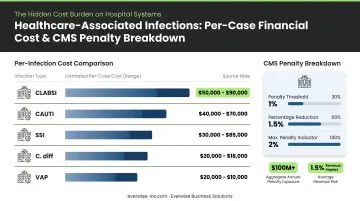
CMS does not reimburse additional costs for hospital-acquired conditions that were not present on admission. Hospitals in the top quartile for HAC scores face a 1% reduction on Medicare fee-for-service payments. A JAMA Internal Medicine meta-analysis put per-case costs at $45,814 for CLABSI, $40,144 for VAP, and $11,285 for CDI. Even marginal improvements in environmental cleanliness reduce financial exposure.
Sourcing Robotic Scrubbers in Texas
Once the financial case is clear, the next step is finding the right equipment and local support. Texas healthcare facilities can explore Gausium autonomous floor scrubbers through Everwise Business Solutions, the authorized Texas distributor headquartered in San Antonio with a branch in Pharr.
Available models include healthcare-relevant capabilities:
- H13 HEPA filtration for medical-grade air quality
- AI floor identification for surface-appropriate cleaning
- Zero-distance edge cleaning with high-precision sensors
- Remote management for facility-wide oversight
Everwise provides local maintenance service and technical support alongside each unit. Contact them directly for pricing.
Reach Everwise Business Solutions at 210.884.0559 or german.zavala@everwise-inc.com (Monday–Friday, 9:00 AM–6:00 PM).
Frequently Asked Questions
Can robotic floor scrubbers replace human cleaning staff in hospitals?
No — they're designed to work alongside EVS teams, not replace them. Robots take over repetitive large-area scrubbing so human staff can focus on patient rooms, high-touch surfaces, and tasks that require judgment and flexibility.
Are robotic floor scrubbers safe to use around patients and staff?
Yes. Modern healthcare robotic scrubbers use AI-powered obstacle detection and real-time rerouting to navigate safely around people, wheelchairs, and equipment. When an obstacle appears, they slow and reroute rather than stopping abruptly.
How do robotic floor scrubbers help reduce HAI risk?
Consistent, automated scrubbing eliminates the variability of manual cleaning and prevents cross-contamination from reused mop heads. Some models, including the Gausium Vacuum 40, add H13 HEPA filtration to reduce airborne particle load during operation.
What floor types can robotic scrubbers handle in a healthcare facility?
Most advanced models handle vinyl, tile, epoxy, and concrete — the surfaces most common in hospitals. Gausium's AI floor identification auto-detects surface type and adjusts cleaning mode accordingly, reducing the need for manual configuration.
How long does setup take in a hospital?
Initial setup involves a facility walkthrough to create the navigation map, followed by programming of cleaning zones and schedules. The process typically takes 1–3 sessions and can be updated as the facility layout changes.
What's the typical ROI timeline for a robotic scrubber in healthcare?
No universal payback period applies across all facilities. ROI is driven by labor hour reallocation, reduced chemical and water consumption, and avoided costs from HAI-related penalties and non-reimbursement — factors that vary significantly by facility size and operations.