The pressure driving adoption is real. Facility managers face persistent labor shortages, rising janitorial costs, and tightening hygiene standards that show no signs of easing. The U.S. Bureau of Labor Statistics projects roughly 351,300 janitor and building cleaner job openings annually through 2034 — not because the workforce is growing, but because turnover replacement demand is relentless.
This article covers what's actually happening in the commercial cleaning robot space right now: the latest market data, the biggest industry announcements, the technology advances worth understanding, and what it all means if your business is evaluating autonomous cleaning.
TL;DR: Key Takeaways
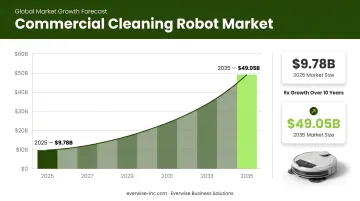
- The floor-cleaning robot market reached $9.78B in 2025 and is projected to hit $49.05B by 2035
- SoftBank Robotics America added three Gausium-powered AI robots to its enterprise portfolio in March 2026: Omnie, V40 2.0, and Phantas 1.3
- Adoption is accelerating on the back of 3D LiDAR, SLAM navigation, vision-language models, and IoT fleet management dashboards
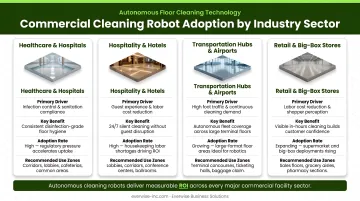
- Hospitals, hotels, airports, and senior living facilities are leading adoption — mid-market and SME deployments are accelerating
- Robots handle repetitive floor work so cleaning staff can focus on detail tasks and higher-touch areas
The Commercial Cleaning Robot Market at a Glance
DataM Intelligence reports floor-cleaning robots reached $9.78B in 2025 and are projected to grow to $49.05B by 2035, a 17.5% CAGR. Even narrower commercial-specific estimates show strong momentum: the industrial robot floor cleaner segment alone is valued at $0.9B in 2025 with a projected 16% CAGR through 2030.
Three forces are driving this growth:
- Labor scarcity — High annual turnover in janitorial roles creates constant pressure to find non-headcount solutions
- Post-pandemic hygiene expectations — Facilities now face higher baseline standards for cleanliness frequency and documentation
- Cost of automation falling — Hardware costs have dropped enough that mid-sized facilities can justify the investment
From Enterprise Pilots to Mainstream Deployment
In 2025–2026, robotic cleaning has moved beyond pilot programs into broad, multi-sector deployment. Tennant's milestone of selling its 10,000th robotic scrubber marks a clear shift from early adopter to mainstream adoption. The company's X4 ROVR targets small to mid-sized commercial spaces specifically — a sign that manufacturers are no longer designing exclusively for large enterprise accounts.
Broader deployment is also compressing ROI timelines. A national grocery chain case managed by KBS reported a 21% cleaning cost reduction and more than $2M in annual savings — though that figure comes from a vendor-managed case study, not an independent audit. As deployment expertise improves and robots require less hands-on intervention, the financial case becomes straightforward for most facility types.
Breaking News: Major Industry Announcements in 2025–2026
SoftBank Robotics America and Gausium Expand Enterprise Portfolios
The most significant partnership announcement of early 2026 came on March 4, when SoftBank Robotics America expanded its solution portfolio with three Gausium-developed AI-enabled commercial cleaning robots:
| Model | Primary Function | Target Environments |
|---|---|---|
| Omnie | Large-space scrubbing | Airports, retail, senior living |
| V40 2.0 | Vacuuming | Medium-to-large indoor environments |
| Phantas 1.3 | Sweeping / light scrubbing | Smaller facilities, offices |
The partnership wasn't sudden. In January 2025, SoftBank Robotics America had already received Gausium's Platinum Service Elite certification — requiring 100+ Gausium robots deployed and at least 30 at a single site. That certification demonstrates an operational track record before the portfolio expansion, not just a distribution agreement.
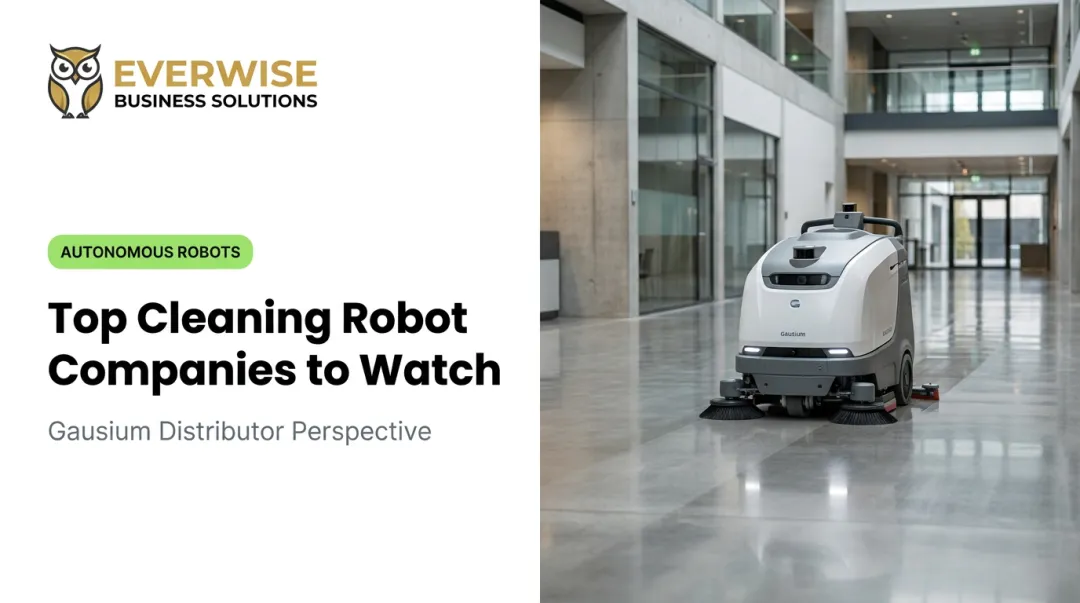
The March 2026 announcement confirms Gausium's position as the technology provider behind SoftBank Robotics America's commercial cleaning lineup. The robots navigate using computer vision, vision-language models, and 3D LiDAR — a combination built for the dynamic obstacle avoidance and spatial awareness that high-traffic environments demand.
Interclean Amsterdam 2026 and the Broader Industry Push
That deal reflects a wider industry push. April 2026's Interclean Amsterdam trade show drew multiple manufacturers debuting new commercial cleaning models:
- Sparkoz presented the TN70 Pro (70L clean-water tank, 8,160 sq. meters per charge) and TN10 Pro
- KEENON Robotics showcased the KLEENBOT C55, C40, and C30 across large-space, mid-sized, and premium office/hotel applications
This level of activity at a major trade event reflects how competitive the commercial segment has become. Manufacturers are now competing on full lifecycle value: deployment support, software updates, training, and maintenance programs bundled into the offering — not hardware alone.
Gausium Robots at Milan's Airports
One deployment worth noting: ahead of the Milano Cortina 2026 Winter Olympics, Gausium deployed Omnie robots at Milan Malpensa and Linate airports. Large international airports are among the most demanding environments for cleaning robots — high foot traffic, constantly shifting layouts, and 24/7 operational requirements. A successful deployment at that scale is meaningful validation.
The Technology Behind the Headlines: AI, LiDAR, and Beyond
Navigation: How Modern Robots Actually Find Their Way
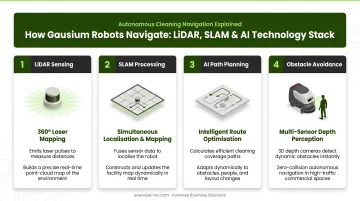
Today's commercial cleaning robots don't follow pre-programmed routes. They build maps and update them continuously. The core technology stack typically includes:
- 3D LiDAR — measures spatial distance in three dimensions for accurate localization, even in low-light conditions
- SLAM (Simultaneous Localization and Mapping) — lets the robot build a map while navigating, updating it when the environment changes
- RGB cameras and depth sensors — provide visual context for obstacle identification and surface recognition
- 360-degree panoramic camera arrays — enable bird's-eye-view perception for scene understanding
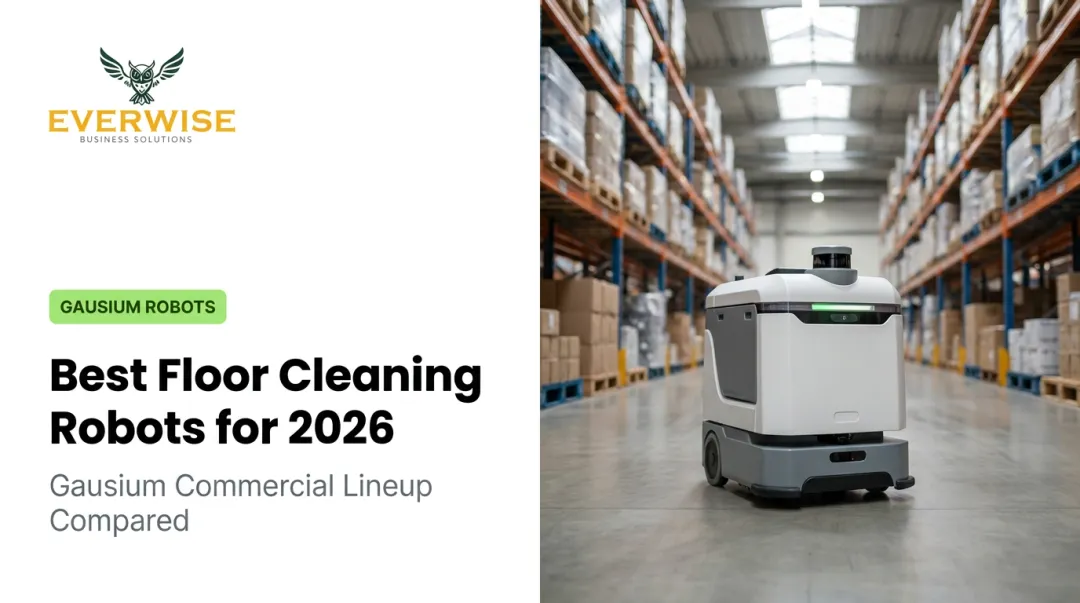
Gausium's Omnie, for example, uses multimodal SLAM and 3D LiDAR that supports mapping in open spaces. When a facility rearranges furniture or a cart appears in a hallway, the robot reroutes — it doesn't stop or get confused.
AI That Adapts to the Floor, Not Just the Map
Beyond navigation, newer models are integrating AI at the cleaning-decision level. The Gausium Vacuum 40 uses 3D depth cameras and AI to identify floor type — hardwood, stone, different carpet pile depths — and automatically adjusts cleaning mode and brush height. This means a single robot can transition between carpet and hard floor without manual reconfiguration.
Vision-language models, verified in SoftBank's March 2026 announcement, take this further: robots can interpret the environment semantically — meaning they understand what they're seeing, not just where objects are. That matters for identifying soil concentration, recognizing occupied areas, and making real-time decisions about cleaning intensity.
IoT and Fleet Management
Remote monitoring has become a standard expectation, not a premium feature. Through connected dashboards, facility managers can:
- Monitor cleaning task progress and coverage area in real time
- Set and modify automated cleaning schedules
- Receive alerts for maintenance needs, water changes, and consumable replacement
- Review productivity reports on a per-session basis
The Gausium Mobile App supports this for multiple models including the Vacuum 40, Omnie, and Scrubber 75 — allowing schedule management and status monitoring from anywhere. For regulated industries tracking cleaning compliance, this kind of documentation capability is increasingly important.
Features That Are Now Standard
What once counted as premium specs are now table stakes in new commercial launches. Buyers evaluating robots today should expect these as baseline:
- H13 HEPA filtration — the Gausium Vacuum 40 captures fine dust and allergens at a standard used in medical environments
- Zero-distance edge cleaning — high-precision sensors reach right against walls and into corners
- Intelligent floor identification — automatic surface detection without manual mode switching
- Multi-function cleaning — the Gausium Phantas combines vacuuming, sweeping, scrubbing, and dust mopping in one unit
Which Industries Are Adopting Commercial Cleaning Robots Fastest?
Hospitality and Healthcare Lead the Way
Hospitals and hotels share a profile that makes them natural early adopters: around-the-clock operations, strict hygiene requirements, high staff turnover in housekeeping roles, and large continuous floor areas.
Real deployments confirm the trend. Alvaro Cunqueiro Hospital in Vigo, Spain deployed two Gausium Phantas units for lobbies and corridors, running three autonomous cleaning cycles per day beginning March 2025. Shanghai Maritime University deployed Gausium Scrubber 50 and Phantas units achieving the same frequency. Both are full operational integrations, not limited pilots.
Senior living facilities are another high-adoption sector. The SBRA-Gausium March 2026 portfolio specifically calls out senior living as a target vertical, reflecting demand from operators who need consistent sanitization without relying on staff levels that fluctuate with turnover.
Retail, Transportation, and Education Follow
Adoption patterns across these three sectors share a common thread: high foot traffic, predictable schedules, and a clear cost case for automation.
- Airports: Gausium's Omnie units at Milan Malpensa and Linate airports handled intensive cleaning demands during Olympic event volumes — a real-world stress test for peak throughput
- Retail: KBS, a large grocery chain operator, reported $2M+ in annual savings after moving beyond single-store pilots into multi-site robot programs
- Education: Large floor areas and consistent daily cleaning needs make campuses a strong operational fit for autonomous scrubbers and vacuums
The Next Wave: Mid-Market and SME
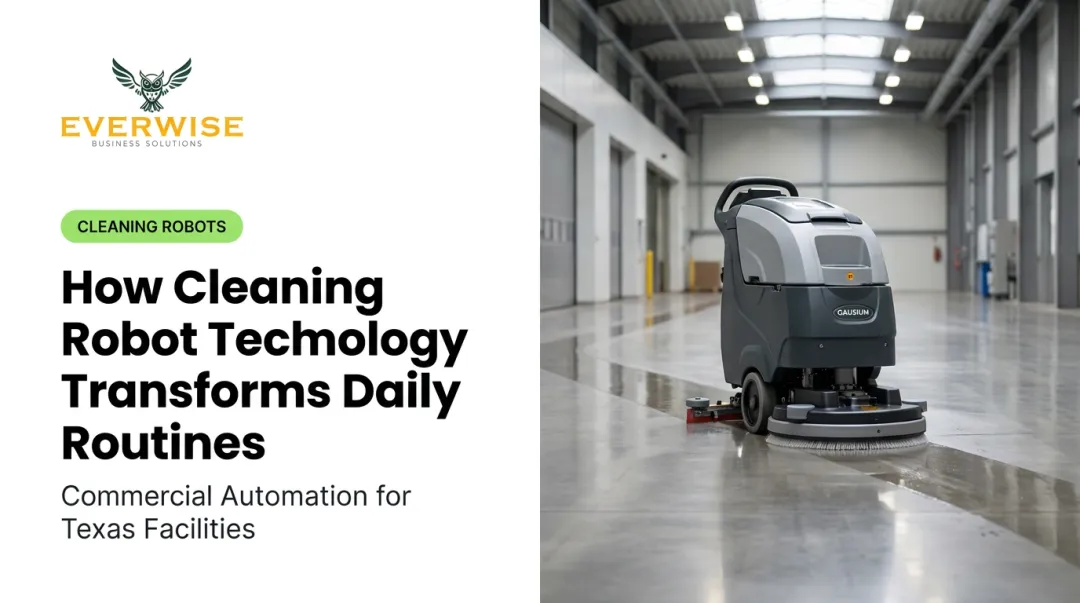
Mid-sized commercial offices and smaller facilities are emerging as the next adoption tier. Manufacturers are deliberately building for this market — Gausium's Scrubber 50 and Vacuum 40, for instance, are sized and priced for facilities that don't need enterprise-scale equipment.
For businesses without capital for outright purchase, financing conversations are worth having directly with distributors. Entry costs have come down considerably, and structured purchase arrangements may be available depending on the provider.
What This Means for Businesses Evaluating Cleaning Robots
Building the Business Case
The cost comparison that matters isn't robot purchase price vs. zero — it's robot total cost of ownership vs. the full cost of current cleaning operations: labor, turnover, training, supervision, compliance documentation, and any productivity loss from inconsistent coverage.
When those full costs are on the table, the math often shifts quickly. A business running two full-time cleaning staff for repetitive floor work — factoring in wages, benefits, turnover replacement costs, and management overhead — is typically spending far more than the annualized cost of a well-deployed robot. That robot operates on schedule, generates cleaning reports, and doesn't call in sick.
What to Actually Evaluate
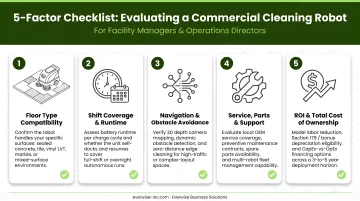
When assessing a cleaning robot solution, hardware specs matter — but they're not the whole story. Look for:
- Navigation system — 3D LiDAR + SLAM vs. older 2D approaches; how well does it handle dynamic environments?
- Cleaning coverage and capacity — match machine size and tank volume to your facility's square footage and floor types
- IoT capabilities — can you monitor progress remotely and pull cleaning verification data?
- Vendor support infrastructure — deployment expertise, staff training, maintenance response, and software update support
- Total lifecycle value — not just purchase price, but what ongoing support looks like
That last point is often underweighted. A robot that's well-deployed and properly maintained delivers reliable ROI. One that sits idle — because the on-site team wasn't trained, or waits weeks for service when something breaks — delivers nothing.
For Texas Businesses
That support infrastructure matters especially when evaluating local partners. For commercial and institutional facilities in Texas, Everwise Business Solutions is the authorized Gausium distributor. The full lineup — Omnie, Phantas, Vacuum 40, Scrubber 75, Mira, Marvel, and Beetle — is available with local deployment support and maintenance service from experienced technicians.
Texas businesses can reach Everwise directly at 210.884.0559 to discuss deployment requirements.
Frequently Asked Questions
What is driving the growth of commercial cleaning robots in 2025 and 2026?
Three factors are combining: persistent labor shortages in janitorial roles, rising post-pandemic hygiene expectations across industries, and AI navigation improvements that have made robots genuinely reliable in complex environments. The result is a broader range of facilities where the economics of deployment now make sense.
What was the significance of the SoftBank Robotics America and Gausium partnership?
In March 2026, SoftBank Robotics America added three Gausium-powered AI robots — Omnie, V40 2.0, and Phantas 1.3 — to its enterprise cleaning portfolio. The partnership positions Gausium as a leading commercial cleaning technology provider and signals growing enterprise confidence in AI-driven autonomous cleaning for complex, high-traffic facilities.
Are commercial cleaning robots suitable for small and mid-sized businesses?
Early adoption was dominated by large enterprises — airports and hospital systems led deployments — but that gap is closing. Newer compact models, lower hardware costs, and flexible purchase arrangements now make autonomous cleaning accessible to offices, schools, and retail operations that previously couldn't justify the investment.
How do commercial cleaning robots handle complex or changing environments?
Modern robots use 3D LiDAR and SLAM to build and continuously update facility maps in real time. When a layout changes or a dynamic obstacle appears — a cart, a person, moved furniture — the robot reroutes autonomously rather than stopping or requiring manual reset.
Do commercial cleaning robots replace human cleaning staff entirely?
No. Robots handle repetitive, large-area floor work on automated schedules while staff shift to detail cleaning, restroom maintenance, and high-touch surface sanitization — tasks that require human judgment. The combination typically improves overall cleaning output without reducing headcount.