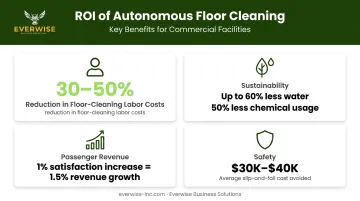
The pressure isn't just operational. Post-COVID, cleanliness became a purchasing decision. According to Tork's 2024 airport whitepaper, 80% of consumers now expect more hygienic public environments than before the pandemic — and a 1% increase in passenger satisfaction correlates with 1.5% growth in airport revenue.
Manual cleaning alone can't close that gap. Autonomous cleaning robots are filling it.
This article covers why airports are adopting robotic cleaning, how the technology works, the measurable benefits it delivers, which zones benefit most, and what to evaluate before committing to a deployment.
Key Takeaways
- Autonomous robots solve three airport facility problems at once: labor shortages, inconsistent hygiene, and unaudited cleaning coverage
- Robots use LiDAR, SLAM, AI, and 3D depth cameras to navigate terminals safely without supervision
- Documented airport deployments show measurable labor cost reductions with capital payback within 12–24 months
- Staff are redeployed to higher-value tasks — restroom sanitization, passenger assistance, and robot oversight
Why Airports Struggle to Maintain Cleanliness
The scale is staggering. A major hub like Chicago O'Hare or Dallas Fort Worth maintains millions of square feet of terminal space that must be cleaned continuously — not between shifts, but during operations, while passengers are actively moving through every zone.
The Labor Crisis Isn't Going Away
The staffing math doesn't work in airports' favor. The Bureau of Labor Statistics projects only 2% employment growth for janitors and building cleaners through 2034 — slower than the national average — while industry turnover in facility services runs at roughly 200% annually. That means most cleaning crews turn over twice a year. Hiring can't keep pace with attrition, let alone growth.
Beyond raw numbers, manual cleaning creates structural inconsistency. Fatigue, training gaps, and shift transitions mean hygiene standards fluctuate between crews and across time of day — even when headcount is sufficient.
The Problem of Unverifiable Cleaning
Inconsistent cleaning is one problem that airports can manage operationally. The harder problem is proving it never happened.
Airport operators face mounting pressure from regulators and airline partners to demonstrate that cleaning is happening on schedule and at the required standard across every zone. Accreditation bodies like ACI — through its Public Health and Safety Readiness Accreditation — now formalize that demand. Manual operations can't produce that evidence without a technology layer.
Verifiable, timestamped cleaning records have moved from a nice-to-have to an operational requirement.
How Autonomous Airport Cleaning Robots Work
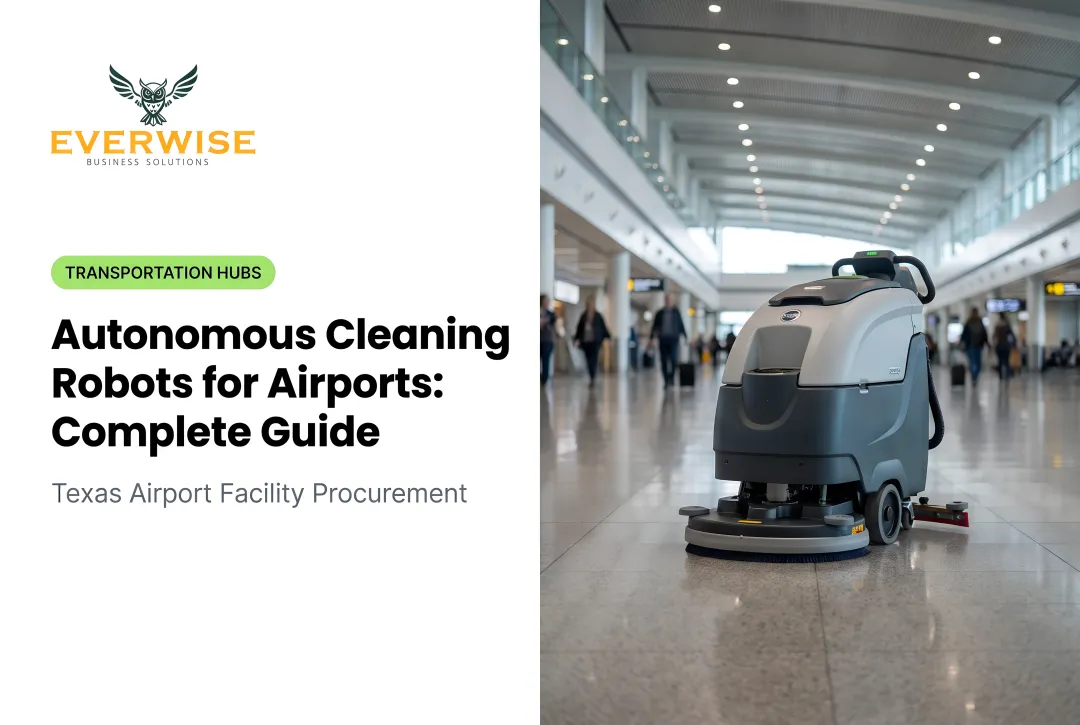
Modern airport cleaning robots operate well beyond remote control. They navigate dynamically, adjust to changing environments, and resume tasks without operator input — running full cleaning cycles with minimal human involvement.
Navigation and Mapping
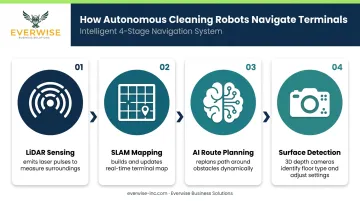
The foundational technology stack combines LiDAR sensors, SLAM (Simultaneous Localization and Mapping), and onboard AI. The robot emits laser pulses, measures return distances to surrounding objects, and builds a continuously updated map of the terminal environment. As conditions change — a queue forms, a cart appears, a gate furniture configuration shifts — the robot replans its route in real time.
Intelligent Floor Identification
Advanced robots go further than basic navigation. Using 3D depth cameras and AI, they detect floor surface type — polished terrazzo, sealed concrete, tile, carpet — and automatically adjust cleaning mode, water dosing, and brush pressure accordingly.
The Gausium Vacuum 40 uses this system to handle seamless transitions between carpeted gate seating areas and hard-floor concourses without stopping or requiring manual reconfiguration. In mixed-surface terminals, that matters — a robot running tile-mode settings on carpet, or dry-vacuuming a surface that needs wet scrubbing, won't deliver a clean floor regardless of how many passes it makes.
Obstacle Avoidance and Passenger Safety
Robots operating in occupied terminals use multi-sensor detection — combining LiDAR, 3D depth cameras, and additional sensing systems — to identify moving passengers, luggage, and temporary barriers in real time. When an obstacle appears, the robot slows, navigates around it, or waits — depending on the situation. Detection typically operates at distances sufficient to stop or redirect before contact, allowing units to run in active concourses without a dedicated operator shadowing each machine.
Auto-Docking and Continuous Operation
When battery levels drop or water tanks need attention, robots autonomously return to docking stations. Gausium's workstation infrastructure — the WS-01, WS-02, and WS-03 series — supports autonomous recharging and water management. Once the cycle completes, the robot resumes its task from where it stopped.
For airport facilities teams, this means overnight and off-peak cleaning windows run without staff on the floor — the robot manages its own refueling and picks up exactly where it left off.
Edge Cleaning and Air Quality
Facility teams often overlook two capabilities during initial evaluations:
- Zero-distance edge cleaning: High-precision sensors allow robots to scrub flush against walls, pillar bases, and gate furniture. The Gausium Phantas is rated at 0 cm from the wall edge — eliminating the missed strips that manual equipment routinely leaves in busy corridors.
- H13 HEPA filtration: The Gausium Vacuum 40 and Beetle are equipped with H13 medical-grade HEPA filters that capture fine particulates and allergens during operation. In high-density terminal environments, this is an air quality benefit that standard floor cleaning equipment doesn't provide.
Key Benefits of Cleaning Robots for Airport Operations
Labor Cost Reduction and Staff Redeployment
Robots handle repetitive large-area floor coverage — the work that consumes the most janitorial hours and delivers the least differentiation. That frees human staff for restroom sanitization, high-touch surface cleaning, spill response, and robot supervision.
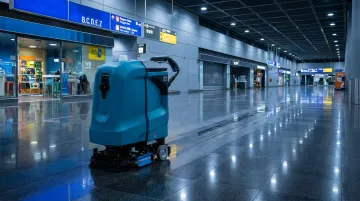
In a documented U.S. airport deployment, Flagship Facility Services' Tennant T7AMR robots cleaned more than 115,000 square feet per six-hour overnight shift at a single airport — with staff explicitly redeployed to higher-value tasks rather than eliminated. Industry benchmarks across large facilities consistently point to 30–50% reductions in floor-cleaning labor costs through autonomous overnight operation.
24/7 Consistent Operation
Human crews have shift constraints, fatigue limits, and coverage gaps. Robots don't. They can be scheduled for overnight runs, deployed during brief lulls between passenger surges, or run continuously during terminal operations.
The result: the same cleaning standard, executed the same way, across every shift — without the variability that comes from crew fatigue or uneven training.
Verifiable, Data-Driven Compliance
The Gausium Mobile App generates cleaning logs that document task completion, robot activity, and operational status. Together, the app logs and SLAM-based mapping create an auditable record of what was cleaned, when, and where.
For airports pursuing ACI accreditation or responding to airline audits, this transforms cleaning from an invisible manual process into a documented, auditable record.
Passenger Safety and Revenue Impact
Wet floors and poor housekeeping are among the leading causes of slip-and-fall incidents. Consistent robotic floor cleaning reduces the surface conditions that drive those incidents — and the financial exposure that follows:
- Each workplace slip-and-fall averages $30,000–$40,000 in compensation and medical costs
- Terminal facilities rank as the third most important factor in the J.D. Power North America Airport Satisfaction Study
- Washroom cleanliness alone accounts for more than 50% of the total terminal cleanliness score (Tork research)
Sustainability and ESG Reporting
Robotic scrubbers use calibrated chemical dosing and precise water application. Compared to manual over-application, this typically reduces water usage by up to 60% and chemical usage by up to 50%. Zurich Airport's TASKI robots recycle water up to three times per cycle.
For airports with green building certifications or ESG disclosure commitments, robot data logs capture water volume consumed, chemical dosing records, and coverage area per cycle — the specific metrics sustainability reports require.
Key Airport Zones Where Robots Make an Impact
Different terminal zones present different cleaning challenges. The right robot — and the right deployment strategy — depends on the zone.
Departure Terminals and Concourses
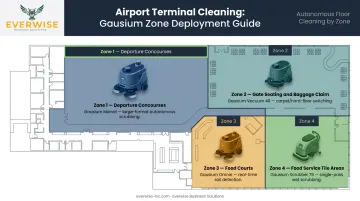
Long concourses with high and variable foot traffic are ideal for large-format autonomous scrubbers. The Gausium Marvel was built for exactly this environment — enterprise-tier throughput across expansive hard-floor zones, sustaining extended autonomous operation without frequent human intervention.
Boarding Gates and Baggage Claim
Gate areas require rapid turnaround cleaning in tight spaces with fixed seating rows. Baggage claim adds moving carousels and scattered luggage to the obstacle mix. Advanced multi-sensor obstacle avoidance handles both environments.
The Gausium Vacuum 40 is the practical solution for carpeted gate seating areas, using AI floor identification to switch between carpet and hard-floor modes as it navigates between zones.
Food Courts and High-Traffic Rest Areas
Unlike concourses with predictable traffic patterns, food courts generate concentrated spills, grease, and debris at unpredictable times. The Gausium Omnie is built for exactly this variability. Its Auto Spot Cleaning intelligence detects high-soil areas in real time and directs cleaning effort there, rather than following a fixed route that may miss the latest spill.
For tile and sealed concrete in food service areas, the Gausium Scrubber 75 delivers heavy-duty wet scrubbing and drying in a single pass. Its 270° rotational brush head reaches edges and corners that fixed-head equipment leaves uncleaned.
Key capabilities across these three zones:
- Departure concourses — large-format autonomous scrubbing with extended runtime
- Gate seating and baggage claim — carpet/hard-floor switching with multi-sensor obstacle avoidance
- Food courts — real-time soil detection and targeted spot cleaning
- Food service tile and concrete — single-pass scrubbing and drying with full edge coverage
Real-World Airport Cleaning Robot Deployments
The business case for airport robotics is no longer theoretical. Documented deployments now span multiple continents and airport sizes.
| Airport | Fleet | Key Metric |
|---|---|---|
| Zurich Airport (Switzerland) | 26 TASKI robots | 120 sq km/day; sub-2-year ROI |
| U.S. airports (Flagship/SoftBank) | 100+ cobots | 35M+ sq ft cleaned; staff redeployed |
| Frankfurt Airport (Germany) | Tennant T16AMR | Detergent-free cleaning; fleet expanding 2025+ |
| GMR Hyderabad Airport (India) | Peppermint Robotics | 75% manpower reduction (partially verified) |
| Pittsburgh International (U.S.) | Carnegie Robotics UV-C | First U.S. airport UV-C robotic deployment |
Zurich Airport's 26-robot TASKI fleet is the benchmark case: 20 Ecobot 50 units and 6 Phantas models covering 120 square kilometers of terminal daily, with water recycled up to three times per cycle and an estimated ROI of under two years.
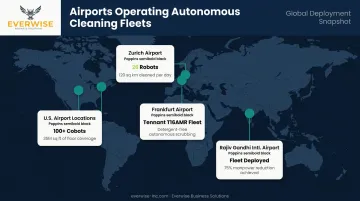
The Flagship/SoftBank deployment across nearly 15 U.S. locations logged almost 10,000 operating hours and cleaned more than 35 million square feet. Flagship explicitly redeployed staff to sanitization tasks rather than cutting headcount. That staffing model now runs across their entire portfolio, which supports 20 of the top-ranked airports in J.D. Power's North America Airport Satisfaction Study.
Avidbots reports that seven of the world's top ten airports by Skytrax ranking have deployed Neo autonomous floor scrubbing robots. At this scale, robotic floor cleaning isn't an experiment — it's standard operating procedure.
What to Consider Before Deploying Airport Cleaning Robots
Infrastructure and Environment Preparation
Before robots can operate independently, the facility needs:
- Dedicated charging and docking stations with adequate floor space
- Clean-water supply and wastewater drainage connections for wet-scrubbing models
- Storage space for robots when not in operation
- An initial commissioning and mapping period — robots learn the terminal layout before operating independently
Floor surface types, layout complexity, and peak traffic windows all inform robot selection and scheduling. A mixed-surface airport with carpet at gates and tile in concourses requires a multi-model approach: a Gausium Vacuum 40 for dry cleaning across mixed surfaces, a Scrubber 75 for wet scrubbing in food service areas, and a Marvel or Omnie for high-throughput concourse coverage.
Staff Training and Change Management
The most consistent adoption barrier isn't technology — it's staff anxiety about job displacement. Successful airport programs address this directly by framing robots as role-expanding tools.
Cleaning crews trained to supervise, schedule, and troubleshoot robots take on more skilled, higher-value responsibilities. The role shifts toward technical oversight rather than manual labor. Everwise Business Solutions includes hands-on training for in-house facility teams as part of every robot deployment, equipping staff to manage scheduling, handle routine troubleshooting, and oversee fleet performance from day one.
Choosing the Right Partner and Acquisition Path
Airports and large facilities can access Gausium robots through outright purchase or through financing options: operating leases, capital leases, or Section 179/bonus depreciation-eligible purchase. This makes it practical to run a proof-of-concept before committing to a full fleet.
Everwise Business Solutions is the authorized Gausium distributor for Texas, serving transportation hubs and large facilities across the state. Their services for evaluating facilities include:
- Onsite demos and proof-of-concept deployments
- Custom ROI modeling for CapEx justification
- Commissioning, maintenance, and ongoing fleet management
- Coverage across San Antonio, Austin, Dallas, Houston, and the Rio Grande Valley
Contact: 210.884.0559 | german.zavala@everwise-inc.com | Monday–Friday, 9:00 AM–6:00 PM
Frequently Asked Questions
How much do airport cleaning robots cost?
Costs vary by robot type, configuration, and acquisition model. Compact autonomous scrubbers start around $27,500; larger enterprise units run higher. Financing through operating or capital leases is available, which reduces the upfront barrier.
Are airport cleaning robots still in use?
Yes — and adoption is accelerating. Zurich Airport, major U.S. airports through Flagship Facility Services, Changi Airport in Singapore, and GMR Hyderabad Airport all operate active robotic cleaning fleets at scale. Avidbots reports seven of the world's top ten airports have deployed autonomous floor scrubbers.
What types of cleaning robots are used in airports?
Airports typically deploy four robot categories: autonomous floor scrubbers (wet scrubbing of hard floors), carpet-cleaning cobots (autonomous vacuuming), UV-C disinfection robots (surface disinfection), and disinfectant spray robots. Most deployments combine multiple types based on floor surfaces and zone requirements.
Do cleaning robots replace human janitorial staff at airports?
No — airports redeploy staff rather than eliminate them. Robots take over repetitive large-area floor coverage; human staff shift toward restroom sanitization, high-touch surface cleaning, spill response, and robot supervision. The Flagship/SoftBank U.S. deployment is the clearest published example of this model.
Can airport cleaning robots operate safely around passengers?
Autonomous floor scrubbers use multi-sensor obstacle detection to navigate occupied terminals safely, slowing and rerouting around passengers and luggage in real time. UV-C disinfection robots are a different matter — UV-C light exposure requires cleared areas, so those units are scheduled for overnight or off-hours operation.
What is the ROI of using cleaning robots at airports?
ROI depends on facility size, labor costs, and utilization rates, but documented airport deployments consistently fall within the 12–24 month payback range. Zurich Airport's 26-robot fleet is the published benchmark — estimated payback under two years — with labor savings, reduced water and chemical use, and lower slip-and-fall liability all driving the return.