Facility managers evaluating autonomous scrubbers face a fork in the road: lease and preserve capital with predictable monthly costs, or buy outright and capture stronger long-term savings once the robot pays for itself. Neither path is universally better. The right choice depends on your cash flow, cleaning volume, and how long you plan to run the machine in its current role.
This guide breaks down both options with real numbers, a practical ROI framework, and clear guidance on which path makes more sense for your specific situation.
Key Takeaways
- Leasing requires little to no upfront capital, typically includes maintenance, and lets you upgrade as technology evolves — ideal for budget-conscious or growing operations
- Buying delivers stronger long-term savings once the payback threshold clears, but shifts all maintenance and obsolescence risk to you
- True ROI goes beyond labor savings — it includes reduced Workers' Comp liability, lower turnover costs, and audit-ready cleaning compliance records
- SMBs and high-growth facilities reach positive ROI faster with leasing; stable, high-volume operations typically favor ownership by year 4–5
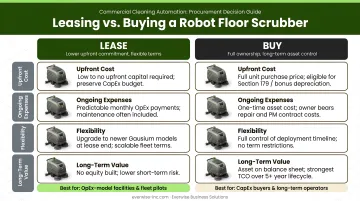
Leasing vs. Buying a Robot Floor Scrubber: At a Glance
| Factor | Leasing | Buying |
|---|---|---|
| Upfront Cost | Low to zero; structured into monthly payments | High upfront cost ($18K–$81K+, depending on model and features) |
| Maintenance | Usually covered by vendor or service agreement | Owner's responsibility — parts, labor, software, consumables |
| Upgrade Flexibility | Switch to newer models at end of term | You own the asset, but bear depreciation and obsolescence risk |
| 3–5 Year Total Cost | Higher cumulative spend, but predictable and lower-risk | Lower total cost if maintained well and used long-term |
Commercial autonomous scrubber prices vary widely by model, capability, and vendor — request a quote to get accurate figures for your facility.
What Is Leasing a Commercial Robot Floor Scrubber?
Leasing is a structured agreement where your business pays a recurring monthly fee to use the robot — the vendor retains ownership. Terms typically run 24 to 60 months depending on the vendor and robot model.
The Financial Case for Leasing
The core advantage is cash flow protection. Instead of a five-figure capital outlay, you redirect that budget toward operations while still deploying advanced cleaning automation from day one.
What's typically bundled into a lease or service subscription:
- Scheduled maintenance and service visits
- Software updates and navigation improvements
- Technical support and remote monitoring
- Some vendors include consumables (pads, brushes, squeegees, detergent)
Gausium's service model, for example, bundles technician visits, 24/7/365 remote monitoring, and consumables into a single package. When you factor those costs into an ownership scenario, the lease price gap narrows considerably — and often disappears.
Technology Risk Protection
That bundled support also matters less if your robot is already obsolete. Tennant announced its 10,000th robotic scrubber sale in 2025, and platforms like BrainOS Clean 2.0 now feature adaptive AI routing that dynamically adjusts paths in real time. Leasing lets you trade in aging equipment at contract end rather than holding a robot that's been outpaced by newer models.
Best Fit for Leasing
- Multi-location businesses managing facilities across different regions
- SMBs with limited capital but immediate cleaning needs
- Facilities in growth or expansion phases where requirements will shift
- Hospitality and retail operations with seasonal cleaning demand fluctuations
What Is Buying a Commercial Robot Floor Scrubber?
Buying means your business pays the full cost upfront — or finances through a loan — and takes full ownership of the asset. You control it, maintain it, and eventually dispose of or resell it.
The Real Cost Beyond the Sticker Price
Public listings put the purchase range for commercial autonomous scrubbers at $18,000 to $81,250 across specific models. But the sticker price is only the starting point.
Ownership costs to budget for include:
- Preventive maintenance contracts — scheduled service from trained technicians
- Replacement consumables — squeegee blade kits, scrub pads, brushes (a T7AMR squeegee kit runs approximately $75.25; a 12V 140Ah AGM battery lists around $693.69)
- Software licensing or update fees — some models bundle lifetime software with purchase; others may require ongoing subscriptions
- Staff time for oversight, troubleshooting, and coordinating repairs
Get a full quote that itemizes all these components before comparing against a lease. The gap between headline purchase price and true annual ownership cost is where buyers get surprised.
The Payback Threshold
Buying makes financial sense only after the robot has covered its own cost through operational savings. That payback comes primarily from labor reallocation, reduced Workers' Comp claims, and more consistent cleaning output. Higher-volume facilities running the robot across multiple daily shifts will cross that threshold faster than low-frequency users — and once that threshold is cleared, the robot generates net savings every month, outpacing leasing on total cost over a 4–5+ year horizon.
Best Fit for Buying
The payback math favors ownership most clearly when:
- High-frequency operations run the robot across multiple daily shifts — warehouses, hospitals, airports, manufacturing plants
- Cleaning programs are stable and predictable, with no major layout or operational changes expected
- The facility has already piloted a robot through a lease or demo and confirmed real-world performance
Gausium autonomous cleaning robots — available through Everwise Business Solutions across Texas — are designed to hold up over multi-year ownership cycles. AI-driven floor identification, advanced 3D navigation, and H13 HEPA filtration aren't just spec-sheet features; they're capabilities that remain relevant as facilities evolve, which directly supports the long-term ROI case for buying.
Leasing vs. Buying: Which Delivers Better ROI?
The decision comes down to three variables: your current cash position, how long you'll use the robot in this role, and whether you need flexibility to scale or upgrade.
ROI Components That Apply to Both Paths
Whether you lease or buy, the same savings drivers are in play:
- Labor reallocation — staff shift from floor scrubbing to higher-value tasks, reducing hours billed to routine cleaning
- Liability reduction — fewer slip-and-fall injuries and Workers' Comp claims from physically demanding manual work. The NSC reports the average Workers' Compensation cost for a fall or slip incident at $54,499 — one avoided claim can cover a full year of lease payments
- Compliance documentation — automated cleaning logs provide proof-of-performance for hygiene audits and stakeholder reporting
The Turnover Cost Angle
This one is underestimated. CleanLink reported commercial cleaning industry turnover rates of approximately 200%, with recruitment and onboarding costs around $1,000 per employee. Deploying a robot — under either model — reduces your dependence on constantly cycling staff and the recurring $1,000-per-hire costs that follow each departure.
A Simple ROI Framework
Add up your annual savings across labor, liability, and turnover, then divide by your total annual cost — lease payment or amortized purchase price plus maintenance.
(Annual Labor Savings + Annual Liability/Turnover Savings) ÷ Annual Total Cost = ROI Ratio
Annual Total Cost = lease payment or amortized purchase price + maintenance
Hypothetical example — mid-sized Texas distribution facility (100,000 sq ft):
| Input | Estimate |
|---|---|
| Annual labor savings (2 FTEs reallocated at $35,000/yr each) | $70,000 |
| Annual Workers' Comp/liability reduction estimate | $10,000 |
| Annual turnover cost avoidance (reduced cycling) | $5,000 |
| Total Annual Savings | $85,000 |
| Annual lease cost | $18,000 |
| Annual maintenance (covered by lease) | $0 |
| Total Annual Cost | $18,000 |
| ROI Ratio | 4.7x |
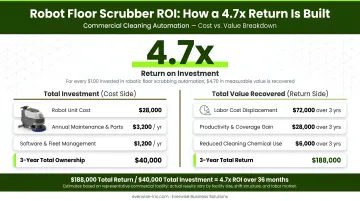
For a purchased robot at $50,000 amortized over 5 years ($10,000/yr) plus $6,000 in annual maintenance, total annual cost drops to $16,000 — pushing the ratio to 5.3x once fully amortized.
Decision Guide
Choose leasing if:
- You need to deploy without a capital outlay
- Your facility's cleaning needs are still evolving
- You want maintenance off your plate entirely
- You value upgrade flexibility as newer models release
Choose buying if:
- You have stable, high-volume cleaning demand
- Access to capital or favorable financing terms
- A clear plan to use the robot for 4+ years
- You've already validated performance in your environment
Real-World Savings: What Facility Operators Are Finding
According to Avidbots, Oxford Properties Group saw ROI ranging from $30,000 to $150,000 per year from autonomous floor scrubber deployment — a wide range that reflects how significantly utilization and labor costs vary by facility.
For a more recent data point: Veritiv's deployment of Tennant T16AMR robots reduced maintenance and labor costs by roughly 50%, with projected savings of $3.4 million over ten years. The program expanded from 6 units to 23 facilities, reflecting clear confidence in the ownership model at scale.
What triggered these decisions? Almost universally: rising labor costs, inconsistent cleaning quality, and difficulty retaining cleaning staff. The lease vs. buy question came second, only after operators confirmed the robot performed in their specific environment.
That's exactly the starting point Everwise Business Solutions — the authorized Gausium distributor in Texas — helps facility managers work through. Whether you're weighing lease or purchase, they can run an ROI assessment tailored to your operation's size and cleaning demands. Reach them at 210.884.0559 or german.zavala@everwise-inc.com.
Frequently Asked Questions
What is the typical payback period for a purchased commercial robot floor scrubber?
Payback periods vary by facility, but most high-utilization deployments recover costs within 2–4 years. Warehouses, hospitals, and large retail spaces tend to see the fastest returns because the robot replaces more labor hours across multiple daily shifts.
Does leasing a commercial robot floor scrubber include maintenance?
Most lease and service subscription agreements include scheduled maintenance, software updates, and technical support, but terms vary by vendor. Before signing, confirm exactly which service visits, consumables, and repair scenarios are covered versus billed separately.
Can I upgrade to a newer robot model if I lease?
Most leasing arrangements allow upgrades at the end of the contract term, which matters as autonomous navigation and AI capabilities continue to improve. Confirm upgrade rights in writing before signing a multi-year term.
Is leasing or buying better for small and medium-sized businesses?
Leasing is generally more accessible for SMBs because it avoids the large upfront outlay and keeps monthly costs predictable. Buying makes more sense once cleaning needs stabilize and usage volume justifies the higher initial investment.
How do I calculate ROI for a robot floor scrubber in my facility?
Add up your annual labor savings, reduced liability costs, and turnover cost avoidance, then divide by total annual cost (lease payment or amortized purchase price plus maintenance). A ratio above 2x indicates a solid business case.
What hidden costs should I watch out for when buying a robot floor scrubber?
Watch for maintenance contracts, replacement consumables (brushes, squeegees, batteries), software licensing or subscription fees, and the staff time required for oversight and troubleshooting. Request an itemized quote covering all these line items before comparing ownership against a lease.