Introduction
Walk into any hotel lobby and cleanliness hits you within seconds — before the front desk greeting, before the room key, before anything else. That first impression shapes reviews, drives rebooking decisions, and ultimately affects revenue.
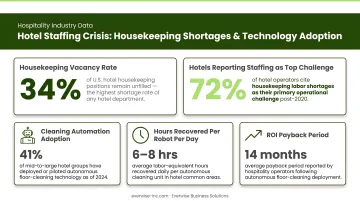
The challenge is keeping that standard consistent. According to the American Hotel & Lodging Association, 65% of U.S. hotels reported staffing shortages in early 2025, with housekeeping topping the list of unfilled roles at 38%. Meanwhile, guest expectations haven't softened — they've climbed.
Hotel robot vacuums are now deployed across major brands — Marriott among them — and independent properties are following quickly. This post covers what's driving that shift, how commercial-grade robots differ from consumer models, which features actually matter in a hotel environment, and what Texas operators need to evaluate before committing to a purchase.
Key Takeaways
- 65% of hotels face staffing shortages — housekeeping is the hardest-hit department
- Commercial hotel robot vacuums use LiDAR and 3D camera navigation to run continuously across large floor areas without supervision
- Prioritize H13 HEPA filtration, quiet operation, auto-recharging, and cloud fleet management
- Lobbies, guest corridors, and banquet halls deliver the fastest ROI
- Robots augment housekeeping staff — they don't replace them
Why Hotels Are Turning to Robot Vacuums Now
The Staffing Crisis Is Real
The numbers tell a blunt story. AHLA's 2025 survey found 71% of hotels had job openings they couldn't fill, with housekeeping cited as the top shortage area. Separately, 82% of hotels raised wages in the six months prior to the 2024 survey — yet vacancies persisted.
A Deloitte survey found 70% of hotels had reduced or eliminated amenities because of staffing shortfalls, while roughly half were already adopting new technology to close the gap. Autonomous vacuuming directly addresses one of the hardest gaps to fill: continuous floor maintenance without adding headcount.
The 24/7 Cleaning Paradox
Hotels never close. Debris accumulates from checkout rushes, lobby foot traffic, banquet events, and overnight arrivals, none of which follows a predictable schedule. Traditional cleaning windows can't keep up.
The result: floors that look clean during the overnight sweep are visibly degraded by 10 AM, just as check-in volume peaks. Robots can run continuously throughout the day, filling those gaps without adding shifts.
Cleanliness Drives Scores — and Scores Drive Revenue
Tripadvisor research found that 92% of travelers cite cleanliness as the most important factor when selecting accommodations. J.D. Power's North America Hotel Guest Satisfaction Index found guests who rated room cleanliness a perfect 10/10 averaged 942 out of 1,000 overall satisfaction — those rating it 8 or 9 dropped to 829/1,000. That 113-point gap is enormous in competitive review environments.
In a market where a single-point rating drop shifts booking decisions, that 113-point satisfaction gap translates directly to lost revenue.
Noise Constraints Make Traditional Vacuuming Self-Defeating
Loud commercial vacuums can't run during occupied hours without generating guest complaints. Running them only at off-peak times means floors stay dirty during peak traffic. WHO guidelines recommend continuous background noise in sleeping areas stay below 30 dB — a threshold most commercial vacuums blow past.
Robots rated for quiet operation can run overnight or through occupied hours without triggering noise complaints — maintaining clean floors around the clock without the tradeoff.
What Separates Commercial Hotel Robot Vacuums from Consumer Models
Scale and Build Quality
Consumer robot vacuums are designed for a 1,500-square-foot home used a few hours a week. A hotel corridor system spans tens of thousands of square feet and needs cleaning multiple times daily, every day. The mechanical stress alone would destroy consumer hardware within weeks.
Commercial hotel robots are built for continuous multi-shift operation. The Gausium Vacuum 40, for example, carries a 3-liter dustbin and is engineered specifically for banquet halls, guestroom corridors, and back-to-back overnight runs — the kind of operational load that consumer hardware simply isn't rated for.
Navigation That Actually Works in Hotels
This is the biggest functional gap between commercial and consumer models:
| Feature | Commercial Hotel Robots | Consumer Robots |
|---|---|---|
| Navigation | LiDAR + Vision Fusion SLAM + 3D depth cameras | Basic bump-and-redirect sensors |
| Mapping | Custom property maps, repeatable routes | Random or basic pattern coverage |
| Obstacle handling | Real-time dynamic avoidance | Collision-based redirection |
| Floor surface adaptation | AI-driven automatic adjustment | Manual or single-surface |
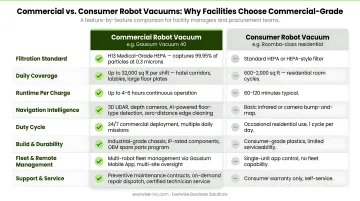
The Gausium Vacuum 40 — distributed across Texas by Everwise Business Solutions — uses 3D depth cameras combined with AI to identify floor surfaces and automatically adjust cleaning mode and brush height. It distinguishes between hardwood, stone, and varying carpet pile depths, transitioning seamlessly between guest room carpets and lobby stone floors without manual reprogramming.
Fleet Management and Proof of Performance
Commercial robots connect to cloud-based management platforms. The Gausium Mobile App lets operators monitor cleaning tasks, receive status updates, and manage schedules remotely — across multiple units simultaneously. For a property running several units across multiple floors, that remote visibility means managers can verify coverage, catch missed zones, and document cleaning compliance — without walking every corridor themselves.
Key Features to Look for in a Hotel Robot Vacuum
Intelligent Navigation and Edge Cleaning
Prioritize robots with LiDAR-based or 3D depth camera navigation that generates a precise custom map and executes consistent routes on repeat. One-time route mapping is particularly valuable: staff walk the robot through the route once, it memorizes the path, and repeats it autonomously from that point forward.
Zero-distance edge cleaning, enabled by high-precision sensors and side brushes, ensures debris along walls, doorframes, and corners is captured rather than left behind. In hotel corridors where baseboards run continuously for hundreds of feet, this matters.
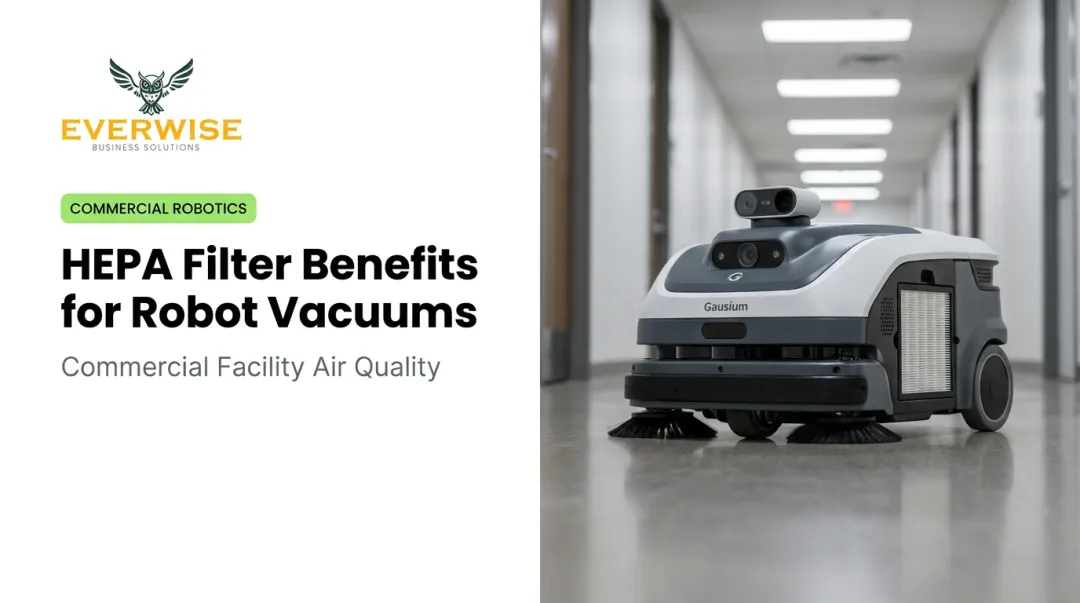
H13 HEPA Filtration
Floor cleanliness and air quality are both guest experience issues. HEPA filters capture at least 99.97% of airborne particles at 0.3 microns, per EPA standards — including dust, pollen, mold, and bacteria. H13-grade filtration performs at medical-grade levels, preventing exhaust air from recirculating contaminants back into corridors and lobbies.
Gausium autonomous cleaning robots include H13 HEPA filtration as standard. For guests with allergies or respiratory sensitivities, this is a specification worth confirming in any commercial hotel robot evaluation.
Autonomous Recharging and Route Resumption
Look for robots that:
- Return to their docking station automatically when battery is low
- Resume the cleaning route after recharging without staff intervention
- Complete overnight cycles uninterrupted
The Gausium Vacuum 40 handles all three. This matters most for overnight corridor cleaning, where the robot needs to complete full floor routes across multiple wings without anyone available to intervene.
Scheduling and Cloud Fleet Management
Robot-level autonomy only goes so far — managing multiple units across floors requires a cloud dashboard that surfaces:
- Real-time robot location and cleaning progress
- Battery status across all active units
- Scheduled route assignments by floor or zone
- Status updates accessible from a mobile device
For properties running more than one unit or managing multiple floors, this visibility is what keeps deployments on schedule and staff informed.
Where Robot Vacuums Make the Most Impact in Hotels
Lobbies and High-Traffic Common Areas
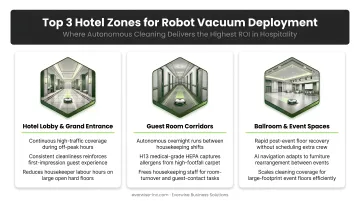
Front-of-house spaces accumulate debris faster than any other hotel zone. Robots can run between check-ins, during slow periods, or overnight — maintaining the first impression guests form without pulling a housekeeping attendant off more demanding tasks.
Guest Room Corridors
Long, repetitive corridors are the ideal robot environment. The consistent layouts, straight runs, and predictable furniture positions mean that once a route is mapped, the robot repeats it with the same precision every time. This is also one of the most physically demanding tasks in a housekeeping shift. Removing it from the manual workload has a direct impact on staff fatigue and retention.
The Gausium Vacuum 40 is specifically designed for this zone: compact enough for narrow hallways, intelligent enough to handle the transition between carpeted guest rooms and hard-surface common areas.
Banquet Halls and Meeting Spaces
Large open-floor venues represent the highest single-session time savings. A robot can clean an entire ballroom overnight after an event — work that would otherwise take several staff hours — so the space is ready for morning setup without anyone coming in early.
For hotels running frequent events, those saved hours add up fast across a typical week.
Key use cases across hotel zones at a glance:
- Lobbies: Continuous cleaning between guest interactions without redirecting staff
- Corridors: Repeatable mapped routes that reduce one of housekeeping's most physically taxing tasks
- Ballrooms & event spaces: Overnight post-event cleaning so rooms are set-ready by morning
The Business Case: ROI and Labor Savings
Quantifying the Labor Hour Offset
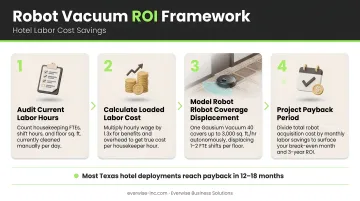
The framework is straightforward:
- Estimate current manual vacuuming hours — total weekly time spent on corridors, lobbies, and event spaces
- Apply the hourly wage baseline — BLS 2023 data puts the mean hourly wage for hotel maids and housekeeping cleaners at $16.66
- Calculate what percentage could be redirected — not eliminated, but reassigned to room turnover, deep cleaning, or guest-facing service
- Weigh that against robot operating costs — hardware investment, maintenance, and any additional support
The case isn't about eliminating positions. With 38% of hotels citing housekeeping as their top unfilled role, the more accurate framing is: robots cover the gap that hiring hasn't filled, while existing staff handle higher-value work that robots cannot. That reallocation is where the ROI becomes tangible.
Consistency as a Quality Metric
A programmed robot follows the same route with the same precision on every run — regardless of shift, fatigue, or time of day. Human cleaning thoroughness varies. That inconsistency is what generates the occasional cleanliness complaint that lands in a review.
Replacing unpredictable manual vacuuming cycles with repeatable robot routes reduces re-cleans, lowers complaint frequency, and protects cleanliness scores.
The Operational Signal Guests Notice
Robots operating in lobbies and corridors have a secondary effect: guests see them. Research from Oracle Hospitality and Skift found 53.6% of travelers wanted contactless, technology-forward service permanently adopted post-pandemic. A robot cleaning the lobby signals investment in hygiene infrastructure — visible, consistent, and repeatable.
Guests don't book a hotel because of robots. But when cleanliness scores slip, it's rarely because the equipment failed — it's because the process was inconsistent. A robot can't have a bad day, and in a review-driven market, that consistency protects the brand.
Everwise Business Solutions is the authorized Gausium distributor serving Texas hotel operators, with offices in San Antonio and Pharr. Their team provides deployment assessments and product recommendations tailored to specific hotel configurations. Reach them at 210.884.0559 or german.zavala@everwise-inc.com.
Frequently Asked Questions
How is a commercial hotel robot vacuum different from a consumer robot vacuum?
Commercial models are built for continuous large-scale operation, with LiDAR navigation, large-capacity dustbins, cloud-based fleet management, and AI-driven surface adaptation. Consumer models lack the hardware durability, navigation precision, and operational reporting that hotel deployments require.
Can hotel robot vacuums clean both carpet and hard floors?
Yes. Commercial robots use onboard AI and 3D depth cameras to detect floor surface type automatically and adjust cleaning mode accordingly. The Gausium Vacuum 40, for example, identifies hardwood, stone, and varying carpet pile depths and transitions between them without manual reprogramming.
How do hotel robot vacuums navigate around guests and furniture without getting stuck?
Commercial robots use LiDAR, 3D depth cameras, and real-time obstacle detection to map their environment dynamically. When the system detects a person, luggage cart, or repositioned furniture, it updates its internal map and reroutes without staff intervention.
How long does it take to program and deploy a hotel robot vacuum?
Most commercial systems use a teach-and-repeat setup: staff walk the robot through the intended route once, it memorizes the path, and the process takes minutes per zone with no technical expertise required beyond basic app familiarity.
Do robot vacuums replace hotel housekeeping staff?
No. Robots handle repetitive vacuuming tasks (corridors, lobbies, ballrooms), freeing housekeeping staff for room turnover, deep cleaning, and guest-facing service. Most operators deploy robots to fill staffing gaps that hiring hasn't resolved — not to reduce existing headcount.
What areas of a hotel are best suited for robot vacuum cleaning?
Lobbies, guest room corridors, banquet halls, and meeting spaces deliver the highest impact. These zones combine large square footage, consistent layouts, high cleaning frequency, and enough repetition that a single mapped route can be executed reliably across hundreds of cleaning cycles.