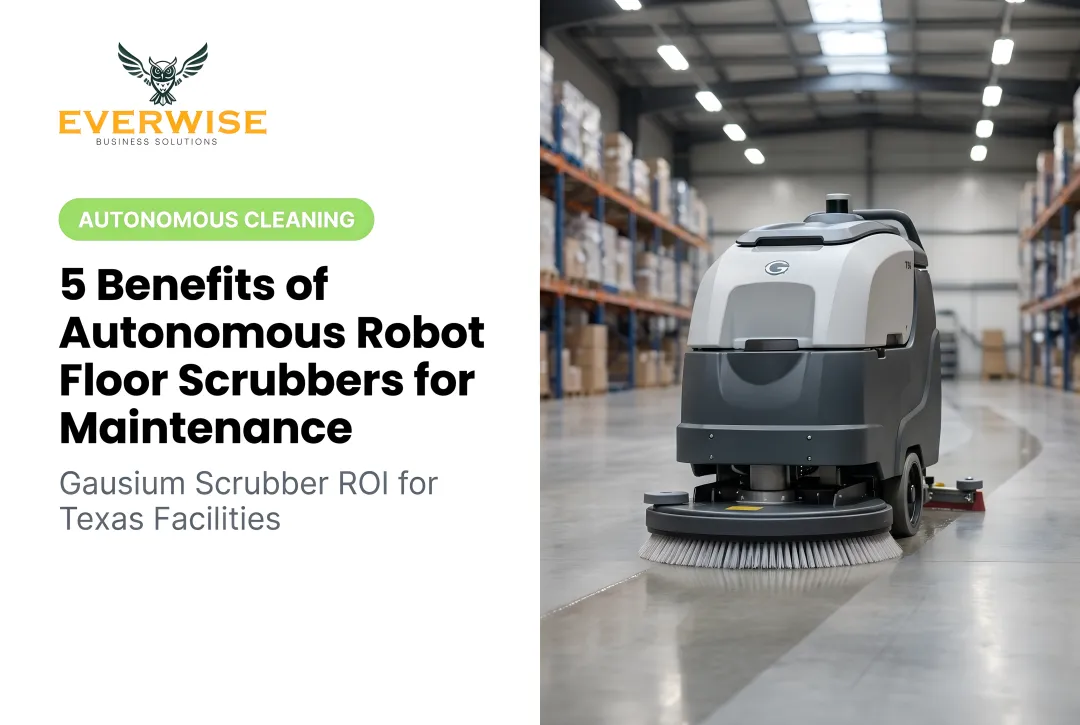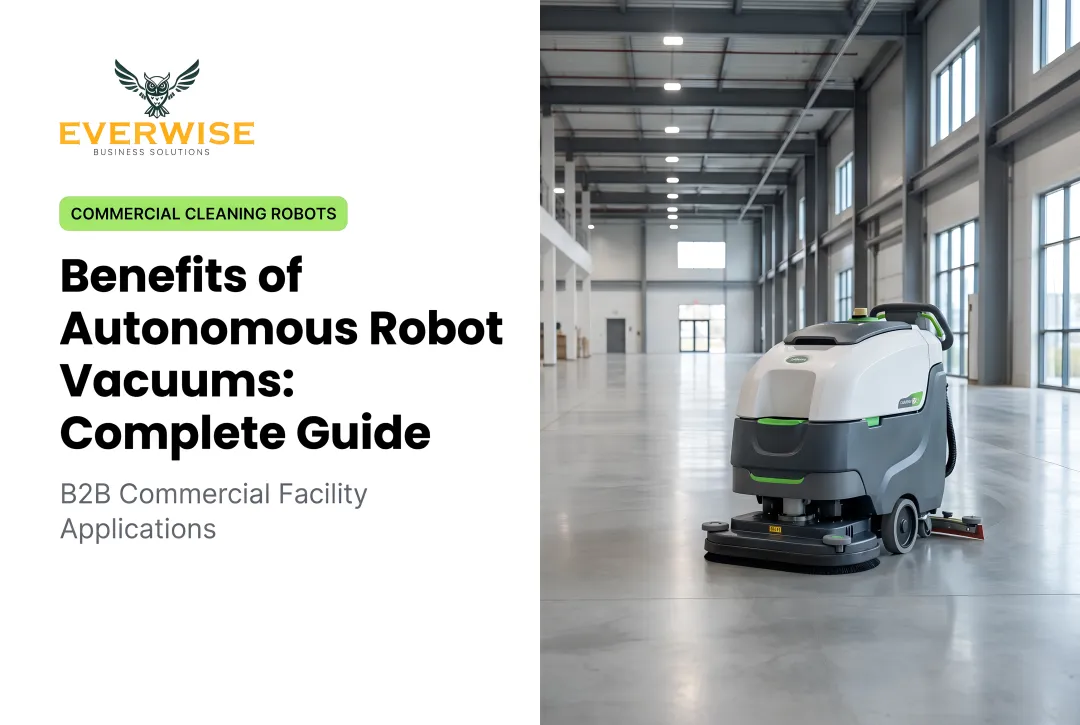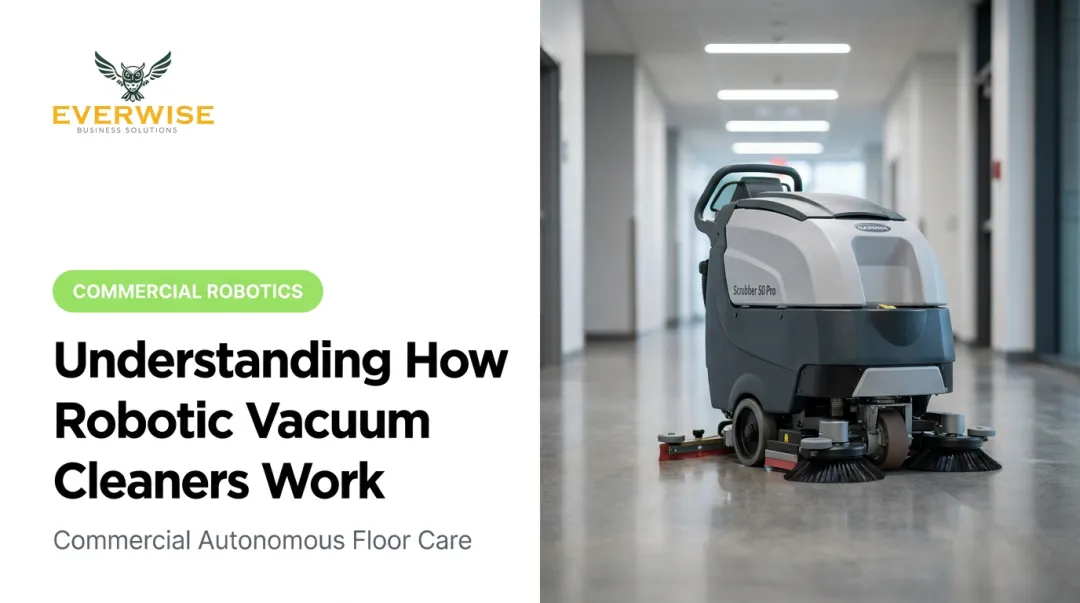
Robot vacuums are often dismissed as home gadgets. In practice, their most measurable impact is showing up in hospitals, warehouses, retail chains, hotels, and schools — environments where cleaning consistency affects compliance outcomes, customer perception, and operating costs simultaneously.
This article breaks down the specific, operational advantages of robot vacuums in commercial settings: what they actually change, which metrics they move, and where the cost of ignoring them compounds fastest.
Key Takeaways
- Robot vacuums automate routine floor cleaning, freeing staff for tasks that require judgment and physical dexterity
- Cleaning costs become more predictable as facilities scale — with less direct labor dependency built in
- AI navigation, H13 HEPA filtration, and scheduling tools enable autonomous operation across large, complex spaces
- Gausium deployment data shows 20%–60% reductions in manual cleaning time at specific facilities
- For hygiene-sensitive or high-traffic environments, automation is an operational necessity
What Are Robot Vacuums?
A robot vacuum is a self-navigating floor cleaning device that uses sensors, AI mapping, and programmed routines to clean autonomously, with no human operator required during the cleaning cycle.
Commercial-grade units go well beyond the consumer devices most people picture. The Gausium Vacuum 40, for example, uses 3D depth cameras and AI to identify floor types in real time, automatically switching between carpet modes, hard-floor sweeping, and dust-mopping in a single pass.
The Gausium Omnie takes this further with dynamic AI navigation that detects spills and high-soil zones, concentrating cleaning effort where it's needed most as conditions change throughout the day.
These robots are deployed in:
- Commercial offices and corporate campuses
- Hospital corridors, lobbies, and cafeterias
- Hotel front-of-house and back-of-house areas
- Warehouses, distribution centers, and manufacturing plants
- Schools, retail stores, and transportation hubs
For facility operators, the distinction matters: robot vacuums are not a gadget purchase. They are a deployment tool for maintaining consistent cleaning standards across large footprints, while freeing your staff for work that requires human judgment.
Key Advantages of Robot Vacuums
Each advantage below connects directly to metrics facility managers, operations directors, and CFOs actively track.
Labor Optimization and Cost Reduction
Labor is the dominant cost in any cleaning operation. 55% of surveyed facility cleaning departments identified labor as their single largest expense — and with median wages up nearly a quarter in four years, that pressure is only intensifying.
Robot vacuums reduce direct labor hours by handling repetitive floor cleaning autonomously. The robot follows a programmed cleaning route during off-hours or low-traffic periods, completes its cycle, and returns to its dock — no supervisor oversight required.
What this translates to in practice:
- Cleaning teams shift from pushing a mop across open floors to handling restrooms, detail work, and high-touch surfaces that require human judgment
- Robots don't call in sick, require overtime, or need scheduling around personal conflicts — labor costs become predictable
- The BLS projects 351,300 annual openings in building cleaning occupations through 2034, driven primarily by workers leaving the field. Reducing headcount dependency shrinks the recurring cost of recruiting and onboarding replacements
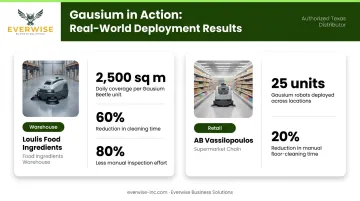
Real deployment data from Gausium installations shows what's achievable. At Loulis Food Ingredients warehouse, a Gausium Beetle covering 2,500 sq m daily produced a 60% reduction in cleaning time and 80% less manual inspection effort, with personnel reassigned to higher-value work.
At AB Vassilopoulos supermarkets in Greece, 25 deployed Gausium units delivered a 20% reduction in manual floor-cleaning time. Results are site-specific, but the pattern holds across facility types and sizes.
KPIs affected: Labor cost per square foot, overtime hours, turnover rate, cost-per-clean
Where this matters most: Large-footprint facilities with high daily cleaning frequency — warehouses, airports, schools, large retail — and any operation in a tight Texas labor market where recruiting cleaning staff is difficult.
Consistent, High-Quality Cleaning Performance
Manual cleaning quality varies. Different staff members apply different techniques. High-traffic areas get more attention than corners. Night-shift coverage differs from day-shift. Over time, these inconsistencies accumulate into hygiene gaps.
Robot vacuums eliminate that variability. They follow pre-mapped routes using AI and sensor technology, executing the same systematic pattern every cycle — same zones, same sequence, same edge coverage.
The Gausium Vacuum 40 illustrates how this works mechanically. Its 3D depth cameras and AI detect floor type in real time — hardwood, vinyl, marble, carpet of varying pile depths — and automatically adjust suction intensity, brush height, and cleaning mode. Its zero-distance edge cleaning (specifically the Phantas and Vacuum 40 models offer 0cm-from-edge cleaning) eliminates the debris strips along baseboards that standard autonomous cleaners consistently miss.
Why consistency matters in regulated environments:
Research at a 305-bed hospital that sustained surface-cleaning performance above 90% for six consecutive years documented concurrent declines of 75% in overall healthcare-associated infections and 55% in surgical-site infections. Concurrent infection-control programs prevent attributing those outcomes to cleaning alone.
What the data does establish is a clear relationship between sustained cleaning compliance and reduced infection risk — one regulators and accreditation bodies take seriously.
CMS survey guidance requires hospitals to maintain sanitary floor conditions as part of infection control program oversight. A robot that runs scheduled cycles, logs every cleaning event through the Gausium Mobile App, and covers the same zones every night supports that compliance posture. Manual cleaning schedules cannot match that level of documentation or repeatability.
Air quality is part of the equation too. The Gausium Vacuum 40 and Beetle both carry H13 medical-grade HEPA filtration — capturing fine dust, allergens, and particulates rather than redistributing them during the cleaning cycle. Research in institutional settings shows HEPA filtration can reduce indoor PM2.5 concentrations by nearly 40–48%. In schools and healthcare environments, that matters for occupant health, not just compliance.
KPIs affected: Cleaning coverage rate, hygiene inspection scores, allergen and particulate levels, compliance audit results
Where this matters most: Healthcare facilities, schools, hotels, and food service environments where visible cleanliness affects regulatory standing and customer trust simultaneously.
Operational Efficiency and Scalability
Robot vacuums don't just reduce labor costs on a single shift — they change the economics of growth entirely.
Traditional scaling is linear: more square footage means more headcount, more scheduling complexity, more supervision, and more turnover exposure. Robot vacuums break that pattern. Adding a new wing or a second location means deploying an additional unit — not hiring, onboarding, and training another employee.
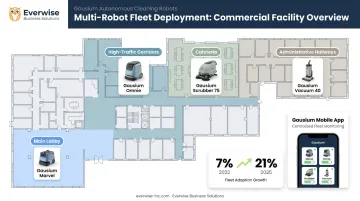
The Gausium Mobile App enables centralized oversight across an entire deployed fleet. Facility managers can monitor cleaning tasks in progress, adjust schedules remotely, review cleaning logs, and manage multiple units across multiple sites from one interface. For multi-location operators — retail chains, hospital networks, hotel groups — this is a real efficiency gain, not just a convenience.
How this plays out operationally:
- Robots scheduled to run during off-hours operate without requiring a supervisor on-site
- Multiple units can run simultaneously across different zones — a large hospital campus can deploy a Gausium Marvel in the main lobby, an Omnie in high-traffic corridors, a Scrubber 75 in the cafeteria, and a Vacuum 40 in administrative hallways all at once
- Cleaning logs generated automatically support compliance documentation for Joint Commission, CMS, and OSHA surveys in healthcare environments
- Fleet adoption among facility cleaning managers rose from 7% in 2022 to 21% in 2025 — a tripling of deployment in three years
KPIs affected: Cleaning coverage per shift, manager oversight hours, operational cost per additional cleaned area, time-to-clean for expanded spaces
Where this matters most: Multi-location businesses, rapidly growing facilities, and operations running 24/7 where cleaning must occur during active hours without disrupting staff or customers.
What Happens When Cleaning Automation Is Ignored
The consequences of staying manual-only don't announce themselves clearly — they accumulate.
When 44% of facility management respondents identify labor shortages as their top operational challenge, staff shortages leave cleaning schedules incomplete. Floors get cleaned less frequently than required. High-traffic zones accumulate buildup between visits.
Supervisors end up managing cleaning logistics instead of higher-priority operations — a misallocation that compounds as facilities grow.
The risks by environment:
- Healthcare: Uneven cleaning creates infection control gaps and increases exposure during CMS or Joint Commission surveys. Research found observed surface-cleaning compliance at only 33.6% across environmental surfaces in hospital settings — far below the rates required for effective infection risk management
- Hospitality: 65% of surveyed U.S. hotels reported staffing shortages, with housekeeping as the most frequently cited gap. Visible cleanliness gaps translate directly to negative reviews and reduced repeat bookings
- Retail and commercial offices: Poor indoor air quality and dusty floors erode the professional environment that clients and employees expect — and create recurring complaints that divert management attention
Manual-only operations also see cleaning costs scale directly with headcount. Every staff departure triggers a recruiting and training cycle — estimated at $1,500–$5,000 per replacement hire in janitorial roles. Automation breaks that cycle and fixes cleaning costs at any scale.
How to Get the Most Value from Robot Vacuums
A robot vacuum running in the wrong configuration delivers a fraction of its potential. Getting full value requires treating the deployment as a structured operational process — one that's configured, scheduled, and maintained from day one.
Three principles that separate high-performing deployments from underperforming ones:
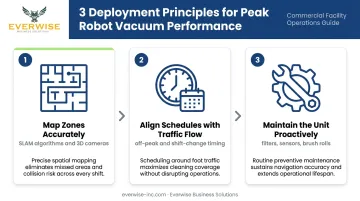
- Map zones accurately from the start. Gausium robots use SLAM algorithms and 3D depth cameras to build internal maps of the facility. Accurate initial mapping — with zones aligned to actual traffic patterns and cleaning priorities — determines whether the robot covers the right areas at the right times
- Align schedules with traffic flow. Robots run most effectively during off-peak hours or low-traffic periods when the floor is clear. Scheduling around shift changes, peak customer hours, and facility-specific patterns maximizes coverage efficiency
- Maintain the unit proactively. Suction degrades with dirty filters, sensors drift without calibration, and brush rolls wear. Reactive maintenance costs more than scheduled upkeep.
Everwise Business Solutions' preventive maintenance program addresses this directly. Quarterly or semi-annual technician visits for high-intensity deployments cover:
- H13 HEPA filter replacement
- Sensor calibration and navigation verification
- Battery health check and drive train inspection
- Software updates and Gausium Mobile App configuration
Performance data from the Gausium Mobile App — cleaning logs, task completion status, and fleet monitoring across all deployed units — gives facility managers the visibility to catch gaps before they become complaints or compliance issues.
That visibility also clarifies where human staff add the most value. Robots supplement cleaning teams — they don't replace them. The best-performing facilities assign robots to systematic floor coverage and staff to restrooms, detail cleaning, and high-touch surfaces. That division is where real efficiency gains land without compromising the areas that still need human judgment.
Conclusion
Commercial robot vacuums deliver three compounding advantages that strengthen over time: labor costs become more predictable as wages rise and staffing tightens, cleaning consistency holds across shifts and staff changes, and facilities can scale operations without adding proportional headcount.
Adopting commercial cleaning automation is an operational investment with a compounding return — one that manual-only operations simply cannot replicate over the same timeframe.
Frequently Asked Questions
What are the benefits of cleaning robots?
Cleaning robots reduce direct labor hours, deliver consistent and repeatable floor coverage, improve indoor air quality through advanced filtration, and free staff for higher-value tasks. In commercial settings with high traffic or infection-control standards, these benefits translate directly into lower operating costs and more reliable compliance outcomes.
Is it a good idea to have a cleaning robot in every home?
Commercial facilities make the strongest case for autonomous cleaning robots. At scale — across hotels, hospitals, warehouses, and retail chains — staffing costs, consistency demands, and compliance requirements make the operational and financial returns measurable and immediate in ways that residential settings simply don't match.
How do robot vacuums reduce labor costs for businesses?
Robot vacuums run scheduled floor cleaning cycles autonomously, cutting direct labor hours per shift. Cleaning staff are reallocated to tasks requiring human judgment — restrooms, high-touch surfaces, detail work — while overtime exposure and turnover-related costs decrease.
Are robot vacuums effective for large commercial spaces like warehouses or hospitals?
Commercial-grade models are specifically designed for large floor areas. Gausium's enterprise lineup — including the Marvel, Beetle, Scrubber 75, and Omnie — uses AI mapping and programmable multi-zone routes to cover extensive spaces systematically. Multiple units can run concurrently across different zones for even greater throughput.
Can robot vacuums replace human cleaning staff entirely?
Robot vacuums work best alongside human cleaning teams, not instead of them. They handle autonomous floor coverage while staff focus on restrooms, high-touch surfaces, and tasks that require on-the-spot judgment — producing measurable labor optimization without eliminating the team.
How often do commercial robot vacuums need maintenance?
For high-intensity commercial deployments, Everwise Business Solutions schedules preventive maintenance quarterly. Each visit covers H13 HEPA filter replacement, brush inspection, sensor calibration, battery assessment, and software updates — performed by factory-trained technicians using genuine Gausium OEM parts.