The traditional model is breaking down. Cleaning & Maintenance Management reported in 2022 that annualized turnover in contract cleaning has soared to as high as 200%, and the ripple effects reach every corner of mall operations: inconsistent coverage, compliance gaps, and tenant friction.
Autonomous cleaning robots aren't an experiment anymore. Forward-thinking retail facility managers across the country are deploying them as a core operational strategy — not a pilot program. This article covers the challenges driving adoption, how the technology actually works in retail environments, the tangible business case, and what to look for when evaluating a solution for your facility.
Key Takeaways
- Custodial turnover rates reaching 200% create chronic inconsistency that manual oversight can't fix at scale
- Autonomous robots use LiDAR, SLAM, and AI to navigate crowded retail environments and adapt to changing floor layouts in real time
- Verified data shows customer satisfaction is 17% higher in facilities rated excellent for cleanliness versus average
- ROI timelines for daily-cleaned facilities like shopping malls typically range from 14 to 24 months, per Bunzl Canada's 2021 analysis
- Authorized distributor support — covering deployment, integration, and ongoing service — determines how quickly robots deliver reliable results
Why Shopping Centers Struggle to Keep Up with Cleaning Demands
A Staffing Crisis That Compounds Every Day
The custodial workforce is notoriously difficult to staff and retain. Contract cleaning turnover has reached as high as 200% annually, according to industry reporting from CMM — meaning the average shopping center may cycle through its entire janitorial crew twice a year. Each departure triggers recruiting costs, onboarding time, and a gap in coverage that no checklist can fully close.
That instability creates a cascade problem. New hires clean inconsistently, and supervisors spend time training rather than auditing. Quality drops during the very window when no one is watching — and in a high-traffic retail environment, that's most of the day.
The Hygiene Expectation Gap
Post-pandemic shopper behavior shifted permanently. According to Tork/Essity's 2021 research, nearly 60% of people have higher hygiene expectations in shopping centers than before, and 66% would reduce their shopping time to avoid unacceptable hygiene conditions.
Tenants are enforcing those expectations through lease compliance standards. A mall that can't demonstrate consistent cleaning performance faces:
- Anchor tenant friction at renewal time
- Specialty retailer complaints that escalate to property management disputes
- Reputational damage that affects foot traffic broadly
Manual cleaning models can't keep pace with these expectations without proportional increases in headcount — and the staffing pipeline simply isn't there.
Documentation and Compliance Risk
Paper-based cleaning records create legal and financial exposure. When a slip-and-fall occurs in a food court, or when a tenant disputes whether cleaning standards were upheld, the question comes down to documentation. Manual logs are incomplete by nature — filled in after the fact, inconsistently dated, and difficult to audit.
OSHA's 29 CFR 1910.22 requires walking-working surfaces be kept clean, sanitary, and free from spills. Without verifiable records showing when floors were cleaned and to what standard, facilities carry liability they can't quantify or defend. That exposure shows up in three compounding ways:
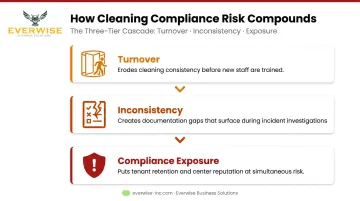
- Turnover erodes cleaning consistency before new staff are fully trained
- Inconsistency creates documentation gaps that surface during incident investigations
- Compliance exposure puts tenant retention and center reputation at risk simultaneously
Autonomous cleaning robots address each layer of this problem — not by replacing oversight, but by making consistent, documented performance the default.
How Autonomous Cleaning Robots Work in Retail Environments
Spatial Mapping and Dynamic Navigation
Professional-grade autonomous cleaning robots use LiDAR and SLAM (Simultaneous Localization and Mapping) to build precise spatial maps of a facility, determine their precise position within that map, and update their understanding of the environment as it changes. Gausium's 2026 technical documentation describes localization accuracy of ±10mm and mapping coverage up to 100,000 square meters.
For shopping centers, that dynamic mapping capability matters more than raw speed. Seasonal displays, promotional kiosks, and event setups shift floor layouts constantly. A robot that reroutes around a new kiosk placement without being manually reprogrammed keeps operations running. One that requires manual reprogramming for every layout change creates scheduling delays and staff overhead that undercut the automation value.
The Gausium Omnie is specifically engineered for this scenario: high-dynamic retail environments where last-minute floor-plan changes make fixed-route robots ineffective.
Multi-Sensor Fusion and Pedestrian Safety
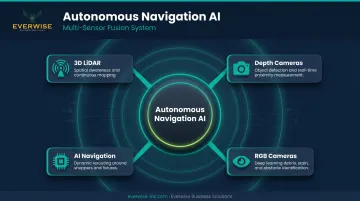
Modern commercial cleaning robots don't rely on a single sensor type. They combine:
- 3D LiDAR for spatial awareness and continuous mapping
- Depth cameras that detect objects and measure proximity in real time
- RGB cameras running deep learning models to identify debris, stains, and obstacles
- Onboard AI navigation that reroutes around shoppers, carts, and temporary fixtures without stopping
This multi-sensor approach allows robots to operate safely during business hours — detecting and avoiding pedestrians without stopping operations entirely.
Auto-Docking and Self-Management
When battery levels drop, robots autonomously return to their charging dock, recharge, and resume their cleaning task. The Gausium Omnie pairs with Gausium charging docks and workstations (CD-01, CD-04, WS-series) along with the Gausium Mobile Water Tank for what Gausium describes as fully autonomous, unattended commercial deployment.
This infrastructure enables:
- Daytime operation around active shoppers
- Evening intensive cycles after tenant close
- Overnight deep cleaning during zero-traffic windows
All three shifts can run with minimal human intervention — a fundamental operational shift from traditional staffing models. That scheduling flexibility also raises a related challenge: each shift may cross entirely different floor surfaces, which requires the robot to adapt cleaning behavior automatically rather than relying on operator mode changes.
Intelligent Floor Identification
Mixed-surface retail environments require robots that adapt on the fly. The Gausium Vacuum 40 uses 3D depth cameras and AI to automatically detect surface types — tile, stone, vinyl/LVT, hardwood, polished concrete, and various carpet pile depths — and adjusts brush height and cleaning intensity accordingly without operator input.
For shopping centers where a single cleaning path might cross from polished marble in an atrium to vinyl in a retail corridor to carpet matting at an entry vestibule, this eliminates the manual mode-switching that slows down and complicates traditional operations.
Real-Time Monitoring and Compliance Reporting
The Gausium Mobile App gives facility managers remote visibility into cleaning operations: task status, schedule management, and cleaning logs that serve as compliance documentation. For shopping centers managing slip-and-fall liability or tenant hygiene disputes, those logs provide the verifiable, time-stamped record that paper systems cannot.
The Business Case: What Shopping Center Operators Actually See
Labor Reallocation, Not Just Reduction
Labor is the dominant cost in commercial cleaning — Imperial Dade's 2021 analysis found it can account for up to 85% of cleaning expenses. Their scenario modeling shows that an autonomous scrubber cleaning 45,000 square feet five days per week generates approximately $40,950 in annual labor savings.
The more accurate framing for most facilities isn't elimination — it's reallocation. Robots handle repetitive, large-area floor maintenance autonomously. Human staff shift to higher-value work: restroom sanitation, high-touch surface cleaning, customer-facing duties, and deep-cleaning tasks that genuinely require human judgment.
ROI Timeline
That labor reallocation directly shapes the financial return. Bunzl Canada's 2021 autonomous cleaning analysis found that for facilities cleaned daily — including shopping malls, airports, and big-box stores — payback typically ranges from 14 to 24 months. Imperial Dade's scenario modeling produces a 16-month payback for a $58,000 autonomous scrubber at a 45,000 sq ft facility.
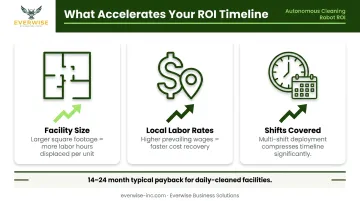
Three variables move that timeline most:
- Facility size — larger square footage accelerates payback
- Local labor rates — higher prevailing wages improve ROI faster
- Shifts covered — multi-shift deployment compresses the timeline significantly
Consistency and Liability Management
The ROI case doesn't stop at labor math. Robots follow programmed routes — they don't take shortcuts, skip sections when tired, or vary their technique from shift to shift. That consistency matters for:
- Slip-and-fall liability — documented, continuous floor maintenance creates a defensible record under OSHA 29 CFR 1910.22
- Tenant compliance — hygiene standards are met and verifiably documented every cleaning cycle
- Insurance exposure — consistent documentation supports favorable claim outcomes
Water, Chemical, and Energy Efficiency
Optimized path planning eliminates redundant passes. Gausium's Scrubber 50 documentation notes that built-in water recycling filtration can reduce freshwater usage by approximately 80%. Imperial Dade's ROI model estimates $850 in annual water and chemical savings for a single-unit deployment.
Overnight robotic operation also creates a secondary efficiency opportunity: facilities can reduce lighting and HVAC intensity in cleaned zones during off-hours, lowering energy draw without affecting cleaning performance.
Where in a Shopping Center Robots Deliver the Most Value
Atriums and Main Concourses
Large, open atrium floors are ideal for robotic scrubbers. Wide paths allow efficient coverage at high speeds during low-occupancy windows. A 2021 shopping center case study involving a deployment across eight locations reported that one autonomous scrubber freed 5 to 6 hours of staff labor nightly from industrial scrubbing — a meaningful reallocation in any facility's budget.
Two Gausium models are the primary recommendations for atrium-scale environments:
- Gausium Omnie — handles dynamic traffic during open hours with AI-powered navigation and real-time spot cleaning
- Gausium Marvel — provides the throughput needed for enterprise-scale square footage during off-hours deep cleans
Food Courts
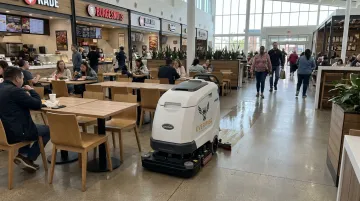
Food courts present the highest-intensity cleaning challenge in any mall: continuous spills, sticky residue, grease migration from vendor stalls, and slip hazard density that peaks precisely when foot traffic is highest.
The Gausium Scrubber 75 addresses the core problem directly. Its 270° rotational brush head reaches around table bases, trash receptacles, and queue barriers — the geometry where food debris concentrates. Its Oil Cleaning Mode handles grease and cooking oil residue that traditional auto-scrubbers struggle with.
The scrubber-dryer function applies solution, agitates the surface, and recovers dirty water in a single pass, leaving floors dry and reducing live slip hazard exposure.
The Gausium Omnie complements this during open hours — its AI-powered Auto Spot Cleaning detects fresh spills in real time and directs cleaning effort to where it's needed, without requiring the space to be cleared.
Retail Corridors and Transition Zones
Connecting corridors, entry vestibules, and indoor-parking transition zones accumulate tracked-in debris at a rate that demands precision navigation and edge-cleaning capability that larger robots can't deliver.
Two Gausium models are purpose-built for this:
- Gausium Phantas / PhanShop — delivers 0cm-from-edge cleaning with a compact form factor engineered for tight retail geometry. The PhanShop is the retail-specific configuration, optimized for shopper-aware navigation and aisle-endcap layouts.
- Gausium Vacuum 40 — adds AI-based floor identification across mixed surfaces, handling the tile-to-vinyl-to-carpet transitions common in entry vestibules without requiring manual mode changes.
How Cleanliness Directly Influences Shopper Behavior
Customer satisfaction runs 17% higher when cleanliness is rated excellent versus average, according to Intouch Insight's 2024 mystery shopping research. That gap has direct financial consequences for shopping center operators.
In a shopping center context, that gap translates to:
- Longer dwell times and higher per-visit spend
- Stronger repeat visit rates for anchor and specialty tenants
- Measurable impact on tenant sales performance that flows back to lease renewal negotiations
The visible presence of an autonomous cleaning robot actively signals to shoppers that the facility takes hygiene seriously. Tork's 2021 research found that 66% of shoppers would reduce their time in a facility with unacceptable hygiene — making cleanliness a direct traffic driver, not just an operational checkbox.
On tenant retention, ICSC's 2023 analysis found that retailers view property maintenance decline as a sign of distress — sometimes limiting lease renewals to a single year when standards slip. A mall with documented, consistent hygiene performance enters renewal negotiations from a materially stronger position.
What to Look for When Choosing a Retail Cleaning Robot
Match Capabilities to Your Floor Environment
Assess your facility's actual surface mix before evaluating models. A shopping center with polished marble atriums, vinyl retail corridors, and carpet-matted vestibules needs AI-based floor identification and adaptive cleaning modes — not a single-mode scrubber that requires manual reconfiguration at every transition.
Prioritize Navigation Sophistication
Retail environments are uniquely challenging for robot navigation: layouts shift with seasonal displays, events add temporary furniture, and pedestrian flow is genuinely unpredictable. Look for:
- Real-time mapping updates that accommodate layout changes without full remapping
- Proven pedestrian obstacle avoidance in crowded environments
- Ability to navigate narrow corridors and doorways reliably
Consider Deployment Support and Ongoing Service
Hardware is only part of the equation. The value of a cleaning robot depends heavily on proper setup, facility mapping, staff training, and ongoing maintenance. Working with an authorized distributor matters.
Everwise Business Solutions is the authorized Gausium distributor for Texas, with operations across San Antonio, Pharr, Austin, Dallas, Houston, and the Rio Grande Valley. Their deployment support includes:
- Factory-trained installation and facility mapping
- Scheduled preventive maintenance contracts
- On-demand emergency repair dispatch statewide
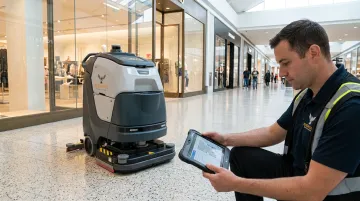
That local support infrastructure is what separates a successful fleet deployment from a costly hardware problem.
Frequently Asked Questions
Can cleaning robots operate while shoppers are present in the mall?
Yes. Commercial cleaning robots use multi-sensor obstacle avoidance and pedestrian detection to operate safely during business hours. Many facilities also schedule intensive cleaning cycles overnight or during low-traffic windows to maximize coverage efficiency alongside open-hours operation.
How much can a shopping center realistically save by switching to robotic cleaning?
Imperial Dade's scenario modeling shows approximately $40,950 in annual labor savings for a single unit covering 45,000 square feet five days per week. ROI timelines for daily-cleaned facilities like malls typically run 14 to 24 months, depending on facility size, local labor rates, and shifts covered.
Do robotic cleaning systems eliminate the need for all janitorial staff?
No. Robots handle repetitive large-area floor maintenance autonomously, which allows human staff to be redeployed to higher-value work — restroom maintenance, high-touch surface sanitation, deep cleaning, and customer-facing responsibilities — rather than eliminated.
Can one robot handle all the different floor types found in a shopping center?
Advanced models with AI-based floor identification, like the Gausium Vacuum 40, automatically detect surface types and adjust brush height and cleaning mode accordingly. For complex mixed-surface facilities, a multi-model deployment combining a scrubber for wet zones with a vacuum unit for dry areas typically outperforms any single unit.
How long does it take to deploy a cleaning robot in a shopping mall?
Most deployments complete within a few days to two weeks, depending on facility size and layout complexity. Everwise handles facility mapping, infrastructure setup, and Gausium Mobile App configuration. For a timeline estimate specific to your mall, call 210.884.0559.
How do cleaning robots support a shopping center's sustainability and ESG goals?
Gausium's built-in water recycling cuts freshwater consumption by approximately 80%, and optimized cleaning paths lower energy draw during overnight operation. The Gausium Mobile App generates documented cleaning logs that directly support LEED green cleaning policies and ESG operational reporting.