Introduction
Commercial facilities face stricter scrutiny of indoor air quality. Hospitals, hotels, schools, and office buildings must demonstrate hygiene standards that go beyond visible cleanliness — and the cleaning equipment they choose directly affects whether they meet those standards or fall short.
Robot vacuums show up frequently in facility procurement conversations, and "HEPA filter" appears on many spec sheets. The problem is that not all HEPA claims are equal, not all grades perform the same, and many buyers don't realize that a non-HEPA robot vacuum can actually worsen air quality by exhausting fine particles back into the space it just cleaned.
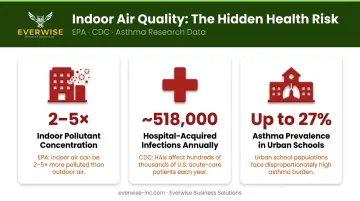
That risk isn't theoretical. The EPA reports that indoor pollutant concentrations are often 2 to 5 times higher than outdoors — which means what happens during a vacuuming cycle is a material concern, not a footnote.
What follows breaks down how HEPA filtration works inside a robot vacuum, why filter grade determines real-world performance, and what's at stake operationally when it's overlooked.
Key Takeaways
- HEPA filters capture at least 99.97% of airborne particles at 0.3 microns — the hardest particle size to trap
- H13 HEPA (≥99.95% efficiency per EN 1822) is the appropriate grade for healthcare, hospitality, and allergy-sensitive commercial spaces
- Robot vacuums without HEPA filtration recirculate fine particles back into the room, worsening air quality over time
- HEPA benefits disappear without consistent filter maintenance — a clogged filter performs like no HEPA filter at all
- Two Gausium models carry confirmed H13 filtration: the Vacuum 40 v1.6 and the Beetle/Beetle Pro
What Is a HEPA Filter?
HEPA (High-Efficiency Particulate Air) is a performance standard, not a brand name. In the United States, the EPA defines a HEPA filter as one that captures at least 99.97% of airborne particles at 0.3 microns in diameter. That 0.3-micron size is significant: it's the most-penetrating particle size (MPPS), meaning it's the hardest for filter media to trap. A filter that meets the threshold at 0.3 microns performs as well or better at smaller and larger particle sizes.
In a robot vacuum, air drawn in during suction carries debris through the system. Before that air is exhausted back into the room, it passes through the filter — making filtration the critical barrier between captured particulates and the air your building occupants breathe.
Understanding Filter Grades
Buyers comparing commercial robot vacuums need to distinguish between filter classes, because the performance gap between them is meaningful:
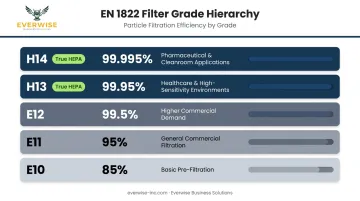
| EN 1822 Class | Minimum Efficiency at MPPS | Common Use Context |
|---|---|---|
| E10 | 85% | Basic pre-filtration |
| E11 | 95% | General commercial |
| E12 | 99.5% | Higher commercial demand |
| H13 | 99.95% | Healthcare, high-sensitivity environments |
| H14 | 99.995% | Pharmaceutical, cleanroom |
Some suppliers still use the older H10–H12 terminology — the current EN 1822 standard reclassifies those as E10–E12. H13 and H14 are the grades formally designated HEPA under this standard.
The practical implication: an E12 filter at 99.5% efficiency and an H13 filter at 99.95% may sound similar, but in a high-traffic commercial space running multiple cleaning cycles daily, the difference in particles exhausted back into the room adds up across hundreds of cleaning passes.
Key Advantages of HEPA Filters in Commercial Robot Vacuums
The advantages below are evaluated from an operational standpoint — not just filter specs. Each connects to outcomes that facility managers, operations leads, and procurement teams track and report on.
Advantage 1: Measurable Improvement in Indoor Air Quality
A standard robot vacuum without HEPA filtration traps visible debris but exhausts fine particulate matter — dust, pollen, mold spores, bacteria — back into the room through its exhaust. In a residential setting, that's a nuisance. In a commercial setting with high foot traffic and frequent cleaning cycles, the effect compounds with every cycle.
In a hotel lobby or open-plan office running daily vacuum cycles, a non-HEPA unit can actually elevate PM2.5 and PM10 readings rather than reduce them. Each pass cycles large volumes of air through the exhaust, redistributing fine particles that remain airborne for hours. Over days and weeks, the cleaning routine itself becomes a source of particulate load.
A peer-reviewed office study found that vacuuming increased PM10 concentrations and produced a measurable PM2.5 increase — evidence that cleaning activity itself generates resuspension when the equipment doesn't capture exhaust-stage particles.
KPIs this affects:
- Indoor air quality scores and PM2.5/PM10 readings
- Occupant complaint rates related to dust or air quality
- Compliance outcomes during health and safety audits
When this matters most:
- Facilities with recirculating HVAC (limited fresh air dilution)
- High-occupancy spaces with continuous human activity
- Environments with carpet or soft furnishings that release fine particles during cleaning
Advantage 2: Reduced Health Risk and Compliance Support
In regulated environments — healthcare, food service, education — indoor air quality isn't a comfort issue. It's a compliance and liability matter that connects directly to equipment specifications.
The CDC recommends that vacuums used around patients at risk from airborne dust be equipped with HEPA filters (Category IB recommendation). This is direct equipment guidance, not general housekeeping advice. For hospital corridors, clinic waiting rooms, and assisted living common areas, the filtration standard of the cleaning equipment directly affects infection control outcomes.
The CDC's 2023 point-prevalence survey found approximately 518,000 healthcare-associated infections (HAIs) in U.S. acute-care hospitals. While no source attributes a specific share of HAIs to vacuum exhaust, the CDC's recommendation to use HEPA-equipped vacuums in at-risk areas reflects the established link between airborne dust control and infection risk management.
On the education side, asthma prevalence in urban school populations runs as high as 27% in some studies. Students with asthma experience measurably more absences — reducing fine airborne allergens through HEPA filtration during regular cleaning contributes to the IAQ conditions that support attendance.
KPIs this affects:
- Infection control audit scores and regulatory compliance status
- Staff and student absenteeism rates
- Guest/patient complaint rates related to allergen or air quality concerns
When this matters most:
- Healthcare facilities (hospitals, clinics, assisted living)
- Schools and universities with high student density
- Hospitality environments serving guests with respiratory sensitivities
- Any facility subject to OSHA IAQ guidelines or CMS environmental standards
Advantage 3: Sustained Cleaning Performance Through Autonomous Operation
Autonomous scheduling eliminates the coverage gaps that undermine manual cleaning programs. Pair that with HEPA filtration and each cycle actively improves air quality, rather than redistributing particles the previous pass stirred up.
Manual cleaning is intermittent by nature. Staff availability, shift gaps, and scheduling constraints create gaps even in well-managed facilities. A HEPA-equipped autonomous robot vacuum can run daily across large commercial floor areas — during overnight hours, between shifts, or during low-occupancy windows — without requiring supervision to maintain consistent filtration performance.
The BLS reports median pay for janitors and building cleaners at $17.27 per hour ($35,930 annually). In large facilities requiring multiple cleaning staff per shift, autonomous HEPA-equipped robots reduce dependence on manual labor for routine floor maintenance — freeing staff for inspection, restocking, and direct-service work that robots can't perform.
In practice, this means:
- Scheduled cleaning runs during low-occupancy periods via app-based management
- Consistent HEPA filtration across all operating hours, not just scheduled shifts
- Documented cleaning logs that support compliance reporting
KPIs this affects:
- Cleaning labor hours and operational cost per square foot
- Cleaning cycle frequency and floor coverage consistency
- Air quality measurement trends over time
When this matters most:
- Large-footprint facilities (hospitals, hotels, airports, warehouses) where manual cleaning frequency is constrained by labor costs
- Multi-shift operations needing air quality maintenance across all hours
The Gausium Vacuum 40 and Vacuum 40 v1.6, available through Everwise Business Solutions for Texas facilities, carry confirmed H13 HEPA filtration and support fully autonomous operation. Scheduled off-hours cleaning cycles are managed through the Gausium Mobile App; the robot auto-returns to its charging dock when battery runs low and resumes once recharged, with no staff intervention required.
What Happens When HEPA Filtration Is Missing or Ignored
This is the scenario that creates the most operational risk: a facility invests in robot vacuum automation, runs it on schedule, and still fails air quality benchmarks. The likely cause is inadequate filtration.
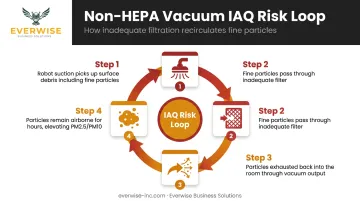
Without HEPA filtration, the cleaning cycle creates a recirculation loop:
- The robot's suction picks up surface debris, including fine particles
- Those fine particles pass through an inadequate filter
- They're exhausted back into the room through the vacuum's output
- They remain airborne for hours, contributing to elevated PM2.5/PM10 readings
The downstream consequences for commercial facilities are concrete:
- Failed air quality audits despite regular cleaning schedules
- Higher allergen-related health incidents among occupants, increasing absenteeism and liability exposure
- Supplementary air purification costs as facilities invest in standalone air purifiers to compensate for poor filtration at the cleaning stage
Filter neglect produces the same outcome, even with H13-grade equipment. A laboratory study on industrial HEPA filters found that dust accumulation increases pressure drop as the filter loads up.
A clogged filter loses suction efficiency and begins to bypass particles that a clean filter would capture. The robot effectively operates without HEPA protection until the filter is replaced.
Filter grade determines the ceiling of protection. Maintenance cadence determines whether that ceiling is ever reached. Both have to be managed.
How to Get the Most Value from HEPA Filters in Robot Vacuums
Match Filter Grade to Facility Type
Not every environment has the same air quality requirements. The decision framework is straightforward:
- H13 HEPA: Healthcare facilities, assisted living, schools with high student density, hospitality properties serving guests with respiratory sensitivities, and any facility subject to specific IAQ compliance requirements
- E12 or lower-grade filtration: Lower-risk office or retail environments where fine pathogen and allergen control is less critical. Confirm this is a documented, intentional decision — not just whatever the unit ships with.
The key is making an informed, documented choice. Defaulting to whatever filter grade is included in the base model without evaluating your facility's requirements is a liability in regulated environments.
Establish a Consistent Maintenance Schedule
Filter replacement frequency depends on usage volume and particulate load. Commercial environments require more frequent replacement than residential use. A robot running 8-hour daily cycles in a hospital corridor builds up debris far faster than a consumer unit running 30 minutes per day at home.
Everwise Business Solutions' preventive maintenance program for Gausium Vacuum 40 and Beetle/Beetle Pro units includes H13 HEPA filter replacement as a standard line item in quarterly PM visits for high-use facilities. For facilities without a maintenance contract, follow manufacturer specifications and adjust based on your facility's dust load. A high-particulate environment (warehouse, school cafeteria, high-traffic lobby) needs more frequent inspection than a low-traffic executive floor.
Integrate HEPA Robots Into Your Broader IAQ Strategy
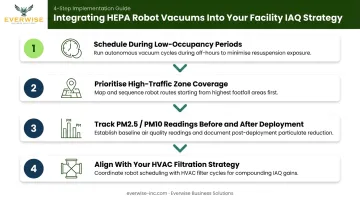
HEPA filtration during floor cleaning is one layer, not the complete solution. To get measurable outcomes:
- Schedule cleaning runs during low-occupancy periods (overnight or early morning) to reduce particle redistribution when occupants are present
- Prioritize high-traffic zones in your coverage map: lobbies, corridors, waiting rooms, and hallways
- Track PM2.5/PM10 readings before and after deploying autonomous HEPA cleaning to confirm measurable improvement
- Align with your HVAC strategy. In facilities with recirculating air systems, HEPA floor cleaning and HVAC filtration work together, not independently
Frequently Asked Questions
Do any robot vacuums have HEPA filters?
Yes. A growing number of commercial-grade autonomous robot vacuums include HEPA or HEPA-grade filtration. Look for a specific filter grade such as H13 rather than accepting "HEPA-style" or "HEPA-like" claims, which carry no standardized performance threshold.
Do you really need a HEPA filter on a robotic vacuum?
For commercial environments — healthcare, hospitality, and high-occupancy facilities in particular — HEPA filtration is not optional when air quality outcomes matter. A robot vacuum without it can worsen IAQ by recirculating fine particles back into the space. H13 HEPA is the most reliable standard across all commercial settings.
What is the difference between H13 HEPA and standard HEPA filters?
Standard HEPA under U.S. EPA definition captures ≥99.97% of particles at 0.3 microns. Under EN 1822, H13 captures ≥99.95% at the most-penetrating particle size (MPPS), while lower grades like E12 capture only 99.5%. In environments where fine pathogen and allergen control is critical, that performance gap is operationally significant.
How often should HEPA filters be replaced in commercial robot vacuums?
Replacement frequency depends on usage volume and environment type. High-use facilities (hospitals, warehouses, busy hotels) typically need more frequent replacement than manufacturer guidance suggests, which is calibrated for average use. Work with your supplier to set an interval based on your facility's actual dust load and daily runtime.
Can a HEPA filter robot vacuum help with regulatory compliance in healthcare settings?
A robot vacuum alone doesn't guarantee compliance, but documented use of H13 HEPA-grade filtration in routine cleaning operations contributes to a facility's overall IAQ hygiene posture and supports audit readiness under CMS and CDC environmental infection control guidelines.
What happens to air quality if a robot vacuum's HEPA filter is not maintained?
A clogged or degraded HEPA filter loses particle-capture efficiency and begins bypassing particles it would otherwise trap. The robot exhausts increasingly unfiltered air back into the space, effectively negating the HEPA benefit — and potentially performing worse than a well-maintained lower-grade filter.
Everwise Business Solutions is the authorized Gausium distributor for Texas, serving commercial facilities across San Antonio, Houston, Dallas, Austin, and the Rio Grande Valley. For specifications on H13 HEPA-equipped models or to discuss deployment for your facility, contact the team at 210.884.0559 or german.zavala@everwise-inc.com.