Introduction
Picture this: it's 8 AM on a Saturday. Your store opened 30 minutes ago, and the produce section already has a trail of condensation across the floor. Your overnight cleaning crew was short-staffed again. The floor supervisor called out. And somewhere between the dairy aisle and the checkout lanes, a shopper is already noticing.
This scenario plays out daily for grocery operators across Texas and beyond. According to FMI's 2024 U.S. Grocery Shopper Trends report, 73% of grocery shoppers want to shop in a clean, neat store.
Autonomous floor cleaning robots give grocery operators a reliable answer to that pressure. This guide covers the staffing and liability challenges driving adoption, how the technology works, the measurable operational benefits, and what to look for when choosing the right robot for your store.
Key Takeaways
- 73% of grocery shoppers prioritize store cleanliness, making floor hygiene a direct driver of repeat visits and purchase decisions
- Autonomous floor scrubbers handle scheduled cleaning while staff focus on spill response and customer service
- Cloud-based cleaning logs create timestamped, auditable records for health inspections and liability protection
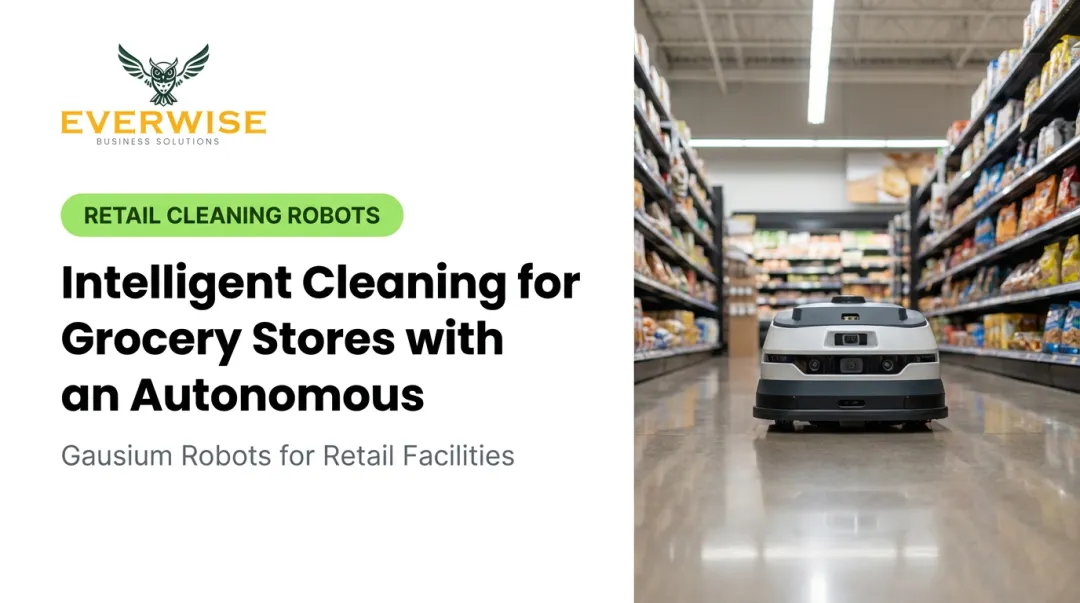
- Purpose-built retail models like the Gausium PhanShop navigate grocery aisles during open store hours
- Local distributor support is the critical factor in minimizing downtime risk — on-site response beats remote vendor tickets every time
The Cleaning Challenges Grocery Stores Can't Ignore
A Staffing Problem That Doesn't Get Easier
The U.S. retail sector recorded 412,000 quits in April 2026, reflecting a 2.7% seasonally adjusted quits rate for retail trade. For grocery operators, that number isn't abstract — it shows up as uncovered overnight shifts, undertrained replacement hires, and supervisors spending their time recruiting instead of managing operations.
The compounding effect is real:
- Overnight cleaning shifts go uncovered or understaffed
- Training cycles for new hires repeat constantly, draining supervisor time
- Overwhelmed workers take shortcuts — aisles get a quick pass, edges don't get touched, spills in low-traffic zones wait
- Visible floor lapses accumulate, and customers notice before management does
The Liability Reality
Grocery stores are uniquely exposed to floor-related incidents. Wet produce sections, refrigeration condensation, leaking coolers, and high foot traffic create constant hazard conditions — and the financial consequences of a single incident can be severe. A 2023 case reported by Claims Journal involved a $10 million award resulting from a wet-floor slip at a Maryland grocery store. That's not a hypothetical risk category.
Legal and insurance guidance from CNA, Hartford, and the National Floor Safety Institute consistently cites cleaning documentation as a critical due-diligence tool. A mop and bucket leaves no audit trail.
Cleanliness Drives Revenue, Not Just Compliance
The audit trail problem has a revenue counterpart. A 2019 ServiceChannel survey found that 64% of shoppers had walked out of a store due to poor physical appearance or disorganization. After a negative store experience, 69% were less likely to return and 40% spent less money on subsequent visits.
Those numbers connect cleanliness directly to basket size and retention, two metrics that matter as much to a grocery operator as pricing and product mix.
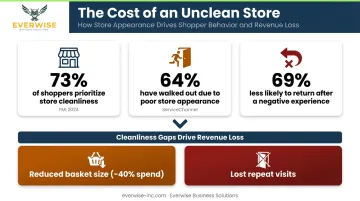
Customer expectations haven't softened, but the turnover data above shows the workforce available to meet them has. That gap is exactly what autonomous cleaning robots are built to close.
How Autonomous Grocery Store Cleaning Robots Work
Navigation: Finding the Route Through a Live Store
Autonomous mobile robots (AMRs) used for floor cleaning navigate using a combination of LiDAR sensors and SLAM (Simultaneous Localization and Mapping) technology. The robot builds a real-time map of the floor while simultaneously tracking its own position within that map.
In a grocery store environment, this matters because the floor plan isn't static. Restocking carts appear mid-aisle. Shoppers stop without warning. Endcap displays get repositioned. Modern systems handle this through adaptive path planning — when an obstacle appears, the robot reroutes around it and resumes cleaning without requiring staff intervention or stopping the session.
These systems combine LiDAR, depth cameras, and RGB cameras to track dynamic obstacles in real time — the same multi-sensor approach Gausium uses across its commercial scrubber lineup.
Cleaning Mechanics: More Than Just a Mop
The core cleaning process in an autonomous floor scrubber is fundamentally different from mopping:
- Rotating scrub brushes apply cleaning solution directly to the floor surface
- Onboard suction lifts debris and dirty water simultaneously
- Squeegee recovery system collects soiled liquid in a single pass, leaving floors immediately dry
Traditional mopping spreads dirty water across the floor and leaves a wet surface — creating the slip hazard it's supposed to prevent. Autonomous scrubbers solve both problems at once.
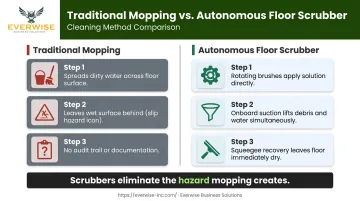
Route optimization also lets the robot prioritize high-risk zones based on traffic patterns: produce sections and refrigeration aisles in the morning, checkout lanes during peak hours, and entrances throughout the day.
When battery runs low, the robot navigates autonomously back to its charging dock, then resumes where it left off — no staff involvement required.
Real-Time Hazard Detection and Digital Cleaning Records
That autonomous operation extends beyond the cleaning pass itself.
Embedded sensors and cameras identify spills or hazards outside the robot's immediate cleaning path and alert staff via mobile app notifications with a pinned floor location — enabling faster response than visual walkthroughs allow.
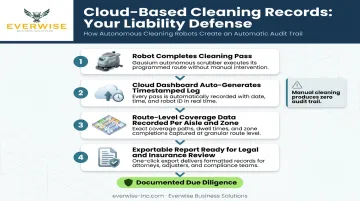
Cloud-based dashboards generate:
- Timestamped cleaning logs per session
- Coverage documentation showing where and when floors were cleaned
- Cleaning records exportable for health inspections, insurance audits, or liability claims
This documentation creates verifiable proof of floor maintenance — the kind of due-diligence evidence that insurers and legal teams need when responding to incidents. Manual cleaning produces none of that audit trail.
Key Benefits for Grocery Store Operations
Labor Cost Reduction and Staff Reallocation
Deploying a cleaning robot doesn't eliminate cleaning staff — it reassigns their hours to work a mop bucket can't do.
Robots handle repetitive scheduled floor scrubbing. That frees employees for:
- Spill response in real time
- Restroom maintenance and restocking
- Customer assistance and cart retrieval
- Back-of-house preparation tasks
The scale of labor recovery is documented. A Tennant manufacturer case study reported 33,649 cumulative labor hours saved in 2024 and $2,120,400 in annual business value from an autonomous scrubber deployment at a leading grocery retailer — a third-party benchmark that illustrates what autonomous floor cleaning delivers at scale.
Everwise Business Solutions' ROI modeling for Gausium deployments across Texas grocery and retail accounts places the labor replacement value at 1–2 janitorial FTEs per store. With total-cost labor running $40,000–$70,000 per FTE annually in Texas, most stores see payback within 12–36 months depending on shift count and footprint.
Liability Reduction Through Documented Maintenance
Consistent, timestamped cleaning records directly support liability defense. When an incident occurs, operations and legal teams need to answer one question fast: can you prove the floor was maintained?
CNA and the National Floor Safety Institute both identify cleaning logs and inspection records as critical due-diligence documentation. Cloud-exported reports from autonomous robots satisfy that requirement automatically. Key evidence they provide:
- Timestamped records of when and where each cleaning pass occurred
- Route-level data showing which aisles and zones were covered
- Automated log generation with no manual entry required
- Exportable documentation ready for operations and legal review
Customer Experience and Brand Perception
Store environment quality has measurable influence on shopper behavior. A robot visibly cleaning during store hours reinforces hygiene perception — and that perception drives real outcomes:
- Dwell time — shoppers stay longer in stores they perceive as clean
- Return visit likelihood — customers are more likely to repeat-shop at stores with consistent presentation
- Brand perception across multi-location chains where cleanliness consistency defines the brand
Sustaining that perception across a portfolio is where consistent execution matters most. For grocery chains managing dozens of locations, the Gausium Mobile App enables district managers to monitor cleaning task completion, review logs, and adjust schedules remotely — maintaining consistent standards without proportionally scaling management labor.
24/7 Coverage Without Supervision
Robots run overnight during restocking without fatigue, absenteeism, or a supervisor present. A single team member deploys the robot at shift start and focuses on other duties for the rest of the night.
For stores with lean cleaning teams — which describes most grocery operators today — that's a meaningful structural advantage.
Types of Robots Transforming Grocery Stores Today
Grocery stores are deploying robots across multiple functions, not just floor cleaning.
Three categories are leading the transformation:
Inventory and hazard detection robots scan shelves, flag spills, and monitor floor conditions in real time. Badger Technologies' "Marty" (Mobile Autonomous Robot Technology) runs in 300+ Stop & Shop locations across the Northeast, scanning more than 7 million products daily — while simultaneously alerting staff to floor hazards before slip-and-fall incidents occur.
Autonomous floor scrubbers and sweepers deliver the clearest ROI for facility managers. Walmart added 1,500 Auto-C autonomous floor cleaners after its pilot program. Sam's Club completed a chainwide rollout of nearly 600 inventory-scan towers mounted on autonomous scrubbers. These are full-scale production deployments, not trials — covering millions of square feet of retail floor space every day.
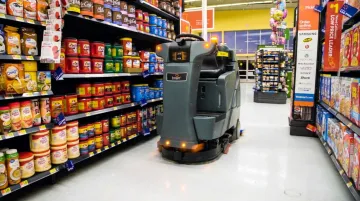
Emerging categories — customer service kiosks, delivery robots, and shopper companions — are gaining traction, but the business case for these is still developing. Floor cleaning AMRs remain the category with the most immediate, measurable returns in labor cost and liability reduction.
What to Look for When Choosing a Grocery Store Cleaning Robot
Evaluation Criteria Before You Shop
Before evaluating specific models, assess your own environment:
- Total floor area and layout complexity — aisle count, endcap density, back-of-house square footage
- Floor surface types — vinyl/LVT, tile, sealed concrete, or mixed surfaces requiring different cleaning modes
- Available cleaning windows — open-hours operation vs. overnight-only vs. mixed
- Peak traffic patterns — which zones need priority cleaning and when
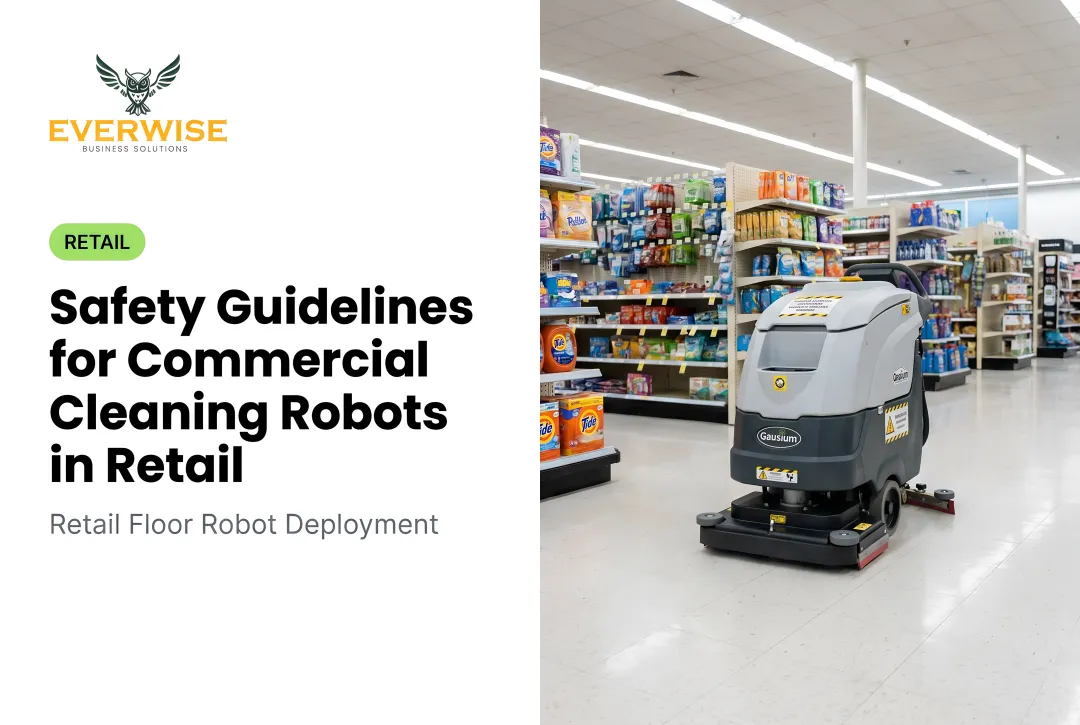
Any robot operating in a public grocery environment must carry documented safety certifications for public-space operation, including multi-layered obstacle avoidance, physical bumpers, and audible and visual alerts. Procurement checklists should require certification evidence aligned with standards such as IEC 63327:2021 and ANSI/CAN/UL 3300:2024.
Technical Features That Separate High-Performing Models
| Feature | Why It Matters in Grocery |
|---|---|
| Advanced navigation (LiDAR + SLAM) | Navigates moving shoppers, carts, and restocking activity without stopping |
| Intelligent floor surface identification | Adjusts cleaning settings automatically for vinyl, tile, or concrete |
| Zero-distance edge cleaning | Cleans flush against shelving gondolas — no manual follow-up needed |
| Auto Spot Cleaning (AI spill detection) | Concentrates cleaning on high-soil zones in real time |
| Cloud-based cleaning logs | Generates timestamped records for inspections and liability documentation |
| H13 HEPA filtration | Captures fine particles, allergens, and food debris — not just floor-level dirt |
Both models below are designed specifically for grocery and retail environments and are available through Everwise Business Solutions, the authorized Gausium distributor in Texas:
- Gausium PhanShop — A 2026 retail-specific configuration designed for grocery store aisles, with shopper-aware navigation, aisle-endcap geometry optimization, and open-hours operation capability
- Gausium Omnie — AI-powered with Auto Spot Cleaning intelligence for high-dynamic environments where real-time spill detection and dynamic rerouting around shoppers and carts are priorities
Why Local Distributor Support Matters
Choosing a local, authorized distributor rather than a remote vendor has a direct operational impact:
- On-site dispatch when a unit goes down, not a multi-day wait for a shipped replacement part
- Factory-trained technicians with model-specific expertise, not third-party generalists
- Local OEM parts inventory for same-region emergency repairs
- Multi-store contract management under one service agreement for chain deployments
Everwise operates from Pharr and San Antonio with statewide coverage across Austin, Dallas, Houston, and the Rio Grande Valley. Their maintenance program covers:
- Scheduled preventive maintenance visits (quarterly or semi-annual based on usage intensity)
- On-demand emergency repair dispatch for fleet customers
- Technical training for in-house facility teams
Frequently Asked Questions
How much does a grocery store cleaning robot cost?
Gausium pricing through Everwise Business Solutions is available on request, as final cost depends on model tier, accessories, and maintenance contract terms. Third-party distributor pricing for comparable mid-size Gausium models has ranged from approximately $38,500 to $51,600 for outright purchase. Financing through approved partners — operating lease and capital lease options — is also available, with Section 179 and bonus depreciation eligibility for qualifying buyers.
What are the robots in grocery stores called?
Grocery store robots fall into two main categories: inventory and hazard detection robots (like Badger Technologies' Marty at Stop & Shop) and autonomous floor scrubbers/AMRs for cleaning. Each serves a distinct function — Marty handles shelf scanning and spill flagging, while floor scrubbers handle scheduled and real-time floor maintenance.
Can cleaning robots operate while the store is open to customers?
Yes. Most autonomous floor scrubbers are designed for safe public-space operation using multi-layered obstacle avoidance, audible alerts, and physical safety systems. The Gausium PhanShop is specifically configured for open-hours grocery aisle operation with shopper-aware navigation. Many operators also schedule overnight or early-morning sessions for full-floor coverage without traffic.
Do cleaning robots replace human cleaning staff?
No — they reallocate staff hours. Robots handle scheduled, repetitive floor scrubbing, while cleaning employees shift to spill response, restroom maintenance, and customer-facing tasks. Most stores see a reduction of 1–2 dedicated floor-scrubbing FTEs per location, not a complete elimination of the cleaning team.
How long does it take to set up a cleaning robot in a grocery store?
Typical deployment runs 1–2 days for floor mapping and route programming, followed by 2–3 days for staff training. Most stores reach full autonomous operation within 30–45 days, after which staff involvement typically drops to a few minutes per shift for consumable refills and exception handling.
What features matter most when choosing a grocery store cleaning robot?
Prioritize: advanced navigation (LiDAR and SLAM), intelligent floor identification that adjusts settings automatically, zero-distance edge cleaning for gondola shelving, AI spill detection for open-hours operation, and cloud-based timestamped cleaning logs. Public-space safety certifications and local service coverage matter just as much — downtime in a grocery environment carries direct liability and revenue consequences.